




Did you know that mobile advertising accounted for about 65% of total digital ad spend in 2024? This rapid rise highlights how deeply mobile devices have become part of daily routines. As more people shop, browse, and connect on their phones, brands face new pressure to stay ahead. Understanding the changing trends and newest tech in mobile marketing could be the difference between growing your audience and getting left behind.
Key Takeaways
| Point | Details |
|---|---|
| Mobile Dominance | Mobile advertising will represent approximately 65% of total digital ad spend by 2024, emphasizing its critical importance for businesses. |
| AI and Personalization | AI-driven strategies enable hyper-personalization, enhancing consumer engagement through tailored experiences and real-time adjustments. |
| Privacy Emphasis | Growing regulations around data privacy necessitate transparent data practices and user consent as foundational elements of mobile marketing. |
| ROI Measurement | Focus on user engagement and retention metrics over simple download numbers to accurately gauge mobile marketing success and sustainability. |
Table of Contents
- Understanding Mobile Marketing Trends 2025
- Key Technologies Shaping Mobile Strategies
- Personalization And AI-Driven Campaigns
- Privacy, Data Security, And Compliance Changes
- Measuring ROI And Avoiding Costly Mistakes
Understanding Mobile Marketing Trends 2025
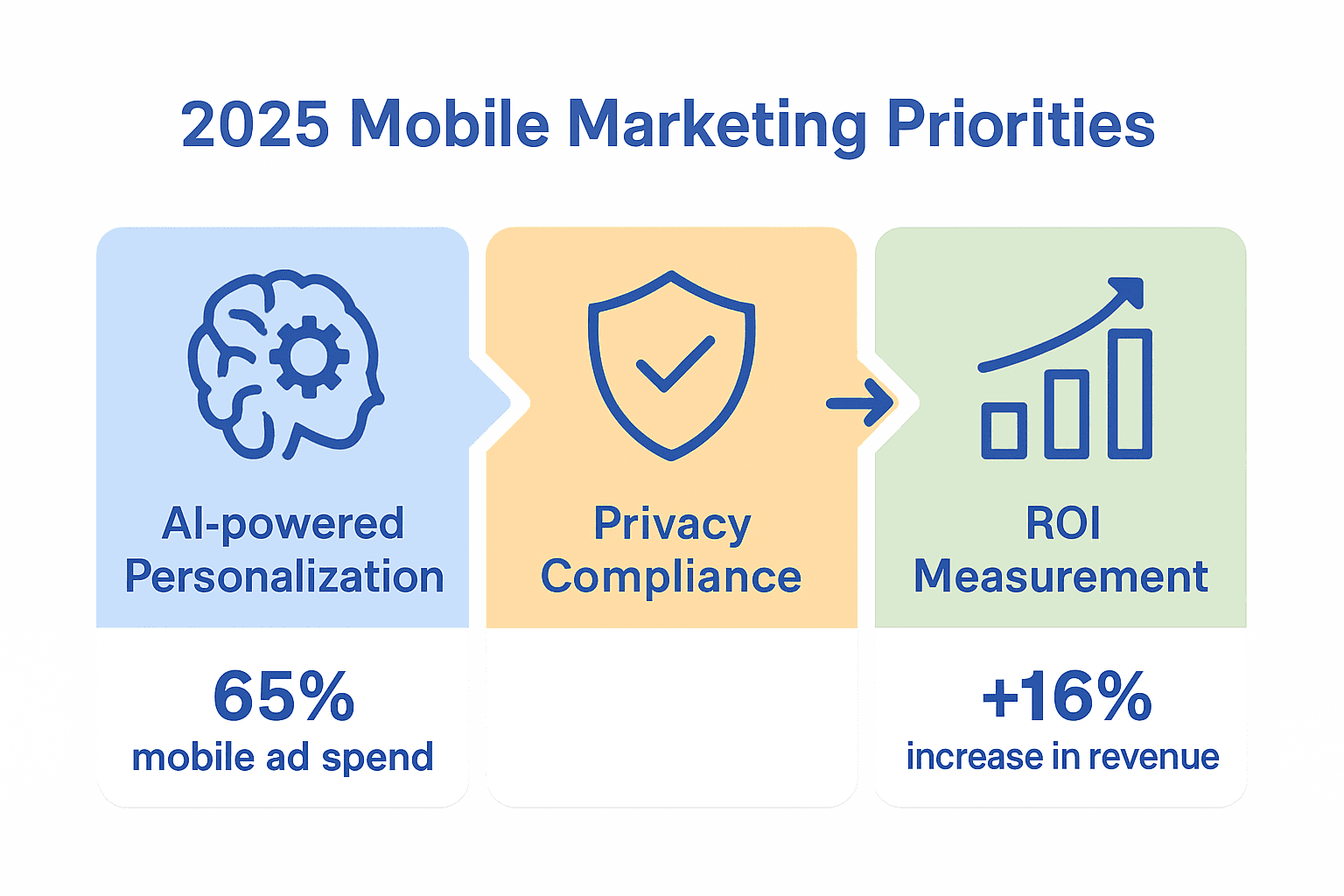
The mobile marketing landscape is undergoing a dramatic transformation. Mobile advertising has emerged as the dominant digital strategy, with recent global digital advertising research revealing that mobile platforms now command approximately 65% of total digital advertising spend in 2024. This seismic shift signals a clear message for businesses: mobile isn’t just important – it’s absolutely critical.
Several key trends are reshaping how brands engage mobile audiences in 2025:
- Hyper-Personalized Mobile Experiences: Consumers expect tailored interactions that feel individualized and contextually relevant
- AI-Driven Mobile Marketing: Advanced algorithms enabling predictive targeting and real-time personalization
- Privacy-First Mobile Strategies: Growing emphasis on transparent data collection and user consent
- Augmented Reality (AR) Marketing: Interactive mobile experiences that blend digital information with real-world environments
Businesses that adapt quickly will gain significant competitive advantages. The mobile marketing ecosystem is no longer about simply having a mobile-responsive website – it’s about creating immersive, intelligent experiences that connect with users precisely when and how they want to be engaged. Strategic mobile marketing in 2025 demands a holistic approach that combines technological sophistication with genuine human understanding. The impact of Google on small businesses cannot be underestimated, as their algorithms and advertising platforms provide tools that can elevate a brand’s visibility. As these small enterprises navigate the complexities of digital marketing, understanding how to leverage search engine optimization and pay-per-click advertising becomes critical. Embracing these strategies will empower small businesses to reach their target audience more effectively and compete in an ever-evolving marketplace.
Key Technologies Shaping Mobile Strategies
Artificial Intelligence is revolutionizing mobile marketing strategies with unprecedented precision and capability. Mobile app development services are now integrating advanced AI technologies that transform how brands interact with consumers. According to marketing technology insights, by 2025, AI-driven chatbots have evolved from simple response mechanisms into sophisticated conversational strategists capable of delivering nuanced, context-aware interactions.
See exactly where your profile stands right now.
Our GBP audit shows your current rank position across your market, how your profile completeness scores against competitors, and the specific gaps holding you back from the Map Pack.
Key technological innovations driving mobile strategies include:
- Visual Recognition Technology: Enabling brands to analyze images and video content for hyper-targeted advertising
- Augmented Reality (AR) Experiences: Interactive product previews and location-based promotional campaigns
- Machine Learning Algorithms: Predicting user behavior and personalizing mobile interactions
- Natural Language Processing: Creating more human-like digital communication channels
Augmented reality is particularly transformative in mobile advertising. As research from App Trove indicates, AR is reshaping user engagement through interactive product demonstrations and location-specific promotional experiences. Brands can now create immersive mobile experiences that blur the lines between digital information and physical environments, offering consumers unprecedented levels of interaction and personalization.
 The future of mobile marketing isn’t just about reaching users – it’s about creating meaningful, contextually intelligent connections that feel seamless and intuitive.
Personalization and AI-Driven Campaigns
AI-powered personalization is transforming mobile marketing with unprecedented precision. The future of AI in content marketing reveals how advanced technologies are revolutionizing customer engagement. According to research from SuperAI, automated micro-segmentation now enables real-time creation of hyper-specific customer groups, allowing brands to deliver incredibly tailored mobile experiences that were impossible just years ago.
Key strategies for AI-driven personalization include:
- Predictive Customer Profiling: Using machine learning to anticipate user preferences
- Dynamic Content Adaptation: Real-time content modification based on user behavior
- Contextual Recommendation Engines: Generating personalized product and service suggestions
- Behavioral Trigger Marketing: Activating campaigns based on specific user interactions
Recent academic research demonstrates the remarkable potential of AI in personalization. A groundbreaking 2025 study introducing the SLM4Offer generative AI model showed a significant 17% improvement in offer acceptance rates through advanced contrastive learning techniques. Companies like Amazon have already proven the effectiveness of this approach, with AI recommendations consistently boosting sales by 10-30%. The future of mobile marketing isn’t about broadcasting messages – it’s about creating individualized experiences that feel uniquely crafted for each user, transforming generic interactions into meaningful, personalized conversations.
Privacy, Data Security, and Compliance Changes
Data privacy is rapidly becoming the cornerstone of mobile marketing strategies in 2025. AI optimization technologies are now intrinsically linked with robust privacy frameworks that protect user information while enabling sophisticated marketing capabilities. The proposed American Privacy Rights Act represents a significant milestone, aiming to establish comprehensive federal guidelines that limit user data collection and provide consumers with unprecedented control over their personal information.
Key privacy and compliance considerations for mobile marketers include:
- Transparent Data Collection: Clearly communicating what user data is collected and why
- Universal Opt-Out Mechanisms: Implementing Global Privacy Control (GPC) standards
- Granular User Consent: Providing detailed, explicit permission options
- Data Minimization: Collecting only essential information for specific purposes
Several U.S. states, including California, Colorado, Connecticut, and New Jersey, have already legally recognized Global Privacy Control as a universal opt-out mechanism. This development signals a profound shift in how businesses must approach data collection and user privacy. Mobile marketers must now design strategies that respect user preferences, prioritize data security, and build trust through transparent, ethical data practices. The future of mobile marketing isn’t about collecting more data – it’s about collecting the right data, with full user understanding and consent.
Measuring ROI and Avoiding Costly Mistakes
Mobile marketing ROI has become increasingly complex in 2025, demanding sophisticated measurement approaches. Understanding digital marketing ROI metrics reveals that success is no longer about raw download numbers, but deep user engagement and sustained revenue generation. According to recent market data, while U.S. app downloads slightly decreased in 2024, in-app revenue rose dramatically by 16%, reaching nearly $52.4 billion – a clear indicator that quality trumps quantity in mobile marketing strategies.
Key strategies for precise mobile marketing ROI measurement include:
- User Lifetime Value (LTV) Tracking: Calculating long-term customer value beyond initial interactions
- Conversion Rate Optimization: Analyzing micro-conversions and user journey touchpoints
- Advanced Attribution Modeling: Understanding multi-channel impact on final conversions
- Engagement Depth Metrics: Measuring time spent, interactions, and repeat usage
The 2024 holiday season dramatically illustrated the critical nature of mobile ROI precision, with mobile transactions comprising 54.5% of online sales – a significant jump from 51.1% in 2023. This surge underscores the necessity of developing granular measurement techniques that go beyond surface-level metrics. Mobile marketers must now adopt a holistic approach, treating each campaign as an investment with measurable returns, focusing on creating value through targeted, personalized experiences that drive genuine user engagement and sustainable revenue growth.
Ready to Master Mobile Marketing in 2025?
The landscape has changed. As outlined in “Mobile Marketing Trends 2025: Complete Guide,” your brand faces new challenges like hyper-personalization, privacy compliance, and AI-driven strategies. The pressure to deliver seamless, tailored, and secure mobile experiences is greater than ever. Are you struggling to keep up with emerging technology and shifting customer expectations? You are not alone. Many businesses worry about falling behind as mobile engagement and ROI measurement become more complex.
This is the work we do for you. Every week, without exception.
Managing GBP at this level takes 6–8 hours a week when done right. Nova handles the entire system — posts, photos, reviews, Q&A, citations, heatmap tracking — so you can focus on running your business.
Partner with a team that can turn these advances into real results for your business. At 12AM Agency, we specialize in mobile app development, strategic AI integration, and privacy-first marketing solutions tailored to your industry. Boost your visibility, compliance, and engagement today. Your future-ready strategy starts now. Contact us for a consultation and let’s build a mobile marketing approach that gets measurable growth.
Frequently Asked Questions
What are the key trends in mobile marketing for 2025?
The key trends in mobile marketing for 2025 include hyper-personalized mobile experiences, AI-driven marketing strategies, privacy-first approaches, and the use of augmented reality in advertising.
How is AI transforming mobile marketing strategies?
AI is revolutionizing mobile marketing by enabling predictive targeting, real-time personalization, and the emergence of advanced AI-driven tools such as chatbots that offer nuanced, context-aware interactions with consumers.
What should businesses consider regarding data privacy in mobile marketing?
Businesses need to prioritize transparent data collection, implement universal opt-out mechanisms, provide granular user consent options, and ensure data minimization to respect user privacy and comply with legal standards.
How can mobile marketing ROI be effectively measured in 2025?
Effective measurement of mobile marketing ROI in 2025 involves tracking user lifetime value (LTV), optimizing conversion rates, using advanced attribution modeling, and analyzing engagement depth metrics rather than just focusing on download numbers.
Recommended
- Top Digital Marketing Trends 2025 for Business Growth | 12AM Agency
- 8 Digital Marketing Trends in 2020 | 12AM Agency
- What Is Digital Marketing? Essential Guide for Business Growth 2025 | 12AM Agency
- Unlock Growth: Essential Digital Marketing Strategies for Small Business Owners in 2025 | 12AM Agency


