






Digital marketing is shifting faster than ever, and by 2025, the stakes are at an all-time high. Here is something that may surprise you. Seventy percent of companies will use artificial intelligence to create hyper-personalized customer journeys—not just track clicks. The real twist is that the brands winning customers are not the ones with the most data, but those who build real trust and deliver experiences so tailored they feel almost psychic.
Table of Contents
- Emerging Technologies Shaping Digital Marketing 2025
- Personalization And Customer Experience Trends
- Data Privacy And AI-Driven Marketing Strategies
- Sector-Specific Tips For Successful Campaigns
Quick Summary
| Takeaway | Explanation |
|---|---|
| Embrace AI and Machine Learning | Utilize AI for real-time data analysis to predict customer preferences and create hyper-personalized content experiences. |
| Prioritize Immersive Experiences | Implement Augmented Reality (AR) and Virtual Reality (VR) technologies to enhance customer interactions and engagement through immersive brand experiences. |
| Focus on Omnichannel Strategy | Ensure consistency in customer interactions across various platforms, integrating real-time data to provide seamless and high-quality experiences. |
| Ensure Ethical AI Practices | Develop transparent AI systems that prioritize consumer trust by providing clear data usage explanations and maintaining ethical standards. |
| Utilize Sector-Specific Strategies | Tailor marketing approaches to the unique needs of different industries, utilizing advanced technologies to enhance customer engagement and retention. |
Emerging Technologies Shaping Digital Marketing 2025
The digital marketing world stands on the brink of a technological revolution. By 2025, businesses must adapt to cutting-edge technologies that redefine customer engagement and strategic communication.
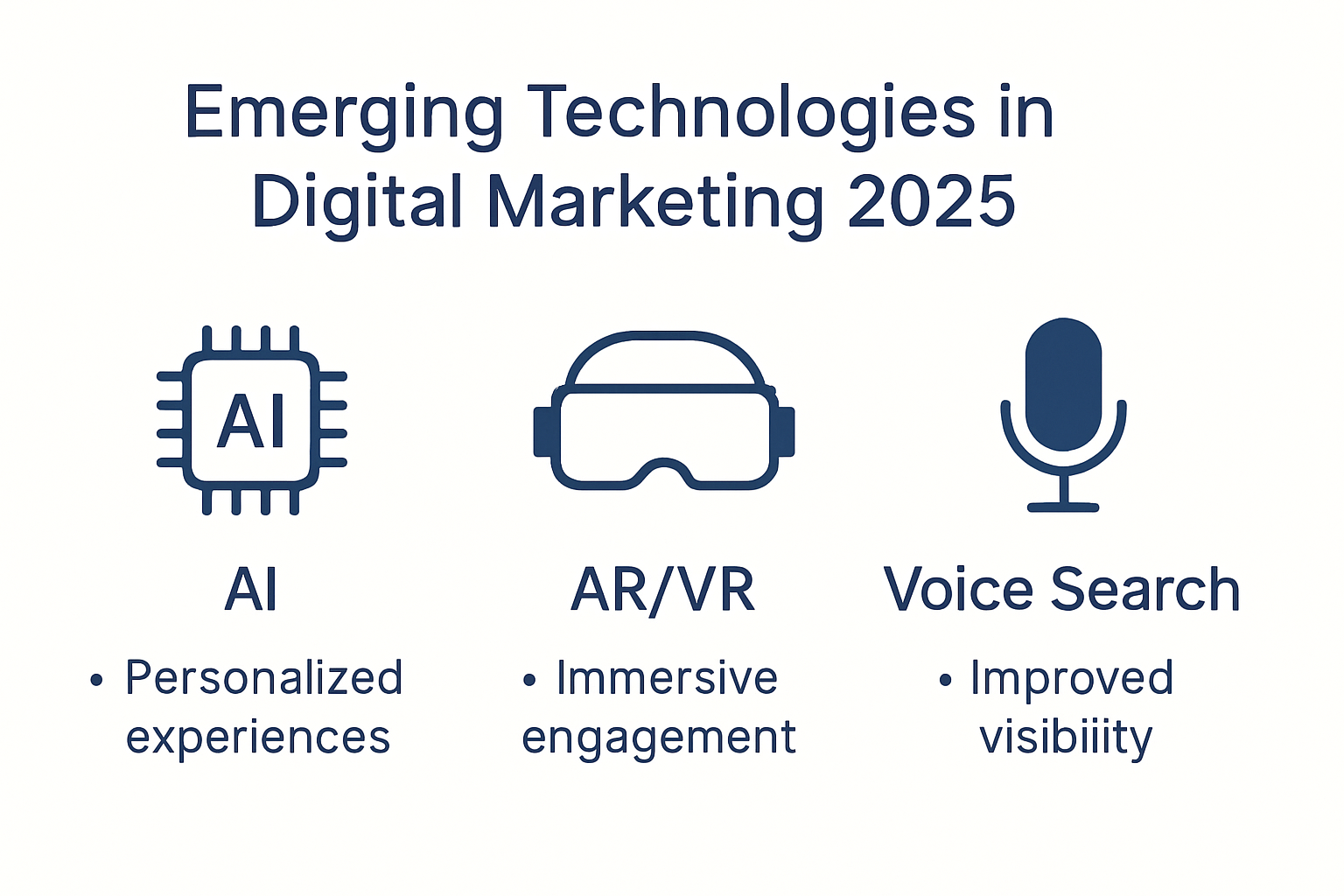
AI and Machine Learning: The Intelligence Revolution
Artificial Intelligence is transforming digital marketing from a guessing game to a precision science. Explore our AI marketing strategies for unprecedented insights into consumer behavior. According to Forbes, AI enables real-time data analysis that delivers hyper-personalized content experiences. Marketing teams can now predict customer preferences with remarkable accuracy, creating targeted messaging that resonates deeply.
Machine learning algorithms continuously refine marketing strategies by analyzing massive datasets. These intelligent systems identify subtle patterns in consumer interactions, allowing businesses to craft more effective communication strategies. Predictive analytics now enable marketers to anticipate customer needs before they even articulate them.
Immersive Experiences: AR and VR Marketing
Augmented Reality and Virtual Reality are revolutionizing how brands interact with consumers. According to Forbes, these technologies offer immersive experiences that transform traditional marketing approaches. Imagine customers virtually trying products, exploring services, or experiencing brand environments without physical limitations.
Retail, real estate, and service industries stand to gain tremendous advantages. Virtual product demonstrations, interactive brand experiences, and 360-degree environment explorations become standard marketing tools. These technologies bridge the gap between digital representation and physical interaction, creating deeper emotional connections with potential customers.
Voice Search and Conversational Marketing
Voice-activated devices are reshaping digital marketing strategies. Research from Forbes highlights the critical need to optimize content for voice search, focusing on conversational language and natural speech patterns. Businesses must adapt their SEO strategies to accommodate how people actually speak, not just how they type.
This shift demands content that answers specific questions directly and uses long-tail keywords that mirror natural conversation. Voice search optimization means understanding user intent at a deeper level, creating content that provides immediate, conversational answers to complex queries.
The technological landscape of digital marketing in 2025 demands agility, intelligence, and a willingness to embrace transformative innovations. Businesses that invest in these emerging technologies will not just survive but thrive in an increasingly competitive digital ecosystem.
Personalization and Customer Experience Trends
Customer experience has evolved from a competitive advantage to an absolute business necessity. In 2025, digital marketing strategies demand unprecedented levels of personalization and customer-centric approaches.
Hyper-Personalized Customer Journeys
Advanced data analytics and artificial intelligence are redefining personalization strategies. According to Marketing Communications Today, businesses can now create individualized experiences that go far beyond basic demographic targeting. Learn about targeted marketing strategies that transform raw data into meaningful customer interactions.
Modern personalization involves understanding not just what customers want, but predicting their needs before they articulate them. Machine learning algorithms analyze complex behavioral patterns, enabling marketers to craft experiences that feel uniquely tailored to each individual. This means content, product recommendations, and communication channels are dynamically adjusted in real-time based on user interactions.

Omnichannel Experience Integration
Customer interactions are no longer linear or confined to single platforms. According to Emirates Digital Customer Experience Report, omnichannel strategies are becoming increasingly sophisticated, integrating real-time data streams to create seamless journeys across multiple touchpoints.
Businesses must now provide consistent, high-quality experiences whether a customer engages through mobile apps, websites, social media, or physical locations. This requires sophisticated technological infrastructure that allows instant data synchronization and context preservation across different platforms. The goal is creating a unified brand experience that feels intuitive and responsive.
Emotional Intelligence in Digital Interactions
Beyond technological capabilities, successful digital marketing in 2025 requires understanding emotional nuances. Brands are investing in technologies that can detect and respond to subtle emotional cues in customer interactions. This means developing communication strategies that are not just personalized, but emotionally intelligent.
AI-powered sentiment analysis tools help businesses understand customer emotions in real-time, allowing for more empathetic and contextually appropriate responses. Whether through chatbots, customer service interactions, or marketing content, the ability to recognize and adapt to emotional states becomes a critical differentiator.
The future of digital marketing is fundamentally human-centric. Technology serves not as a replacement for human connection, but as a sophisticated tool to enhance understanding, anticipate needs, and create more meaningful interactions. Businesses that master this delicate balance between technological capability and genuine empathy will lead their industries in customer experience excellence.
Data Privacy and AI-Driven Marketing Strategies
As digital marketing becomes increasingly data-driven, the delicate balance between personalization and privacy emerges as a critical challenge for businesses navigating the 2025 technological landscape.
Ethical AI and Consumer Trust
Artificial Intelligence in marketing is no longer just about technological capability but about maintaining ethical standards and consumer trust. Explore our AI ethics framework to understand the nuanced approach required. According to research from ArXiv, the integration of AI in digital marketing raises significant ethical concerns, particularly regarding consumer privacy and algorithmic fairness.
Businesses must develop transparent AI systems that provide clear explanations of data usage, consent mechanisms, and potential algorithmic biases. This means creating marketing strategies that prioritize individual autonomy and provide users with meaningful control over their personal information. The goal is not just compliance, but building genuine trust through responsible technological implementation.
Privacy-Preserving Technologies
Emergent privacy-centric technologies are revolutionizing how businesses collect and utilize consumer data. Research from ResearchGate highlights innovative approaches like differential privacy and federated learning that enable personalized marketing while protecting individual data integrity.
Differential privacy introduces controlled noise into data analysis, ensuring individual user information remains anonymous while still providing valuable aggregate insights. Federated learning allows machine learning models to be trained across decentralized devices without raw data leaving its original location. These technologies represent a sophisticated approach to maintaining marketing effectiveness without compromising personal privacy.
Predictive Personalization with Consent
By 2025, AI-driven personalization will demand a more collaborative relationship between businesses and consumers. According to research from an academic journal, hyper-personalized experiences are expected to dramatically improve engagement and conversion rates, but only when implemented with explicit user consent and transparent data practices.
Successful marketing strategies will incorporate granular consent mechanisms, allowing users to understand exactly how their data will be used and providing easy opt-out options. This means developing user interfaces that make data sharing feel like a mutual value exchange rather than an invasive process. Marketers must shift from viewing data as a commodity to treating it as a privileged insight granted by willing participants.
The future of digital marketing lies not in technological prowess alone, but in creating ecosystem where advanced AI capabilities coexist with robust privacy protections. Businesses that can masterfully navigate this complex terrain will distinguish themselves by demonstrating respect for individual autonomy while delivering genuinely personalized experiences.
Sector-Specific Tips for Successful Campaigns
Digital marketing strategies are not one-size-fits-all. By 2025, successful businesses will leverage sector-specific approaches that recognize the unique challenges and opportunities within their industries.
Below is a table summarizing sector-specific digital marketing focuses for 2025, as covered in the article.
| Sector | Main Strategy | Key Focus Area |
|---|---|---|
| Food & Hospitality | Predictive Personalization | Personalized offers, dynamic menus, customer insights |
| Healthcare & Prof. Services | Trust-Driven Strategies | Educational content, segmentation, confidentiality |
| Retail & E-Commerce | Omnichannel Experience Optimization | Integrated shopping, data synchronization, seamless CX |
Food and Hospitality: Predictive Personalization
The food and hospitality sector stands at the forefront of AI-driven marketing transformation. According to research from ArXiv, artificial intelligence is revolutionizing marketing by enabling hyper-personalized recommendations and predictive analytics. Discover targeted marketing techniques that can dramatically improve customer engagement.
Restaurants and hospitality businesses can now predict customer preferences with remarkable precision. Machine learning algorithms analyze past dining behaviors, dietary restrictions, seasonal trends, and even social media interactions to craft marketing messages that feel individually tailored. This means creating dynamic menus, personalized promotional offers, and targeted content that speaks directly to each customer’s unique tastes and preferences.
Healthcare and Professional Services: Trust-Driven Strategies
In sectors where trust is paramount, digital marketing requires a nuanced approach that balances technological innovation with professional credibility. According to Wikipedia’s AI Marketing insights, predictive analytics can transform how professional services communicate with potential clients.
Healthcare providers and professional service firms must develop marketing strategies that demonstrate expertise while maintaining patient and client confidentiality. This involves creating content that educates, builds trust, and showcases professional competence without compromising ethical standards. AI-powered tools can help segment audiences, personalize communication channels, and develop targeted educational content that addresses specific client concerns.
Retail and E-Commerce: Omnichannel Experience Optimization
Retail and e-commerce sectors are experiencing a radical transformation in marketing approaches. Advanced AI technologies enable businesses to create seamless, personalized shopping experiences that bridge online and offline interactions. Predictive analytics allow retailers to anticipate customer needs, optimize inventory, and create marketing campaigns that feel intuitive and responsive.
Successful strategies involve integrating data from multiple touchpoints: website interactions, mobile app usage, in-store purchases, and social media engagement. By developing a holistic view of customer behavior, businesses can create marketing campaigns that feel less like advertisements and more like personalized recommendations.
The future of sector-specific marketing lies in understanding that each industry has unique communication dynamics. Technology is not a replacement for industry expertise but a powerful tool to amplify and refine marketing strategies. Businesses that can blend technological capabilities with deep sector understanding will set new standards for customer engagement and brand loyalty.
Frequently Asked Questions
What are the top digital marketing trends for 2025?
The top trends include the use of artificial intelligence for hyper-personalization, immersive experiences through AR and VR, voice search optimization, and the integration of omnichannel strategies to enhance customer engagement.
How is AI transforming digital marketing?
AI is enabling businesses to analyze customer data in real-time, predict preferences, and create highly personalized marketing messages that resonate more effectively with their target audience.
Why is personalization important in digital marketing?
Personalization is crucial because it enhances customer experience by providing tailored content and recommendations, which can lead to increased engagement, loyalty, and sales.
What are the ethical considerations in AI-driven marketing?
Ethical considerations include maintaining consumer trust by being transparent about data usage, avoiding algorithmic biases, and ensuring user consent for data collection and personalization.
Ready to Embrace 2025’s Digital Revolution?
Your business already feels the pressure to adapt to rapid changes in digital marketing. As covered in this article, standing out will depend on mastering AI-powered personalization, creating seamless customer journeys, and building real trust in a privacy-driven world. If you’re struggling to keep up or uncertain how to apply immersive strategies like AR, voice search, or omnichannel integration, you’re not alone. Many companies want to deliver the psychic-like customer experience the article describes but need proven guidance to get there.
Don’t just watch the trends—turn them into results. 12AM Agency specializes in blending industry-tested tactics with state-of-the-art solutions like AI review management and Google My Business optimization. Our team crafts custom plans for your unique industry, whether you are looking for next-level SEO, PPC, or a complete digital transformation. Connect with us now to boost visibility, earn more loyal customers, and position your brand at the forefront of 2025’s digital landscape.