


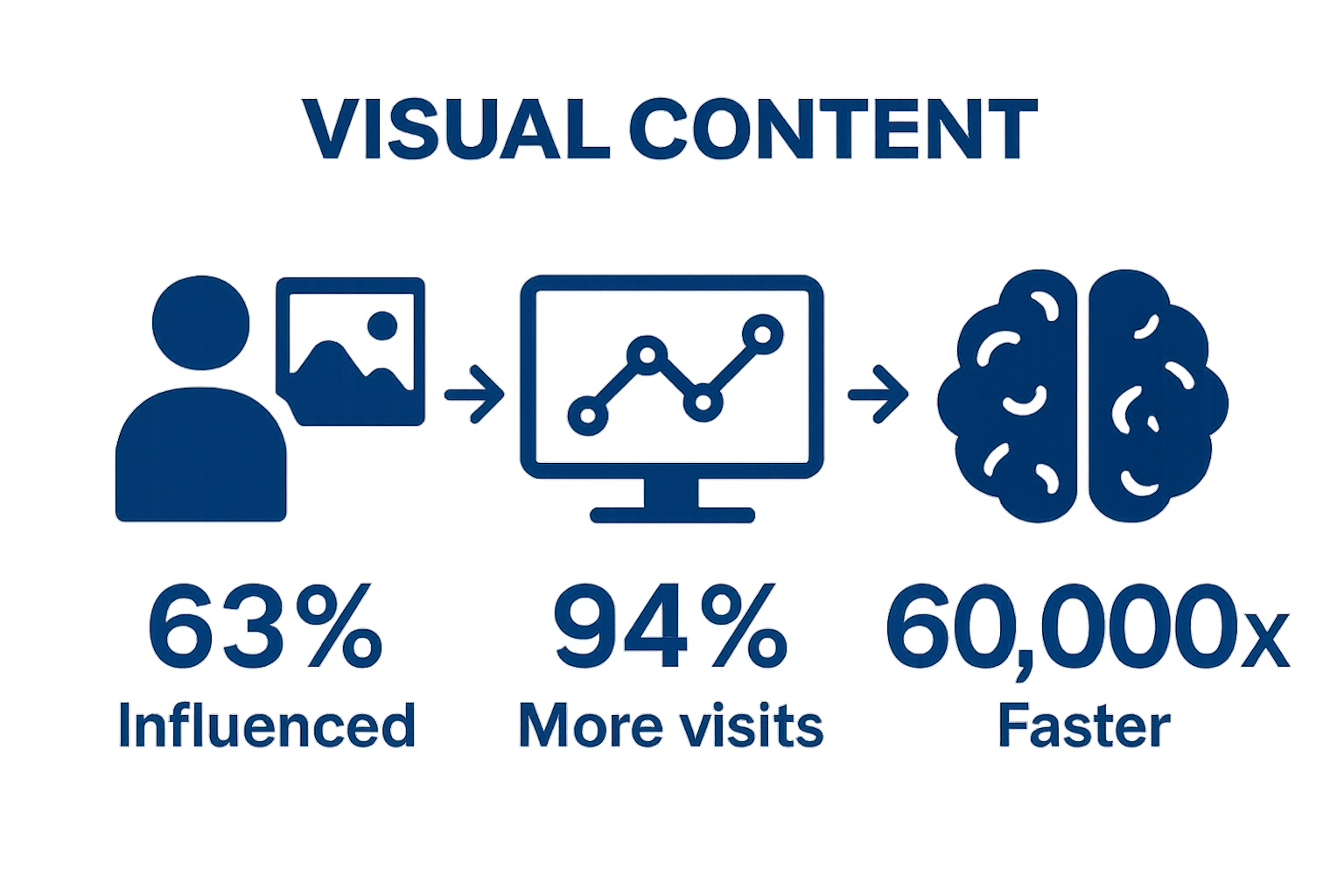
Visual content marketing is changing how brands connect with people online and making messages stick. Research shows that 63 percent of consumers say visuals heavily influence their buying decisions. Most think visuals are just about making things look pretty or flashy. That misses the point. The real impact comes from shaping how fast we learn, how much we remember, and how deeply we feel about a brand—all in a single glance.
Table of Contents
- What Is Visual Content Marketing And Why Is It Important?
- The Benefits Of Visual Content Marketing For Businesses
- Key Components Of Effective Visual Content Marketing
- How Visual Content Marketing Influences Audience Engagement
- Real-World Examples Of Successful Visual Content Marketing
Quick Summary
| Takeaway | Explanation |
|---|---|
| Visual content enhances audience engagement | Using images and videos increases audience interaction and retention. Text alone often fails to create emotional connections effectively. |
| Strategic design is crucial | Understanding your audience’s preferences ensures that visual content resonates and communicates the intended message clearly. |
| Visual storytelling differentiates your brand | Compelling visuals help establish stronger brand identities in crowded markets, showcasing your unique values and propositions. |
| Faster communication of complex ideas | Visuals can simplify and expedite the explanation of complicated concepts, making information easier for audiences to absorb. |
| Effective visuals improve sharing potential | Creating visually appealing content encourages audiences to share it on social media, increasing brand reach and recognition. |
What is Visual Content Marketing and Why Is It Important?
Visual content marketing represents a strategic approach to communication that leverages visual elements to engage audiences, communicate complex messages, and drive business objectives. At its core, visual content marketing transforms traditional text-based communication into compelling graphic narratives that capture attention and enhance information retention.
Understanding Visual Content Fundamentals
Visual content marketing goes beyond simple graphic design. It involves creating purposeful visual assets that communicate brand stories, explain complex concepts, and stimulate audience interaction. These visual assets can include:
- Infographics that break down complex data
- Branded videos explaining product features
- Custom illustrations that represent brand personality
- Interactive graphics that encourage user engagement
- Photography that showcases product experiences
When businesses strategically deploy visual content, they tap into powerful psychological mechanisms. Research from Frontiers in Communication reveals that 63% of consumers are significantly influenced by visual narratives in their purchasing decisions, demonstrating the profound impact of strategic visual communication.
Strategic Value for Business Growth
Visual content marketing delivers multiple strategic advantages. It accelerates audience comprehension, increases information retention, and creates emotional connections that text alone cannot achieve. Visual content can communicate complex messages faster and more effectively than traditional text, helping businesses cut through digital noise and capture audience attention.
Moreover, visual content supports search engine optimization efforts and enhances social media engagement. By creating shareable, visually appealing content, businesses can expand their digital reach and build stronger brand recognition. Learn more about how content marketing drives business growth.
The key is not just creating visuals, but crafting strategic visual experiences that align with brand messaging, audience preferences, and communication objectives.
To help clarify the unique benefits of visual content marketing compared to traditional text-based approaches, the following table organizes the strategic advantages mentioned throughout the article.
| Benefit | Visual Content Marketing | Traditional Text-Based Marketing |
|---|---|---|
| Audience Engagement | High – Visuals drive deeper interaction and retention | Lower – Harder to create emotional connection |
| Speed of Communication | Fast – Conveys information quickly with visuals | Slower – Requires more reading time |
| Emotional Connection | Strong – Evokes immediate feelings through imagery | Moderate – Relies mainly on word choice |
| Memory Retention | High – Aids recall with visual cues | Lower – Easier to forget |
| Sharing Potential | High – Highly shareable on social media | Moderate – Less likely to go viral |
| Brand Differentiation | Strong – Distinctive visuals enhance brand identity | Weaker – Harder to stand out |
| Simplification of Complex Concepts | Easy – Visuals simplify data and concepts | Difficult – Text may make ideas complex |
Successful visual content marketing requires understanding audience psychology, design principles, and storytelling techniques that transform passive viewers into engaged brand advocates.
See exactly where your profile stands right now.
Our GBP audit shows your current rank position across your market, how your profile completeness scores against competitors, and the specific gaps holding you back from the Map Pack.
The Benefits of Visual Content Marketing for Businesses
Visual content marketing offers businesses a powerful strategy to communicate, engage, and convert audiences through compelling graphic narratives. Unlike traditional marketing approaches, visual content creates immediate emotional connections and accelerates information comprehension.
Enhanced Communication and Engagement
Businesses leveraging visual content experience significant communication advantages. Recent research from MIT Sloan Management Review demonstrates that original visual content generates remarkable engagement metrics, with posts featuring visuals receiving 94% more page visits and attracting substantially higher audience interaction.
The key communication benefits include:
- Faster message transmission compared to text-only content
- Higher emotional resonance with target audiences
- Improved information retention and recall
- Increased social media sharing potential
- Simplified explanation of complex concepts
Competitive Differentiation and Brand Positioning
Visual content serves as a strategic differentiator in crowded digital marketplaces. By creating unique, memorable visual experiences, businesses can distinguish themselves from competitors and establish stronger brand identities. Visual storytelling allows companies to showcase their personality, values, and unique selling propositions more effectively than traditional advertising methods.
Moreover, visual content supports broader marketing objectives by enhancing search engine optimization and driving organic engagement. Explore our comprehensive guide to content marketing strategies to understand how visual narratives can transform your digital presence.
The strategic implementation of visual content marketing requires understanding audience preferences, design principles, and storytelling techniques. Successful businesses recognize that visual content is not merely decorative but a critical communication tool that bridges emotional and informational gaps, ultimately driving meaningful audience connections and business growth.
Key Components of Effective Visual Content Marketing
Effective visual content marketing is a sophisticated blend of strategic design, audience understanding, and purposeful communication. Success requires carefully orchestrating multiple interconnected elements that transform visual assets into powerful marketing instruments.
Strategic Design and Audience Alignment
Successful visual content marketing begins with deep audience comprehension. Organizations must develop visual strategies that resonate with target demographic preferences, psychological triggers, and communication expectations. According to research from Western Governors University, this involves creating compelling visual narratives using vibrant colors, engaging imagery, and simplified informational representations.
Key strategic design considerations include:
- Clear visual hierarchy and information flow
- Consistent brand color palette and design language
- High quality, professionally crafted graphics
- Mobile responsive visual assets
- Adaptable design across multiple digital platforms
Beyond digital channels, brand consistency should carry into tactile touchpoints like direct mail. When launching event invites, product kits, or welcome packages, teams can design custom envelopes and use Canva to customize envelope layouts easily, ensuring color, typography, and logo usage mirror your online assets. Branded envelopes elevate unboxing moments, increase open rates, and reinforce recall, turning even transactional mail into a shareable visual experience that aligns with your broader content strategy.
Content Quality and Technical Excellence
Beyond aesthetic appeal, visual content demands technical sophistication. High-performing visual content integrates design principles with strategic communication objectives. This requires understanding composition, color theory, typography, and visual storytelling techniques that transform graphics from mere decorative elements into powerful communication tools.
Technical excellence encompasses:
- Professional image and video production
- Precise graphic design standards
- Accessibility and inclusive design considerations
- SEO-optimized visual metadata
- Performance tracking and analytics integration
Learn more about advanced social media branding strategies that can elevate your visual content approach.
The most impactful visual content marketing transcends aesthetic beauty, becoming a strategic communication mechanism that connects emotionally, communicates efficiently, and drives meaningful audience engagement. By meticulously combining design expertise, technological proficiency, and audience insights, businesses can create visual experiences that not only capture attention but also inspire action.
This table summarizes key components and technical considerations for effective visual content marketing as discussed in the article, allowing readers to quickly scan the core requirements for creating impactful visuals.
| Component | Description |
|---|---|
| Strategic Design | Align visuals with audience preferences and brand story |
| Clear Visual Hierarchy | Organize information for easy scanning |
| Consistent Branding | Use uniform color palettes and design language |
| High-Quality Production | Employ professional-level images, videos, and graphics |
| Mobile Responsiveness | Ensure visuals display well on all devices |
| Accessibility | Design with inclusivity and usability in mind |
| SEO Optimization | Use descriptive metadata for search visibility |
| Analytics Integration | Track performance and engagement with analytics |
How Visual Content Marketing Influences Audience Engagement
Visual content marketing represents a sophisticated psychological strategy that transforms passive content consumption into active audience engagement. By leveraging visual communication techniques, businesses can create profound connections that transcend traditional marketing approaches.
Psychological Mechanisms of Visual Engagement
Visual content triggers immediate neurological responses that text-based communication cannot replicate. The human brain processes visual information 60,000 times faster than text, creating instantaneous emotional and cognitive connections. Research from the National Library of Medicine demonstrates that strategic visual content can significantly influence audience behavioral engagement through enhanced brand perception.
Key psychological engagement triggers include:
- Emotional resonance through color and imagery
- Rapid information comprehension
- Increased memory retention
- Subconscious brand association development
- Reduced cognitive processing effort
Interactive Visual Communication Strategies
Successful visual content marketing moves beyond passive observation, creating interactive experiences that invite audience participation. Effective visual strategies transform viewers from passive consumers into active participants. This approach requires understanding audience preferences, designing compelling visual narratives, and creating content that encourages deeper exploration.
Interactive engagement strategies encompass:
- User-generated visual content campaigns
- Gamified visual experiences
- Personalized visual storytelling
- Dynamic infographics with interactive elements
- Immersive video content
Discover advanced strategies for social media branding that can amplify your visual engagement approach.
The most sophisticated visual content marketing transcends mere aesthetic appeal, becoming a nuanced communication mechanism that connects intellectually and emotionally. By understanding the intricate relationship between visual stimuli and audience psychology, businesses can craft experiences that not only capture attention but also foster genuine, lasting engagement.
Real-World Examples of Successful Visual Content Marketing
Successful visual content marketing transcends theoretical concepts, demonstrating tangible business impact through strategic, creative visual storytelling. These real-world examples showcase how innovative brands leverage visual communication to drive engagement, build brand awareness, and generate significant market results.
Innovative Corporate Visual Strategies
Brands that excel in visual content marketing understand the power of storytelling through graphics. Harvard Business Review research highlights that successful campaigns create narratives that resonate emotionally and intellectually with target audiences.
Stand-out corporate visual marketing examples include:
- Airbnb’s user-generated travel photography campaigns
- Nike’s inspirational athlete storytelling videos
- Spotify’s personalized year-end listening wrap graphics
- National Geographic’s immersive environmental photography series
- Adobe’s creative professional showcase campaigns
Sector-Specific Visual Content Approaches
Different industries leverage visual content marketing with unique strategic nuances. Technology companies often use infographics and animated explainer videos, while fashion brands rely on high-quality lifestyle imagery and interactive visual experiences.
This is the work we do for you. Every week, without exception.
Managing GBP at this level takes 6–8 hours a week when done right. Nova handles the entire system — posts, photos, reviews, Q&A, citations, heatmap tracking — so you can focus on running your business.
Sector-specific visual content strategies demonstrate:
- Technology sector preference for data visualization
- Fashion industry’s emphasis on lifestyle photography
- Healthcare’s use of informative medical infographics
- Real estate’s virtual tour and architectural visualization
- Educational institutions creating research-driven visual narratives
Explore our comprehensive guide to content marketing strategies to understand how visual narratives can transform your digital presence.
The most effective visual content marketing goes beyond aesthetic appeal, creating meaningful connections that communicate brand values, solve audience problems, and inspire action. By studying these successful examples, businesses can develop visual communication strategies that not only capture attention but also drive substantial engagement and business growth.

Unlock the Potential of Strategic Visual Content for Your Business
Struggling to stand out online or turn viewers into loyal customers? The article reveals that many businesses face the challenge of making their brand message heard in a world overflowing with generic visuals and complicated information. If you see your brand overlooked or your engagement flatlining, you likely need more than ordinary graphics. You need intentional, data-driven visual content that connects, inspires, and converts.
Your next move is clear. Let 12AM Agency create visual strategies that drive genuine results. Our experts combine advanced marketing tactics and AI-powered insights to craft visuals that match your business goals and audience expectations. Start achieving stronger engagement, higher retention, and a brand presence customers remember. Contact us now for a free visual marketing strategy session and see how we can transform your digital outcomes today. Need more insight on the power of content? Explore our blog for proven solutions or learn what makes content marketing so effective. It’s time to capture attention and unlock growth for your business.
Frequently Asked Questions
What is visual content marketing?
Visual content marketing is a strategic approach that utilizes visual elements, such as infographics, videos, and illustrations, to effectively engage audiences and communicate complex messages. It transforms traditional text-based communication into compelling graphic narratives that enhance audience understanding and retention.
Why is visual content important for businesses?
Visual content is important for businesses as it enhances communication, increases engagement, accelerates information comprehension, and builds emotional connections with audiences. It can also boost search engine optimization efforts and is more likely to be shared on social media, contributing to brand awareness and recognition.
How can businesses create effective visual content?
To create effective visual content, businesses should deeply understand their target audience and align their visuals with audience preferences. Key components include strategic design, high-quality graphics, mobile responsiveness, and accessibility. They should also ensure their visual content meets SEO standards and employs robust storytelling techniques.
What are some examples of successful visual content marketing?
Successful visual content marketing examples include Airbnb’s user-generated photography campaigns, Nike’s storytelling videos featuring athletes, and Spotify’s personalized year-end listening graphics. These campaigns effectively engage audiences by telling compelling stories through visuals, enhancing brand connection and awareness.
Recommended
- Content Marketing Explained: A Clear Guide for Businesses | 12AM Agency
- Content Marketing Strategies for Business Growth in 2025 | 12AM Agency
- Why Content Marketing Matters for Every Business Growth | 12AM Agency
- The Ultimate Guide to Creating a Content Calendar That Drives Real Growth | 12AM Agency

