



Content marketing often gets pegged as just another marketing trend, but the numbers say otherwise. Over 90 percent of marketers are now actively investing in content marketing and that shift is bigger than it looks. Most people think content is only about pumping out blog posts or social media updates, but the real surprise is how it directly fuels measurable business growth, trust, and customer loyalty. What if consistently sharing the right content actually costs less and generates more leads than running traditional ads? The data backs it up.
Table of Contents
- The Real Impact Of Content Marketing
- Building Trust And Authority Online
- Boosting Engagement And Customer Loyalty
- Driving Measurable Business Growth
Quick Summary
| Takeaway | Explanation |
|---|---|
| Content marketing builds trust and credibility. | Consistent, high-quality content connects with customers and enhances brand reliability. |
| Effective content drives measurable growth. | Companies with strategic content marketing see increased leads, retention, and revenue. |
| Establishing online authority requires transparency. | Engage audiences by sharing your expertise and maintaining consistent content delivery. |
| Customer engagement fosters loyalty. | Personalization and interactivity in content create deeper customer connections and brand advocates. |
| Track content effectiveness through key metrics. | Use lead generation and engagement metrics to refine content strategy for better conversion rates. |
The Real Impact of Content Marketing
Content marketing has transformed from a trendy strategy to a critical business imperative that drives sustainable growth and customer engagement. In an increasingly digital world, businesses that understand and leverage content marketing gain significant competitive advantages across multiple dimensions of their operations.
Building Trust Through Strategic Content
At its core, content marketing is about establishing credibility and trust with potential customers. Learn more about strategic content development By consistently producing high-quality, valuable content that addresses specific customer pain points, businesses create meaningful connections that transcend traditional advertising.
According to Hubspot’s State of Marketing report, 90 percent of marketers actively invest in content marketing, signaling its critical importance. This statistic reveals that businesses recognize content as more than just promotional material—it’s a powerful mechanism for educating, engaging, and ultimately converting potential customers.
Measurable Business Growth Through Content Strategy
The impact of content marketing extends far beyond brand awareness. Strategic content directly influences key business metrics. Research indicates that companies implementing robust content marketing strategies experience significant improvements in lead generation, customer retention, and overall revenue.
For instance, Semrush reports that 89 percent of companies rely on organic search as their most effective distribution channel. This highlights how well-crafted content can serve multiple purposes: attracting potential customers, establishing thought leadership, and improving search engine visibility simultaneously.
Businesses across various sectors—from technology startups to traditional service providers—are discovering that content marketing offers a sustainable approach to customer acquisition. By creating content that genuinely helps and informs their target audience, companies can:
- Establish Authority: Demonstrate deep industry knowledge and expertise
- Improve SEO: Generate organic traffic through valuable, keyword-rich content
- Nurture Customer Relationships: Provide ongoing value beyond transactional interactions
The most successful content marketing strategies go beyond generic blog posts. They involve creating comprehensive, targeted content that speaks directly to specific customer segments, addressing their unique challenges and aspirations. This approach transforms content from a marketing expense into a strategic asset that continuously drives business growth.
As digital landscapes become increasingly competitive, businesses can no longer view content marketing as optional. It has become a fundamental component of modern marketing strategies, offering a cost-effective, scalable method for connecting with potential customers and building long-term brand equity.
See exactly where your profile stands right now.
Our GBP audit shows your current rank position across your market, how your profile completeness scores against competitors, and the specific gaps holding you back from the Map Pack.
Building Trust and Authority Online
In the digital ecosystem, trust and authority are not just marketing buzzwords—they are critical currencies that determine a business’s online success. Modern consumers are sophisticated, discerning, and increasingly selective about the brands they choose to engage with and support.
The Psychology of Digital Trust
Trust online is built through consistent, transparent, and valuable content that demonstrates genuine expertise. Explore our strategy for establishing online credibility According to research in the Academy of Strategic Management Journal, digital content marketing plays a pivotal role in developing long-term customer relationships and fostering brand loyalty.
The digital audience evaluates content through multiple lenses. A study in the International Journal of Communication reveals that users’ trust in web content is significantly influenced by how they arrive at a site and the perceived credibility of the information presented. This means businesses must focus not just on creating content, but on creating authoritative, well-researched content that genuinely serves the audience’s needs.
Strategies for Establishing Online Authority
Establishing online authority requires a multifaceted approach. Businesses must consistently demonstrate expertise, provide unique insights, and deliver content that solves real problems for their target audience. The International Journal of Engineering Technologies and Management Research highlights that trust in digital information significantly influences user engagement across various sectors.
Effective strategies for building online trust include:
To help readers understand different strategies for establishing online authority, the following table summarizes key approaches mentioned in this section, along with their descriptions.
| Strategy | Description |
|---|---|
| Transparency | Openly sharing company values, processes, and expertise |
| Consistency | Maintaining a regular content publication schedule |
| Expertise | Providing in-depth, well-researched, valuable content |
| Authenticity | Presenting real solutions and honest perspectives |
- Transparency: Openly sharing company values, processes, and expertise
- Consistency: Maintaining a regular content publication schedule
- Expertise: Providing in-depth, well-researched content that offers genuine value
- Authenticity: Presenting real solutions and honest perspectives
Businesses that prioritize building trust through content marketing create a competitive advantage. They transform from mere service providers to trusted advisors in their industry. This shift is crucial in a digital landscape where consumers have unprecedented access to information and multiple options.
The most successful brands recognize that trust is not a one-time achievement but an ongoing process. It requires continuous investment in creating high-quality content, engaging with the audience, and demonstrating consistent value. By focusing on building genuine connections and providing actionable, reliable information, businesses can establish themselves as authoritative voices in their respective markets.
Boosting Engagement and Customer Loyalty
Content marketing has emerged as a powerful strategy for transforming passive consumers into active, loyal brand advocates. In an era of information overload, businesses must go beyond traditional marketing approaches to create meaningful connections that resonate with their target audience.
The Dynamics of Customer Engagement
Explore our advanced engagement strategies According to a scoping review published in SAGE Open, content marketing contributes significantly to building better relationships, creating brand awareness, and ensuring deeper consumer brand engagement. The research highlights that effective content marketing can enhance brand identity, increase brand loyalty, and foster greater trust.
The Journal of Theoretical and Applied Electronic Commerce Research validates customer engagement as a multidimensional construct, emphasizing its critical role in predicting and nurturing customer loyalty. This means businesses must approach content creation as a strategic tool for building long-term relationships, not just a means of short-term promotion.
Strategies for Meaningful Customer Connection
Successful engagement goes beyond mere content production. An empirical study in Innovative Marketing demonstrated that a multi-channel content marketing approach can significantly impact customer trust and loyalty.
Key strategies for boosting engagement include:
- Personalization: Tailoring content to specific customer segments and individual preferences
- Interactivity: Creating content that encourages user participation and feedback
- Consistency: Maintaining a regular, reliable content delivery schedule
- Value-Driven Approach: Focusing on solving customer problems rather than direct selling
Businesses that master these strategies transform their content from mere information to a genuine connection point. They create experiences that make customers feel understood, valued, and supported throughout their journey.
The most successful brands recognize that engagement is not a one-way communication but a dynamic, ongoing dialogue. By consistently delivering high-quality, relevant content that addresses customer needs and challenges, businesses can turn casual consumers into passionate brand supporters.
Ultimately, content marketing is about building relationships. It’s a strategic approach that requires empathy, creativity, and a deep understanding of your audience’s evolving needs. Companies that invest in meaningful, authentic content marketing create more than just marketing materials—they create communities, conversations, and lasting customer loyalty.
Driving Measurable Business Growth
Content marketing is not just about creating engaging materials—it’s a strategic approach to driving tangible, measurable business growth. In today’s competitive digital landscape, businesses need more than traditional marketing tactics to truly scale and succeed.
Quantifying Content Marketing Impact
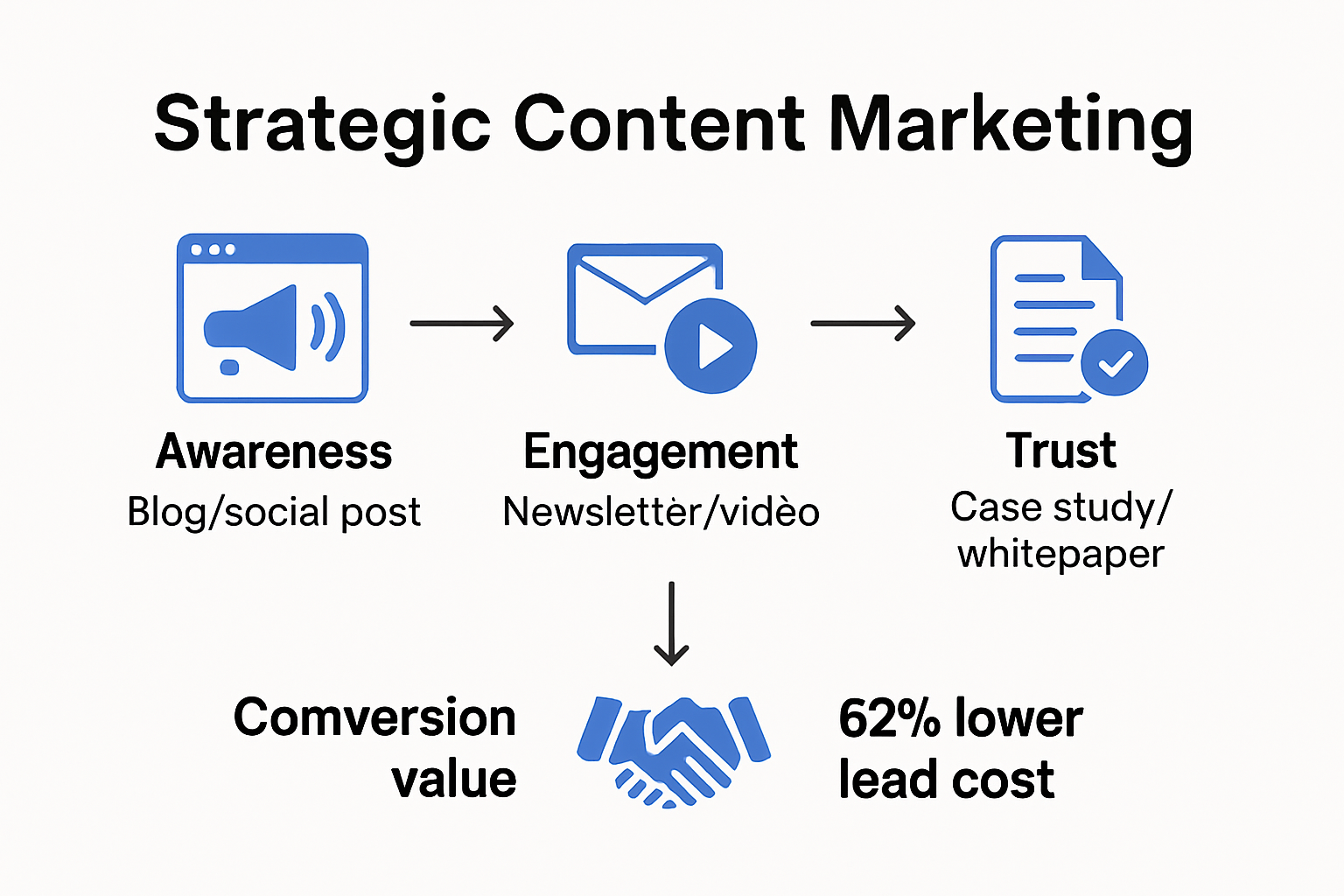
Discover strategic growth techniques While many view content marketing as an abstract concept, sophisticated businesses understand it as a precise, data-driven strategy for generating measurable outcomes. According to research from Content Marketing Institute, companies that implement a documented content marketing strategy are 60 percent more likely to achieve measurable results compared to those with an ad-hoc approach.
The financial implications of strategic content marketing are substantial. A study by Demand Metric revealed that content marketing generates three times more leads than traditional outbound marketing, while costing 62 percent less. This demonstrates that content marketing is not just an effective strategy, but also an economically efficient approach to business growth.
Strategic Conversion and Revenue Generation
Effective content marketing transforms website visitors into qualified leads and, ultimately, paying customers. By creating targeted, valuable content that addresses specific customer pain points, businesses can significantly improve their conversion rates. Research from HubSpot indicates that companies publishing 16 or more blog posts per month generate 3.5 times more traffic than those publishing zero to four monthly posts.
Key performance indicators for measuring content marketing success include:
Here is a summary table highlighting the primary key performance indicators (KPIs) used to measure content marketing success, based on the article’s recommendations.
| KPI | What It Measures |
|---|---|
| Lead Generation | Number and quality of leads generated through content |
| Conversion Rates | Effectiveness of content in moving prospects through funnel |
| Customer Acquisition Cost | Cost-effectiveness compared to traditional advertising |
| Engagement Metrics | Time on page, social shares, and interaction rates |
- Lead Generation: Tracking the number and quality of leads generated through content
- Conversion Rates: Measuring how effectively content moves prospects through the sales funnel
- Customer Acquisition Cost: Analyzing the cost-effectiveness of content marketing compared to traditional advertising
- Engagement Metrics: Evaluating time spent on page, social shares, and interaction rates
The most successful businesses view content marketing as a precision instrument for growth. They leverage advanced analytics and tracking tools to continuously refine their strategies, ensuring that every piece of content contributes directly to business objectives.
This is the work we do for you. Every week, without exception.
Managing GBP at this level takes 6–8 hours a week when done right. Nova handles the entire system — posts, photos, reviews, Q&A, citations, heatmap tracking — so you can focus on running your business.
Moreover, content marketing provides compounding returns. Unlike traditional advertising that stops generating value once the campaign ends, high-quality content continues to attract, engage, and convert potential customers long after its initial publication. This creates a sustainable growth engine that consistently delivers value.

In the digital age, businesses cannot afford to treat marketing as an expense. Strategic content marketing represents an investment in building lasting customer relationships, establishing industry authority, and creating a predictable pathway to sustainable business growth. By focusing on creating genuinely valuable content and rigorously measuring its impact, companies can transform their marketing from a cost center to a powerful revenue generation mechanism.
Frequently Asked Questions
What is content marketing and why is it important?
Content marketing is a strategic approach focused on creating and distributing valuable content to attract and engage a target audience. It’s important because it builds trust, establishes authority, and drives measurable business growth.
How does content marketing impact business growth?
Content marketing can lead to increased leads, improved customer retention, and higher revenue. Businesses using strategic content marketing often see significant improvements in their key performance metrics compared to those that do not.
How can I measure the effectiveness of my content marketing?
You can measure the effectiveness of content marketing by tracking key performance indicators (KPIs) such as lead generation, conversion rates, customer acquisition cost, and engagement metrics like time spent on page and social shares.
What strategies can I use to build trust through content marketing?
To build trust, focus on transparency, consistency in content delivery, providing expert knowledge, and maintaining authenticity in your interactions with your audience.
Ready to Turn Content Into Real Business Growth?
If you are struggling with trust, authority, or seeing real results from your content marketing, you are not alone. The article highlights how crucial strong content is for driving leads, winning customer loyalty, and standing out in a crowded market. But knowing this is only the first step. To actually boost your authority online and convert engagement into measurable growth, you need an expert strategy, deep industry knowledge, and the latest technology working for your business. That is where 12AM Agency delivers real power.
Businesses across legal, dental, automotive, and more trust our team to turn content marketing challenges into ROI. Ready to see how tailored content and a full-service digital strategy can fuel your company’s growth? Visit 12AM Agency today or check out how we build digital marketing campaigns that drive results for every type of business. In a fast-moving digital world, waiting costs you the leads and loyalty your competitors are capturing right now. Take the next step to get ahead—let us show you what the right content and a strategic partner can do.

