



Digital marketing is turning business growth on its head. Companies that focus on digital channels can achieve revenue increases of up to 760% by using advanced audience segmentation. Most people think traditional advertising still holds the power but today’s smart moves are all about precision, data, and results you can actually see. The surprise is just how much smaller brands can outpace giant competitors with the right digital strategies.
Table of Contents
- Unlocking Business Growth With Digital Marketing
- Cost Effectiveness Compared to Traditional Ads
- Targeting The Right Audience Online
- Measuring Results And Improving Strategies
Quick Summary
| Takeaway | Explanation |
|---|---|
| Invest in digital marketing for growth | Businesses leveraging digital channels gain a competitive edge and unlock opportunities for expansion. |
| Digital marketing is cost-effective | Compared to traditional ads, digital strategies offer lower costs and precise targeting, maximizing marketing budget efficiency. |
| Leverage precise audience targeting | Use advanced segmentation and targeting technologies to engage specific customer demographics for better conversion rates. |
| Utilize real-time analytics for optimization | Continuously track and analyze campaign performance to make immediate adjustments and improve marketing effectiveness. |
| Adopt predictive analytics for planning | Implement predictive models to forecast customer behavior and refine strategies, ensuring proactive marketing efforts. |
Unlocking Business Growth With Digital Marketing
Digital marketing has transformed the way businesses connect with customers, create brand awareness, and drive sustainable growth. Modern enterprises recognize that traditional marketing strategies no longer suffice in an increasingly digital world. By strategically investing in digital channels, businesses can unlock unprecedented opportunities for expansion and competitive advantage.
The Strategic Advantage of Digital Marketing Investments
Businesses that embrace digital marketing gain a critical competitive edge. Our guide on digital transformation strategies reveals that companies leveraging comprehensive digital approaches experience significantly higher growth rates compared to those relying solely on traditional marketing methods.
According to American Military University, Search Engine Optimization (SEO) plays a pivotal role in driving website traffic and enhancing online visibility. This strategic approach allows businesses to reach targeted audiences more effectively than ever before, transforming how companies generate leads and build brand recognition.
Measuring Digital Marketing’s Impact on Business Performance
Investopedia highlights the unique advantages of digital marketing over traditional methods. Digital strategies offer unparalleled benefits including:
- Cost Efficiency: Significantly lower investment compared to traditional advertising channels
- Precise Targeting: Advanced analytics enable businesses to reach exact customer demographics
- Real-Time Performance Tracking: Immediate insights into campaign effectiveness and return on investment
Businesses can now track every interaction, understanding customer behavior with unprecedented depth. This data-driven approach allows for continuous optimization of marketing strategies, ensuring resources are allocated most effectively.
Breaking Through Marketing Limitations
Traditional marketing channels often impose significant constraints on businesses. Digital marketing eliminates geographical boundaries, enabling companies to reach global audiences instantaneously. Whether you’re a local service provider or a national brand, digital platforms provide scalable solutions that adapt to your specific growth objectives.
The ability to personalize marketing messages, segment audiences, and engage customers through multiple touchpoints represents a revolutionary shift in how businesses communicate. By investing in digital marketing, companies transform from passive advertisers to active relationship builders, creating meaningful connections that drive long-term growth and customer loyalty.
Understanding and implementing digital marketing is no longer optional – it’s a critical strategic imperative for businesses seeking sustainable success in the modern marketplace. The question is not whether to invest in digital marketing, but how quickly and comprehensively you can integrate these powerful tools into your growth strategy.
See exactly where your profile stands right now.
Our GBP audit shows your current rank position across your market, how your profile completeness scores against competitors, and the specific gaps holding you back from the Map Pack.
Cost Effectiveness Compared to Traditional Ads
Digital marketing represents a revolutionary approach to advertising that dramatically reduces marketing expenses while simultaneously improving audience engagement and measurable results. Unlike traditional advertising channels that demand significant financial investments with limited tracking capabilities, digital marketing offers businesses unprecedented cost-effectiveness and precision in reaching potential customers.
Breaking Down the Financial Advantages
Learn more about our digital marketing optimization strategies that help businesses maximize their marketing budgets. Traditional advertising methods like television, radio, and print media require substantial upfront investments with minimal guarantee of reaching the intended audience. A single television commercial can cost tens of thousands of dollars, whereas digital marketing campaigns can be launched for a fraction of that expense.
According to research from the United States International University-Africa, digital advertising provides businesses with more flexible and scalable marketing solutions. Small businesses can start with minimal budgets and incrementally increase spending as they see tangible results, a luxury rarely available in traditional advertising platforms.
Precision Targeting and Return on Investment
The economic efficiency of digital marketing extends beyond initial cost savings. Research analyzing brand advertising demonstrates that digital ads not only reduce expenses but also increase perceived brand value among consumers. Traditional advertising operates on a broad, scattershot approach where businesses pay to reach massive audiences, many of whom have no genuine interest in their products or services.
Digital marketing platforms offer granular targeting options that allow businesses to:
- Demographic Precision: Target specific age groups, income levels, and interests
- Geographic Customization: Reach local or global audiences with pinpoint accuracy
- Behavioral Tracking: Adjust campaigns based on real-time user interactions and engagement
Performance Metrics and Long-Term Value
Unlike traditional advertising, where measuring campaign effectiveness is challenging, digital marketing provides comprehensive analytics. Businesses can track every click, conversion, and customer interaction, enabling data-driven decision-making. This level of insight allows for continuous optimization, ensuring that marketing budgets are invested most efficiently.
The cost per acquisition in digital marketing is significantly lower compared to traditional channels. While a print advertisement might reach thousands of people with minimal engagement, digital campaigns can generate targeted leads at a fraction of the cost. Small businesses can compete with larger corporations by leveraging smart, cost-effective digital strategies that maximize every marketing dollar.
To help clarify the unique benefits digital marketing brings compared to traditional advertising, here’s a side-by-side comparison of key features:
| Feature | Traditional Advertising | Digital Marketing |
|---|---|---|
| Cost Efficiency | High upfront costs | Lower, scalable costs |
| Targeting Precision | Broad, less precise | Highly targeted (demographic, geographic) |
| Real-Time Performance Data | Limited or delayed | Immediate, actionable analytics |
| Flexibility | Fixed and slow to adjust | Agile, campaigns can change in hours |
| Measurability | Difficult to measure ROI | Comprehensive, granular tracking |
| Geographic Reach | Often geographically limited | Local, national, or global reach possible |
| Personalization | Generic messaging | Dynamic, personalized content |
In an era of tight budgets and increasing competition, digital marketing emerges as the most economical and impactful approach to business growth. The ability to reach the right audience, at the right time, with minimal financial investment represents a paradigm shift in marketing strategies. Businesses that embrace these digital approaches position themselves for sustainable growth and long-term success.

Targeting the Right Audience Online
Digital marketing has revolutionized how businesses identify, engage, and convert potential customers by providing unprecedented capabilities in audience targeting. Unlike traditional marketing approaches that cast wide nets, online marketing enables businesses to pinpoint and interact with precise demographic segments, transforming how companies approach customer acquisition and retention.
Strategic Audience Segmentation
Discover advanced targeting techniques that can dramatically improve your marketing precision. According to Harvard Business School, effective audience segmentation can increase revenue by up to 760% by organizing consumers with similar needs and preferences into strategic groups.
Modern digital marketing platforms offer multidimensional targeting capabilities that go far beyond basic demographic information. Businesses can now segment audiences based on:
Below is a summary table showing the types of audience segmentation available through digital marketing, with a note on how each enhances marketing effectiveness:
| Segmentation Type | What It Focuses On | Benefit |
|---|---|---|
| Demographic | Age, income, education, etc. | Targets offers to demographic needs |
| Behavioral | Browsing/activity history | Engages based on interests & timing |
| Psychographic | Values, attitudes, lifestyle | Personalizes messaging to audience interests |
| Technological Engagement | Devices used, platforms preferred | Optimizes delivery for preferred touchpoints |
| Geographic | Location (local, national, global) | Reaches relevant customers based on location |
| Real-Time Optimization | Adapts segments based on live feedback | Continuously improves targeting accuracy |
- Behavioral Patterns: Online browsing habits and interaction history
- Psychographic Characteristics: Personal interests, values, and lifestyle choices
- Technological Engagement: Device usage, preferred platforms, and digital interaction preferences
Precision Targeting Technologies
TechTarget highlights that digital marketing enables precise audience targeting across multiple dimensions including demographics, behaviors, interests, and geographic location. This granular approach ensures that marketing resources are allocated efficiently, minimizing waste and maximizing potential customer interactions.
Adobe emphasizes that online targeting technologies allow businesses to create highly personalized marketing experiences. By analyzing extensive digital footprints, companies can craft messages that resonate deeply with specific audience segments, increasing engagement rates and conversion potential.
Dynamic Audience Optimization
The true power of digital marketing lies in its ability to continuously refine audience targeting. Unlike static traditional marketing approaches, online platforms provide real-time feedback and analytics. Businesses can instantaneously adjust their strategies based on audience response, creating a dynamic and responsive marketing ecosystem.
This adaptive approach means marketing campaigns become increasingly sophisticated over time. Machine learning algorithms analyze user interactions, progressively improving audience targeting accuracy. Small businesses can now compete with larger corporations by leveraging these intelligent targeting technologies that were previously accessible only to enterprises with massive marketing budgets.
The landscape of digital marketing has transformed audience engagement from a broad, generalized approach to a precise, personalized science. By embracing these advanced targeting technologies, businesses can create meaningful connections with potential customers, turning digital interactions into sustainable growth opportunities. The future of marketing is not about reaching more people, but about reaching the right people with the right message at the right moment.
Measuring Results and Improving Strategies
Digital marketing distinguishes itself from traditional advertising through its unprecedented ability to measure, analyze, and continuously optimize marketing performance. Unlike traditional methods where success remains largely ambiguous, digital platforms provide businesses with comprehensive, real-time insights that enable data-driven decision-making and strategic refinement.
Comprehensive Performance Analytics
The digital marketing landscape offers an array of sophisticated tracking tools that transform how businesses understand their marketing effectiveness. Explore our advanced analytics approach that helps companies turn data into actionable strategies.
Key performance indicators (KPIs) in digital marketing go far beyond simple metrics like website visits. Modern analytics platforms enable businesses to track:
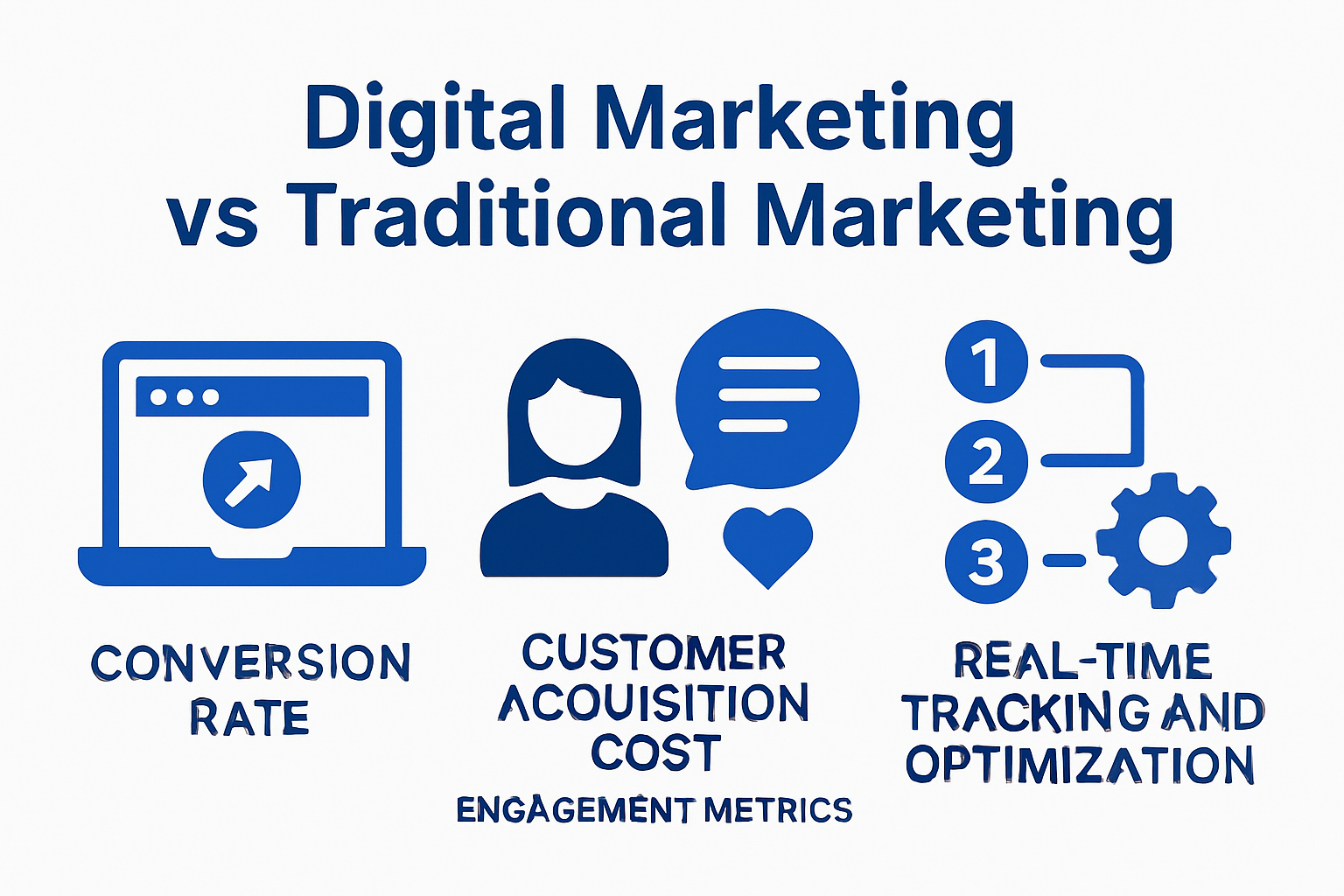
- Conversion Rates: Precise measurement of how many potential customers take desired actions
- Customer Acquisition Costs: Detailed understanding of the financial investment required to gain each new customer
- Engagement Metrics: In-depth analysis of how users interact with digital content
Real-Time Strategy Optimization
According to research from Google Analytics, businesses can implement strategy changes within hours of receiving performance data, a flexibility unimaginable in traditional marketing channels. This agile approach allows for continuous improvement and rapid adaptation to changing market conditions.
Digital marketing tools provide granular insights that enable businesses to:
- Identify which marketing channels generate the highest quality leads
- Understand customer behavior patterns and preferences
- Allocate marketing budgets more efficiently based on proven performance
Predictive Analytics and Future Planning
This is the work we do for you. Every week, without exception.
Managing GBP at this level takes 6–8 hours a week when done right. Nova handles the entire system — posts, photos, reviews, Q&A, citations, heatmap tracking — so you can focus on running your business.
McKinsey & Company highlights that advanced digital marketing analytics now incorporate predictive modeling. These sophisticated algorithms can forecast future customer behaviors, trends, and potential marketing outcomes with remarkable accuracy.
By leveraging machine learning and artificial intelligence, businesses can:
- Anticipate customer needs before they arise
- Develop proactive marketing strategies
- Reduce wasted marketing expenditure
The ability to measure, analyze, and predict marketing performance represents a quantum leap in business strategy. Digital marketing transforms marketing from a cost center into a precision instrument for growth. Companies that embrace these analytical capabilities position themselves to outperform competitors who rely on traditional, less-informed approaches.
Ultimately, digital marketing is not just about creating marketing campaigns – it’s about creating intelligent, responsive, and continuously improving marketing ecosystems. The businesses that master these analytical tools will define the future of marketing, turning data into their most valuable strategic asset.
Frequently Asked Questions
What are the benefits of investing in digital marketing for business growth?
Investing in digital marketing can lead to increased revenue, enhanced brand visibility, and improved customer engagement. Businesses using digital channels can experience growth rates significantly higher than those relying on traditional marketing methods.
How does digital marketing compare in cost-effectiveness to traditional advertising?
Digital marketing is often more cost-effective than traditional advertising. It offers lower upfront costs, precise targeting options, and measurable performance analytics, allowing businesses to maximize their marketing budgets and achieve better returns on investment.
What role does audience segmentation play in digital marketing?
Audience segmentation allows businesses to categorize consumers based on similar needs and preferences. This targeted approach improves engagement rates and conversion potential, resulting in more effective marketing strategies and increased revenue.
How can businesses measure the success of their digital marketing efforts?
Businesses can measure digital marketing success through comprehensive performance analytics. Key performance indicators (KPIs), such as conversion rates, customer acquisition costs, and engagement metrics, provide valuable insights into campaign effectiveness and areas for improvement.
Take Control of Your Growth With Proven Digital Marketing Results
Are you tired of investing in marketing channels that drain your budget and deliver unclear results? The article showed how digital marketing can break through growth limitations, deliver real-time performance insights, and help local businesses engage the right audience. But making sense of advanced strategies like precision targeting and predictive analytics on your own can leave you feeling overwhelmed or unsure where to start.
Let our experts turn your business goals into reality by building tailored marketing campaigns that focus on what matters most. From SEO management and full-service digital transformation to reputation management and Google My Business optimization, our solutions drive measurable results for your industry. Start your journey to revenue growth now by visiting 12AM Agency and requesting your first personalized strategy session. Don’t miss this chance to put your business ahead of the competition.

