




Enterprise email marketing is changing how big companies talk to their customers and it is not just about sending messages to huge lists. Some companies manage millions of email contacts and still craft personalized messages for every segment. That sounds impossible with so many people to reach, right? The wild part is the real magic happens after those emails are sent because advanced analytics and machine learning turn every click and open into a smarter strategy for the next campaign.
Table of Contents
- What Is Enterprise Email Marketing And Why It Matters
- The Core Components Of Effective Email Marketing
- How Enterprise Email Marketing Works: Strategies And Tools
- The Role Of Data And Analytics In Email Marketing
- Challenges And Best Practices In Enterprise Email Marketing
Quick Summary
| Takeaway | Explanation |
|---|---|
| Enterprise email marketing enhances customer engagement | This strategy integrates advanced data and personalization to foster meaningful interactions with large customer bases. |
| Leverage automation to optimize email campaigns | Automation tools create responsive workflows that adjust messaging based on user behavior, improving engagement rates. |
| Use predictive analytics for targeted communication | Analyzing customer behavior helps businesses predict preferences and tailor messages for better results. |
| Ensure compliance with data privacy regulations | Organizations must maintain user consent and transparency regarding data usage to build trust and avoid legal issues. |
| Continuously track performance metrics | Regularly analyzing metrics like open rates and conversions allows marketers to refine strategies for improved effectiveness. |
What is Enterprise Email Marketing and Why It Matters
Enterprise email marketing represents a sophisticated digital communication strategy designed specifically for large organizations to engage, nurture, and convert their extensive customer base through strategic email campaigns. Unlike traditional email marketing, enterprise email marketing operates at a significantly larger scale, leveraging advanced technologies, robust data analytics, and intricate personalization techniques to deliver precise messaging.
Below is a table comparing the key differences between enterprise email marketing and traditional email marketing, summarizing how scale, technology, personalization, and goals differ in practice.
| Feature | Enterprise Email Marketing | Traditional Email Marketing |
|---|---|---|
| Scale | Targets millions of contacts | Targets small to moderate-sized contact lists |
| Technology | Uses AI, machine learning, and advanced analytics | Relies on basic email service providers |
| Personalization | Highly segmented and dynamic content | Limited or generic personalization |
| Data Integration | Aggregates data from many enterprise sources | Minimal integration, often manual imports |
| Automation | Complex, responsive workflows | Basic automation, often limited to scheduled sends |
| Compliance | Robust privacy and consent management | Standard opt-in and unsubscribe features |
| Strategic Goals | Revenue generation, customer retention, relationship | Basic communication, simple marketing goals |
The Strategic Importance of Enterprise Email Marketing
For modern businesses, enterprise email marketing transcends basic communication. It serves as a critical channel for:
- Driving customer acquisition and retention
- Generating measurable revenue through sophisticated targeting
- Building long-term relationships with complex customer segments
The core strength of enterprise email marketing lies in its ability to transform raw customer data into meaningful, personalized interactions. Large organizations can segment audiences with incredible precision, crafting messages that resonate with specific demographic, behavioral, and transactional characteristics.
Advanced Technological Foundations
Modern enterprise email marketing platforms integrate cutting-edge technologies like artificial intelligence and machine learning to optimize campaign performance.
These systems analyze massive datasets to predict customer behaviors, recommend optimal send times, and dynamically adjust content based on individual engagement patterns.
According to Coursera’s digital marketing research, email marketing remains a powerful tool for enterprises, offering an impressive return on investment compared to other digital marketing channels. The ability to track, measure, and continuously refine campaigns makes it an indispensable strategy for businesses seeking data-driven growth.
By leveraging comprehensive enterprise digital marketing solutions, organizations can transform email from a simple communication tool into a sophisticated revenue generation mechanism that delivers personalized experiences at unprecedented scale.
See exactly where your profile stands right now.
Our GBP audit shows your current rank position across your market, how your profile completeness scores against competitors, and the specific gaps holding you back from the Map Pack.
The Core Components of Effective Email Marketing
Enterprise email marketing success hinges on mastering several critical components that transform basic communication into strategic engagement.
This table outlines the core components of effective enterprise email marketing, highlighting their functions and significance in driving overall marketing success.
| Component | Function/Description | Importance |
|---|---|---|
| Strategic Content & Personalization | Develops relevant messaging for user segments | Drives engagement and conversion |
| Technical Infrastructure | Ensures message deliverability and scalability | Maximizes reach and maintains sender reputation |
| Automation & Workflows | Automates messages based on user behavior | Improves responsiveness and campaign efficiency |
| Data Integration & Segmentation | Unifies customer data for precise targeting | Enables granular audience segmentation |
| Analytics & Optimization | Tracks performance metrics and informs improvements | Facilitates data-driven decision making |
| Compliance & Privacy | Manages consent and respects data regulations | Builds trust and avoids legal issues |
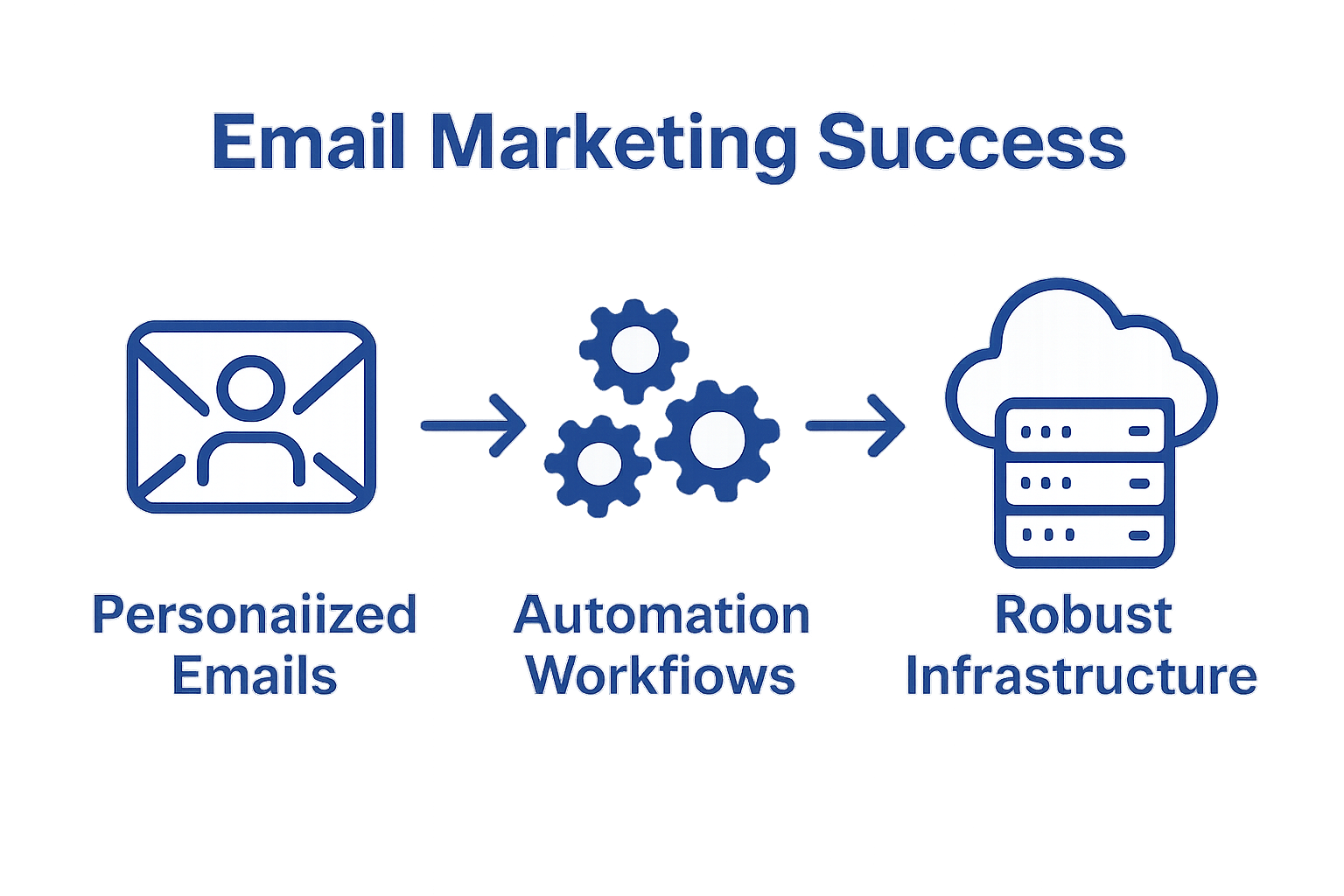 Sophisticated email marketing requires a holistic approach that integrates technology, data analysis, creative content, and precise audience segmentation.
Strategic Content and Personalization
At the heart of effective email marketing lies the ability to create highly personalized, contextually relevant content. Enterprises must move beyond generic messaging to develop:
- Dynamically generated content tailored to individual user profiles
- Segmented messaging based on behavioral and demographic data
- Adaptive communication strategies that respond to user interactions
Effective personalization means understanding not just who your audience is, but anticipating their needs, preferences, and potential pain points. This requires sophisticated data integration and advanced analytics capabilities that can transform raw customer information into meaningful communication strategies.
Technical Infrastructure and Deliverability
The technical backbone of enterprise email marketing involves robust infrastructure that ensures message reliability, security, and optimal performance. Modern email marketing platforms must provide:
- Advanced authentication protocols to prevent spam filtering
- Real-time performance tracking and analytics
- Scalable sending capabilities that maintain high deliverability rates
According to research from the Small Business Administration, effective email marketing is not just about sending messages, but creating a comprehensive communication ecosystem that respects user preferences and maintains high engagement standards.
By developing strategic media outreach strategies, organizations can elevate their email marketing from a mere communication tool to a sophisticated engagement platform that drives meaningful business outcomes.
How Enterprise Email Marketing Works: Strategies and Tools
Enterprise email marketing operates through a complex ecosystem of sophisticated technologies, strategic frameworks, and advanced data management systems that transform raw customer interactions into precision-driven communication channels. Integrated marketing platforms enable organizations to orchestrate comprehensive email campaigns that transcend traditional marketing approaches.
Automation and Workflow Orchestration
At the core of enterprise email marketing lies advanced automation technologies that create intelligent, responsive communication pathways. These systems enable businesses to:
- Trigger personalized email sequences based on specific user behaviors
- Create complex, multi-stage communication workflows
- Dynamically adjust messaging based on real-time customer interactions
Modern automation tools leverage machine learning algorithms to predict optimal engagement times, content preferences, and potential conversion points. This approach transforms email from a static communication medium into a dynamic, intelligent engagement platform that adapts continuously to individual user journeys.
Data Integration and Segmentation Technologies
Successful enterprise email marketing hinges on sophisticated data integration capabilities. Organizations must develop robust systems that can:
- Consolidate data from multiple customer touchpoints
- Create granular audience segmentation models
- Implement real-time data synchronization across platforms
According to research from the National Institutes of Health, effective enterprise email marketing requires comprehensive data management strategies that respect privacy regulations while enabling precise targeting.
By exploring enterprise automation strategies, organizations can develop email marketing approaches that not only communicate but truly connect with their audience through intelligent, context-aware communication systems.
The Role of Data and Analytics in Email Marketing
Data and analytics represent the strategic nerve center of modern enterprise email marketing, transforming raw customer information into actionable insights that drive sophisticated communication strategies. Advanced analytical frameworks enable organizations to move beyond traditional marketing approaches, creating hyper-personalized experiences that resonate with individual customer profiles.
Predictive Analytics and Customer Behavioral Mapping
Enterprise email marketing leverages complex predictive modeling to understand and anticipate customer behaviors. These analytical approaches allow businesses to:
- Develop granular understanding of customer engagement patterns
- Predict potential conversion opportunities before they emerge
- Create dynamically adaptive communication strategies
Predictive analytics goes beyond simple demographic segmentation, using machine learning algorithms to uncover nuanced behavioral signals that traditional analysis might miss. By mapping intricate customer journeys, organizations can craft messaging that feels personally tailored and contextually relevant.
Performance Metrics and Continuous Optimization
Data-driven email marketing relies on comprehensive performance tracking that provides deep insights into campaign effectiveness. Key analytical metrics include:
- Open rates and engagement duration
- Conversion tracking across multiple touchpoints
- Detailed audience interaction and response patterns
According to research from the National Institutes of Health, digital communication analytics are crucial for understanding and improving audience engagement strategies. These insights allow marketers to continuously refine their approach, ensuring each communication becomes more precise and effective.

By exploring quantitative analysis techniques, enterprises can transform email marketing from a static communication channel into a dynamic, intelligent engagement platform that adapts in real-time to customer needs and preferences.
Challenges and Best Practices in Enterprise Email Marketing
Enterprise email marketing operates within a complex landscape of technological, regulatory, and strategic challenges that demand sophisticated approaches and continuous adaptation. Strategic compliance and innovation are crucial for organizations seeking to leverage email as an effective communication and marketing channel.
Regulatory Compliance and Data Privacy
Modern enterprise email marketing must navigate intricate legal frameworks that govern digital communication. Organizations face critical challenges including:
- Ensuring explicit user consent for communication
- Implementing robust data protection mechanisms
- Maintaining transparent opt-out and preference management systems
Successful email marketing strategies require meticulous attention to regulatory requirements, balancing aggressive marketing objectives with respect for individual privacy rights. This involves developing comprehensive consent management protocols and maintaining clear, accessible communication about data usage.
Technical and Strategic Performance Optimization
This is the work we do for you. Every week, without exception.
Managing GBP at this level takes 6–8 hours a week when done right. Nova handles the entire system — posts, photos, reviews, Q&A, citations, heatmap tracking — so you can focus on running your business.
Enterprise email marketing demands continuous refinement of technical and strategic capabilities. Key performance challenges include:
- Managing complex email deliverability infrastructures
- Mitigating potential spam and security risks
- Creating adaptive, personalized communication workflows
According to research from the Federal Trade Commission, organizations must implement robust technical frameworks that ensure legal compliance while maintaining effective communication strategies.
By exploring small business automation strategies, enterprises can develop more sophisticated, compliant, and efficient email marketing approaches that balance technological innovation with strategic communication objectives.
Ready to Transform Your Enterprise Email Marketing Results?
You have seen how advanced enterprise email marketing depends on powerful strategies, automation, and pinpointed data analytics. Yet managing all those components can feel overwhelming, especially when it comes to personalization, compliance, and getting real engagement from complex customer segments. If you struggle with converting raw customer data into growth or meeting the high standards of sophisticated email campaigns, you are not alone. Many large organizations want meaningful connections with their clients but find the technology and strategy difficult to master.
Let us help you unlock your next level of growth with a marketing approach that blends technology, data-driven insight, and creative communication. Discover how our digital marketing experts at 12AM Agency can simplify your email marketing challenges by building campaigns that turn analytics into action. If you are serious about driving retention, acquisition, and measurable revenue, now is the time to contact us. Our proven solutions are here to help your enterprise succeed. Schedule your strategy call today and see what precise, innovative marketing can do for your business.
Frequently Asked Questions
What is enterprise email marketing?
Enterprise email marketing is a sophisticated digital communication strategy tailored for large organizations, aimed at engaging and converting customers through strategically crafted email campaigns.
How does enterprise email marketing differ from traditional email marketing?
Enterprise email marketing operates on a larger scale, utilizing advanced technologies, data analytics, and personalization techniques to deliver more targeted and effective messaging compared to traditional email marketing.
What are the key components of effective enterprise email marketing?
Effective enterprise email marketing includes strategic content personalization, robust technical infrastructure for deliverability, advanced automation and workflow orchestration, and sophisticated data integration and segmentation capabilities.
How can data and analytics enhance enterprise email marketing efforts?
Data and analytics enhance enterprise email marketing by providing insights into customer behavior, enabling predictive modeling for tailored campaigns, and measuring performance metrics to continuously optimize email strategies.


