




A client asked me a question recently I couldn’t answer cleanly: “We rank #1 on Google for our main service term. So why isn’t ChatGPT mentioning us when people ask about it?”
That’s the AIEO problem in one sentence.
AIEO, AI Engine Optimization is the practice of getting your brand cited, mentioned, and surfaced inside AI-generated answers. Google AI Mode. Gemini. ChatGPT. Perplexity. Claude. It’s adjacent to SEO, but it doesn’t work the same way, and the businesses figuring it out first are about to take a serious lead on the ones still chasing blue-link rankings.
This post breaks down what AIEO actually is, how citation inside AI answers works, the six signals that drive it, and a self-audit checklist you can run on your site today.
AIEO vs SEO vs GEO vs AEO, what’s the actual difference?
The acronyms are a mess. Here’s how we use them at 12AM, and why it matters after Google I/O 2026.
SEO is optimization to rank in traditional search results. The goal is a click from a SERP.
AEO (Answer Engine Optimization) is the older sibling — optimizing to win featured snippets and “position zero.” Still relevant, but increasingly folded into the broader AI conversation.
See exactly where your profile stands right now.
Our GBP audit shows your current rank position across your market, how your profile completeness scores against competitors, and the specific gaps holding you back from the Map Pack.
GEO (Generative Engine Optimization) is a research-driven term from a 2023 academic paper out of Princeton. It refers specifically to optimization for generative AI outputs. Most practitioners use GEO and AIEO interchangeably.
AIEO (AI Engine Optimization) is the umbrella term we use because it covers the full picture: AI search (Google AI Mode, Perplexity), conversational AI (ChatGPT, Claude, Gemini), and the agent-based systems Google just announced at I/O 2026.
The short version: SEO is about rankings. AIEO is about citations. After May 19, citations matter more.
How citation actually works inside an AI answer
Here’s the part most marketers don’t understand yet. When someone asks Gemini “Who are the best personal injury lawyers in Dallas?”, the AI doesn’t pull a ranked list of websites the way Google’s blue links do. It does something closer to what a research assistant does. It synthesizes an answer, and it picks sources to back up that answer.
The selection process isn’t random. It runs on a stack of signals:
- The model identifies the entities that match the query — businesses, people, products, places.
- It evaluates which sources discuss those entities authoritatively.
- It checks for structural and semantic clarity. Is the content actually answering the question, or burying the answer in fluff?
- It cross-references with other trustworthy sources to confirm the information.
- It selects a small number of sources to cite directly, often surfacing them as named links.
If you’re not in that final list, you don’t exist for that query. Doesn’t matter how well you rank.
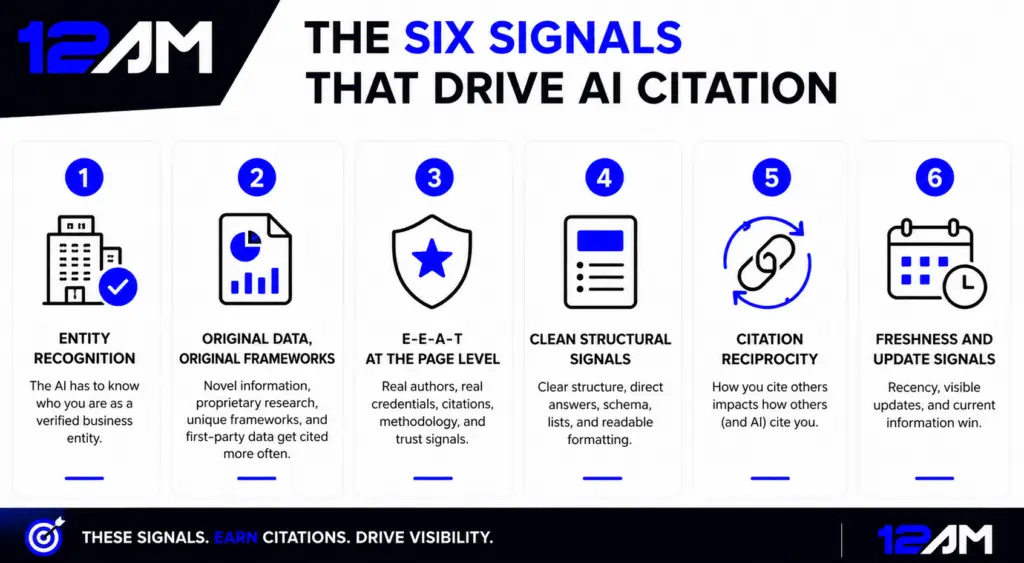
The six signals that drive AI citation
After hundreds of client queries and a lot of testing across Gemini, ChatGPT, and Perplexity, these are the patterns we see consistently.
1. Entity recognition
The AI has to know who you are. Not just your domain — you, as a verified business entity. That means Organization schema, Wikidata presence, consistent NAP across the web, a real Knowledge Graph footprint, and consistent mentions across credible third-party sources. If you’re a name on a website but nothing else, you won’t be cited.
2. Original data, original frameworks
AI systems are biased toward novel information. A blog post that references original research, a proprietary study, a unique framework with a name (like our Authority Flywheel™), or first-party data gets cited far more often than a post that aggregates what everyone else has already said. If your content can be paraphrased into a more generic source, the AI will paraphrase it into a more generic source.
3. E-E-A-T at the page level
Experience, Expertise, Authoritativeness, Trustworthiness. Real authors with real credentials linked to real bio pages. Citations to authoritative sources. Last-updated timestamps. Disclosed methodology where relevant. The AI is making a judgment about whether your content is worth elevating into its synthesized answer, and these are the signals it uses.
4. Clean structural signals
Clear headers. Direct answers in the first one or two sentences after a question. Short, declarative paragraphs. FAQ schema. HowTo schema. Lists where lists make sense, prose where they don’t. AI parsers reward content structured the way they want to consume it. Walls of text and meandering 800-word intros don’t get cited.
5. Citation reciprocity
Counterintuitive one: how you cite other sources affects how others cite you. Pages that link to reputable sources with proper attribution, name real experts, and reference original studies tend to themselves get cited more often. The AI models seem to treat “sources well-grounded content” as a trust signal in itself.
6. Freshness and update signals
Information agents and AI Mode both weight recency heavily. Content updated in the last 90 days, with a visible last-updated date, and references to current information, beats older content covering the same topic. This is a reversal from old-school SEO, where evergreen content could sit untouched for years and keep ranking.
The AIEO audit: what gets cited, what doesn’t
Run your site against this list. Be honest.
What gets cited:
- Pages with Organization, Article, FAQPage, and HowTo schema
- Content that answers the user’s question in the first paragraph
- Posts with real author bylines and bio pages
- Pages with original data, statistics, or named frameworks
- Sites with strong entity signals across Google Business Profile, Wikidata, and Knowledge Graph
- Content updated within the last six months
- Pages that cite three or more authoritative external sources
- Content with clear topical depth — not one shallow post, but a cluster
What doesn’t:
- Thin pages under 500 words on broad topics
- Anonymous content with no clear author or organization behind it
- Pages stuffed with keyword variations and SEO boilerplate
- Sites with no schema beyond basic page metadata
- Content that buries the answer below 800 words of intro
- Promotional landing pages without educational substance
- Sites with no Knowledge Graph presence
- Stagnant content untouched for two-plus years
If you scored well on the first list and poorly on the second, you have an AIEO foundation. If it’s the other way around, you have work to do.
What this looks like in practice at 12AM
For our legal, dental, home services, and franchise clients, AIEO work usually starts in three places.
This is the work we do for you. Every week, without exception.
Managing GBP at this level takes 6–8 hours a week when done right. Nova handles the entire system — posts, photos, reviews, Q&A, citations, heatmap tracking — so you can focus on running your business.
We audit the entity layer first. Knowledge Graph, Wikidata, schema, NAP, citation diversity. That’s the foundation. No entity, no citations.
Then we restructure existing content. Most clients have years of blog posts written for SEO that are completely wrong for AIEO. We refit them with question-first headers, clear answer paragraphs, FAQ schema, fresh data, and proper author attribution.
Then we produce new content built for citation from day one. Original frameworks. Original data. Cross-linked answer clusters. Named experts on every byline.
It’s slower than the old SEO playbook. It also actually works inside the new Google.
Run the audit on your site
We built an AIEO Readiness Scorecard, a 10-point self-audit you can run on your own site in about 15 minutes. It scores you across entity strength, schema coverage, content structure, originality, and freshness. Download it free below.
If you want a full AI Visibility Audit done for you, covering Google AI Mode, ChatGPT, Perplexity, and Gemini citation patterns specific to your business, book a free consultation with our team.


