



“Google Search as you know it is over.”
That was the TechCrunch headline the morning after Google I/O 2026. It sounds dramatic. It isn’t.
On stage in Mountain View on May 19, Sundar Pichai called what he was about to announce the biggest change to Search in more than 25 years. He wasn’t exaggerating. The blank white box that has been the front door to the internet since 1998 is being replaced, with information agents, AI-built mini-apps, and a Search interface that no longer expects you to type in keywords.
If your business depends on Google traffic, this matters. Probably more than anything that’s happened to SEO in the last decade.
We’ve spent the last several days at 12AM Agency reading every announcement, watching every keynote clip, and stress-testing what it all means for our clients in legal, dental, home services, and franchise. Here’s what changed, what’s about to break for most websites, and what you need to do about it.
What actually changed at Google I/O 2026
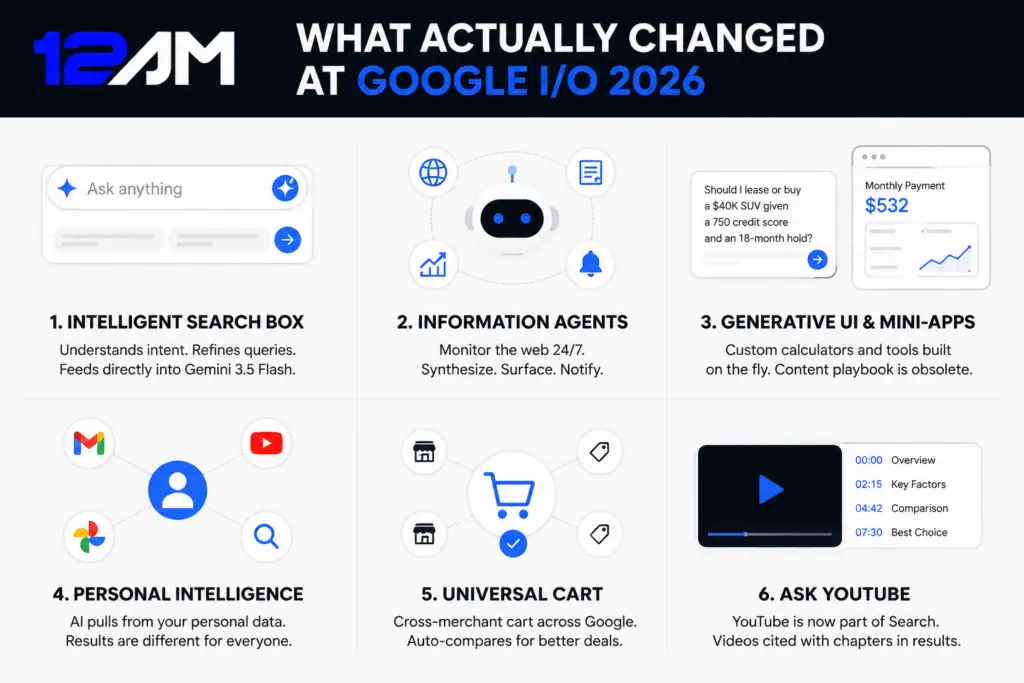
For the first time since 1998, the Search box is gone — or more accurately, completely rebuilt around AI. Here’s what Google rolled out on May 19.
An intelligent Search box, in every country running AI Mode. It doesn’t just autocomplete. It anticipates intent, suggests how to phrase your question, and feeds the query directly into Gemini 3.5 Flash, the new default model for AI Mode. Type “best slip and fall attorney near me” and the box might refine it into “what’s the average settlement for a Dallas slip and fall case in 2026, and who handles them with the highest success rate?” That’s a different query. It rewards a different kind of content.
Information agents that scan the web around the clock. This is the part most SEOs missed. Users can now spin up background agents that monitor specific topics — pricing changes, new product launches, sneaker drops, court rulings, anything — and get notified when something happens. The agent looks at blogs, news sites, social posts, and Google’s real-time data feeds. It synthesizes. It surfaces sources. Your business either shows up in those updates or it doesn’t.
Generative UI and mini-apps. Ask Google a comparison question like “should I lease or buy a $40K SUV given a 750 credit score and an 18-month hold” and instead of ten blue links, Search builds you a custom calculator on the fly. Inputs, outputs, the works. Users can also create their own mini-apps using natural language. The traditional content playbook (write the 2,000-word “lease vs buy” blog post and rank for it) doesn’t apply when Google just builds the calculator itself.
Personal Intelligence, now in roughly 200 countries. Google’s AI now pulls from your Gmail, Photos, YouTube history, and Search history when generating answers. Liz Reid, Google’s head of Search, said this directly on stage: “The results that I see are going to be totally different from the results that you see for a lot of queries.” Universal rankings are functionally dead. Two of your customers searching the same thing now get different answers based on what Google knows about them.
See exactly where your profile stands right now.
Our GBP audit shows your current rank position across your market, how your profile completeness scores against competitors, and the specific gaps holding you back from the Map Pack.
Universal Cart. A cross-merchant shopping cart that runs across Search, Gmail, YouTube, and the Gemini app. The second a product hits the cart, Google starts checking competitors for cheaper prices and better stock. If your e-commerce strategy still ends at “rank product pages,” you’re about to find out what happens when Google itself is comparison shopping on behalf of your customer.
Ask YouTube. YouTube is now searchable through Google’s AI layer directly. Your videos can be cited inside text answers, with timestamped chapters surfaced as standalone results. Video content is no longer a separate channel from Search. It’s the same channel.
There were other announcements, Gemini Spark, Intelligent Eyewear glasses with Samsung, a new $100/month AI Ultra tier, but for SEO and visibility, those six are the ones that matter.
What this does to your traffic
Plain truth: traffic is going to drop. For most sites it’s already dropping.
AI Overviews, the precursor to what Google just announced, already cut click-through rates on informational queries by 30% to 60% depending on the study and the vertical. Some industries got hit harder. Health content has cratered. So have how-to and recipe sites. Local service businesses with thin content have been getting strangled in slow motion since AI Mode launched in the US last year.
The May 19 update accelerates all of that. Here’s why.
When Google synthesizes the answer, the user doesn’t need to click. When Google’s agent monitors something on the user’s behalf, the user doesn’t need to search again. When Google builds a custom calculator inside the SERP, the user doesn’t need your blog post with the same calculator embedded in it. And when Personal Intelligence factors in someone’s Gmail and YouTube history, your carefully optimized landing page might never enter their personalized result set in the first place.
That’s not the end of the web. It is the end of a particular business model — the one where you create content, rank for keywords, and harvest the resulting clicks.
The businesses that grow through this transition are the ones that show up inside the AI answer itself, get triggered by information agents, and own a direct audience that doesn’t depend on Google to find them.
That’s the work now.
The new visibility hierarchy
For 25 years, SEO had one goal: rank in the top three blue links. That’s still part of the job, but it’s the bottom of a four-layer stack now.
Layer 1: Cited inside the AI answer. When Gemini synthesizes a response, it pulls from sources. Being one of those sources is the new #1 ranking. This is the layer most agencies are not optimizing for. It’s also where the disproportionate traffic and trust now live.
Layer 2: Surfaced through information agents. If a user has an agent monitoring “best new family law firms in Dallas,” you want that agent to find you when it scans. That requires structured, fresh, machine-readable content. It requires entity clarity. It requires being the kind of source an AI considers credible.
Layer 3: Included in AI Overviews and generative UI. When Google builds a comparison table or a calculator on the fly, your product, service, or data point needs to be inside that interface. Schema markup and clean structured data are how you get included.
Layer 4: Traditional SERP ranking. Still real. Still matters. But it’s the fallback now, not the goal.
The agencies that win the next five years optimize all four layers in parallel. The ones still selling “we’ll get you to page one” are selling a 2019 product.
The 7-point action plan for website owners
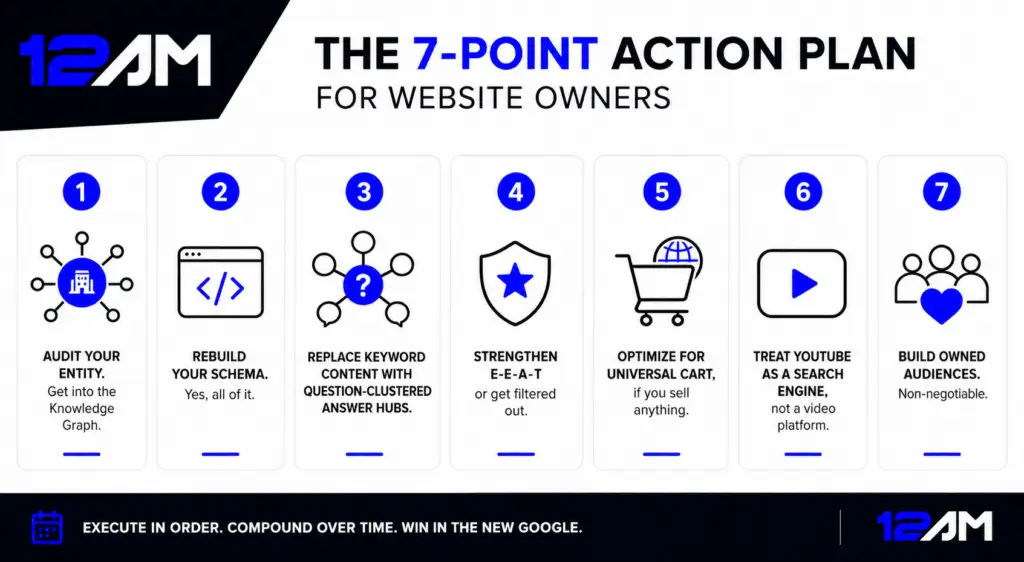
If you run a business and you want to be visible in the new Google, here’s what to actually do. In order.
1. Audit your entity. Get into the Knowledge Graph.
Google’s AI doesn’t think in keywords anymore. It thinks in entities. Is your business a recognized entity in the Knowledge Graph? Does Google understand who you are, what you do, where you operate, who your people are, and how you relate to other entities in your industry?
Most local businesses fail this audit. They have a website, a Google Business Profile, and a Facebook page — and nothing else tying them together as a single, verifiable entity. Fixing this means cleaning up NAP consistency, adding Organization schema, claiming and structuring Wikidata entries where possible, and making sure your About page, author bios, and external citations all reinforce the same entity signal.
2. Rebuild your schema. Yes, all of it.
The most tactical item on this list. If your site doesn’t have current schema covering Organization, Product, Service, FAQ, HowTo, Review, LocalBusiness, and Article — fix that this month. Schema is how AI agents and generative UI know what to pull from your site. No schema, no inclusion. That simple.
3. Replace keyword content with question-clustered answer hubs.
Stop writing blog posts titled “Top 10 Tips for Dental Implants.” Start building deep, cross-linked clusters that answer the chain of questions a real patient actually asks: what is it, who’s a candidate, what does it cost, what’s the recovery, what are the risks, how do I pick a provider, what happens if it fails. Cover the entire question fan-out, not the head keyword. AI Mode breaks one query into many; your content has to cover the whole tree.
4. Strengthen E-E-A-T or get filtered out.
Experience, Expertise, Authoritativeness, Trustworthiness. Google has been saying this matters for years, and most websites have been faking it with generic author boxes and stock photos. That doesn’t work anymore.
When the AI chooses who to cite, it weighs entity signals heavily: real authors with real credentials, original data, named clients, named cases, press mentions, podcast appearances, conference talks. Your founder needs a real digital footprint. Your subject matter experts need to be findable as people, not just bylines on a CMS.
5. Optimize for Universal Cart, if you sell anything.
If you run e-commerce, even tangentially, your Merchant Center feed is now a primary visibility asset. Pricing accuracy, stock signals, structured product data, deal flags. The Universal Cart scans competitors automatically — you want to be the one it shows users, not the one it replaces.
6. Treat YouTube as a search engine, not a video platform.
Ask YouTube changes the math. Video content with strong transcripts, clean chaptering, entity-tagged descriptions, and topical depth can be cited inside AI answers the same way a blog post can. If you’re not producing video, start. If you are, audit it for searchability the same way you’d audit a website.
7. Build owned audiences. Non-negotiable.
When Google keeps the click, the only durable traffic is traffic you don’t have to ask Google for. Email lists. SMS subscribers. App downloads. Loyal social followings on platforms you don’t fully control but at least don’t have to bid against AI agents for. Every dollar you spend on SEO should be matched by a dollar spent building direct relationships with the people SEO brings you.
How 12AM Agency is helping clients adapt
This is the work we do for you. Every week, without exception.
Managing GBP at this level takes 6–8 hours a week when done right. Nova handles the entire system — posts, photos, reviews, Q&A, citations, heatmap tracking — so you can focus on running your business.
We’ve been building toward this update for two years. The Authority Flywheel™, our framework for stacking entity SEO, AIEO, GBP optimization, and topical authority into a compounding visibility system, was designed for exactly the shift Google just announced. We saw it coming in the AI Mode beta. We saw it in the AI Overviews rollout. We watched referral traffic patterns shift across our legal and home services clients in real time.
Here’s what we’re doing for clients right now:
AI Visibility Audit. We map where you currently appear (and don’t) inside AI answers across Google AI Mode, ChatGPT, Perplexity, and Gemini. Then we identify the entity gaps, schema gaps, and content gaps preventing inclusion. You get a prioritized 90-day plan.
Entity and Knowledge Graph optimization. We rebuild your entity footprint so Google’s AI recognizes you the way a human researcher would. NAP cleanup, schema deployment, Wikidata seeding, author authority building, Knowledge Graph submissions.
Agent-Ready Content. We restructure your existing content (and produce new content) so information agents can find it and generative UI can include it. Question-clustered answer hubs, structured comparison data, fresh-data feeds, FAQ schema at scale.
Product Feed and Commerce Optimization. For e-commerce and franchise clients, we audit and optimize Merchant Center feeds, pricing signals, and product schema so you compete inside the Universal Cart instead of getting replaced by it.
We work primarily with legal practices, dental practices, home services businesses, and franchise systems. If you’re in one of those categories and your traffic feels different than it did 12 months ago, it’s not your imagination. Let’s talk about it.
The next 12 months
The next year is going to be the most disruptive period for organic search since Google launched. Some businesses lose 40% of their organic traffic and never get it back. Others compound visibility because they got the entity, schema, and content layers right early.
If you’d like an honest read on which trajectory your site is on, book a free AI Visibility Audit with our team. We’ll show you exactly where you stand inside the new Google, and what to do about it.


