



Creating a marketing funnel is often treated like a simple checklist. Everyone talks about audience, content, and conversions, so it sounds straightforward. But get this. Over 68 percent of businesses admit their funnels actually don’t guide leads effectively through each stage. That missing detail is costing real sales. The secret? It’s not about cranking out more ads or landing pages. It’s all about how precisely you craft each step to match your customer’s true journey.
Table of Contents
- Step 1: Define Your Target Audience
- Step 2: Map Out Your Customer Journey
- Step 3: Create Compelling Lead Magnets
- Step 4: Design Your Funnel Stages
- Step 5: Implement Tracking and Analytics
- Step 6: Test and Optimize Your Funnel
Quick Summary
| Key Point | Explanation |
|---|---|
| 1. Define Your Target Audience | Understand your audience deeply by creating detailed customer personas that go beyond demographics. |
| 2. Map Out the Customer Journey | Document every touchpoint in the customer experience from awareness to conversion, highlighting key interactions and emotions. |
| 3. Create Compelling Lead Magnets | Develop targeted resources that address specific audience challenges to encourage sharing of contact information. |
| 4. Design Funnel Stages | Create structured, intentional experiences for each stage of the marketing funnel, catering to customer needs at every phase. |
| 5. Implement Tracking and Analytics | Use analytics tools to measure lead behavior and identify opportunities for funnel improvements effectively. |
Step 1: Define Your Target Audience
Building a successful marketing funnel starts with understanding exactly who you want to reach. Your target audience is the foundation of every marketing strategy, determining how you communicate, what messages resonate, and ultimately how effectively you convert leads.
To define your target audience, begin with comprehensive market research that goes beyond basic demographics. Develop a detailed customer persona that captures not just age and location, but deeper psychological and behavioral characteristics. This means exploring your potential customers’ pain points, motivations, challenges, and aspirations.
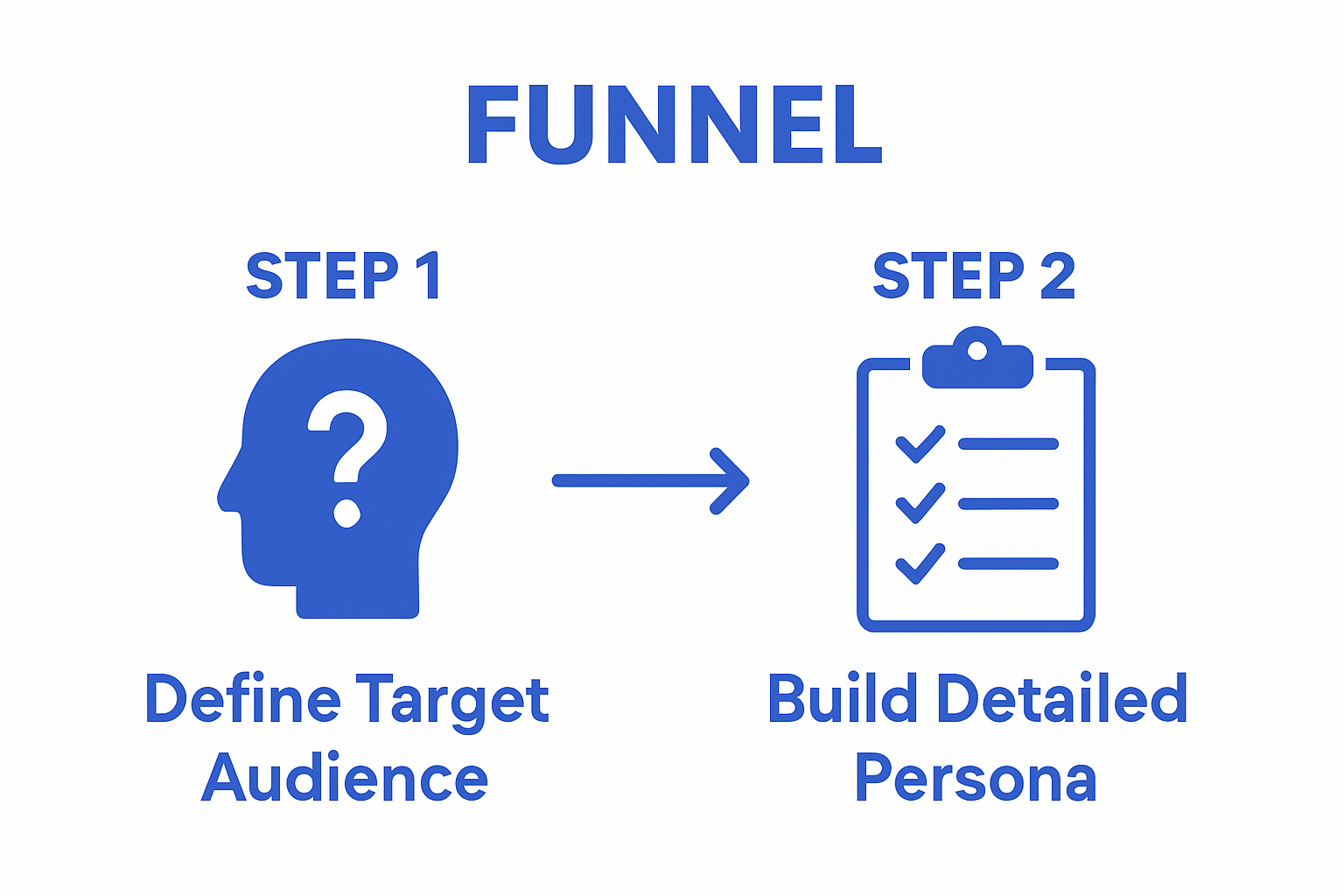 Consider creating a comprehensive profile that includes professional background, personal interests, decision making patterns, and specific problems your product or service can solve.
Utilize multiple research methods to gather insights. Conduct surveys with existing customers, analyze website analytics, review social media engagement data, and interview current clients to build a nuanced understanding. Tools like Google Analytics and social media insights can provide rich behavioral data that helps you refine your audience definition. You might discover, for instance, that your ideal customer is not just a 35-year-old professional, but a mid-level marketing manager who struggles with lead generation and is actively seeking scalable solutions.
Segmentation is critical in this process. Break down your broader audience into specific subgroups with unique characteristics and needs. This allows for more targeted messaging and personalized marketing approaches. For example, a digital marketing agency might segment audiences into small business owners, enterprise-level marketing directors, and franchise operators, each requiring a distinct communication strategy.
To verify you’ve successfully defined your target audience, ensure you can answer these key questions:
- Can you describe your ideal customer in detailed, specific terms?
- Do you understand their primary challenges and motivations?
- Have you identified multiple audience segments with distinct characteristics?
- Can you articulate how your product or service specifically solves their problems?
The checklist below helps you confirm that you have completed all essential steps when defining your target audience.
| Verification Checklist for Defining Target Audience | Status (Yes/No) |
|---|---|
| Can you describe your ideal customer in detailed, specific terms? | |
| Do you understand their primary challenges and motivations? | |
| Have you identified multiple audience segments with distinct characteristics? | |
| Can you articulate how your product or service specifically solves their problems? |
Once you’ve completed this critical first step, you’ll be ready to read more about crafting targeted marketing messages that speak directly to your audience’s needs and drive them through your marketing funnel.
Step 2: Map Out Your Customer Journey
Mapping your customer journey transforms abstract marketing strategies into a precise, actionable roadmap that guides potential leads from initial awareness to final conversion. This critical step involves meticulously documenting every interaction and touchpoint a customer experiences while engaging with your brand.
See exactly where your profile stands right now.
Our GBP audit shows your current rank position across your market, how your profile completeness scores against competitors, and the specific gaps holding you back from the Map Pack.
The customer journey is not a linear path but a complex network of interactions across multiple channels and platforms. Start by identifying each stage of the journey: awareness, consideration, decision, and retention. At the awareness stage, customers first encounter your brand through various channels like social media, search engines, or referrals. During consideration, they actively research solutions and compare options. The decision stage involves evaluating specific offerings, while retention focuses on post-purchase experiences and customer loyalty.
To create an effective journey map, collect data from multiple sources. Analyze website analytics, customer feedback, sales conversations, and interaction logs. Pay special attention to customer pain points, emotional responses, and decision triggers at each stage. Use tools like Google Analytics to track user behavior and understand how different audience segments navigate through your marketing funnel.
Visualize the journey by creating a comprehensive diagram that illustrates customer touchpoints, potential obstacles, and opportunities for engagement. This map should highlight key interactions such as website visits, email communications, social media engagement, and direct sales contacts. Identify the specific actions customers take at each stage and the information or support they require to move forward.
To verify you’ve successfully mapped your customer journey, confirm you can answer these critical questions:
- Have you documented every significant interaction point?
- Can you describe the emotional and rational motivations at each stage?
- Have you identified potential barriers that might prevent progression?
- Do you understand the specific needs and expectations of your target audience?
Once completed, you’ll be ready to explore advanced strategies for optimizing customer interactions and designing a more effective marketing funnel.
Step 3: Create Compelling Lead Magnets
Lead magnets are the critical conversion tools that transform casual website visitors into potential customers by offering something of genuine value in exchange for contact information. These strategic resources act as the bridge between initial interest and deeper engagement in your marketing funnel.
Developing an irresistible lead magnet requires understanding your audience’s most pressing challenges. Focus on creating resources that provide immediate, actionable solutions to specific problems your target customers face. This might include comprehensive guides, detailed checklists, video tutorials, research reports, or exclusive templates that demonstrate your expertise and provide tangible value. The key is crafting content so compelling that potential leads willingly share their contact information to access it.
Design your lead magnet with laser-focused precision. Instead of broad, generic resources, develop highly targeted materials that speak directly to specific audience segments. For instance, a digital marketing agency might create separate lead magnets for small business owners, franchise operators, and enterprise-level marketing directors, each addressing unique industry challenges. Utilize tools like Canva or professional design platforms to ensure your lead magnet looks polished and professional, reinforcing your brand’s credibility.
Consider diverse lead magnet formats that align with your audience’s preferences and consumption habits. Video tutorials work well for visual learners, while detailed PDF guides might appeal to those who prefer in-depth reading. Webinars can provide interactive learning experiences, and calculator tools or assessment templates offer practical utility. The format should match the complexity of the problem you’re solving and the preferences of your target audience.

To verify you’ve successfully created a compelling lead magnet, assess these critical criteria:
- Does the resource solve a specific, urgent problem for your target audience?
- Would you personally find value in downloading this lead magnet?
- Have you designed the resource to be immediately useful?
- Can potential leads quickly understand the value proposition?
Once completed, you’ll be ready to explore advanced strategies for converting leads and maximizing your marketing funnel’s effectiveness.
Step 4: Design Your Funnel Stages
Designing your marketing funnel stages transforms your abstract customer journey into a structured, strategic pathway that guides potential leads from initial awareness to final conversion. This critical step requires creating intentional, targeted experiences that systematically move prospects through each phase of engagement.
The classic marketing funnel consists of four primary stages: awareness, interest, consideration, and conversion. At the awareness stage, your goal is to capture attention through compelling content, targeted advertising, and strategic visibility across multiple channels. During the interest phase, potential leads begin actively exploring solutions to their challenges, seeking more detailed information about your offerings. The consideration stage involves deeper evaluation, where prospects compare your solution against alternatives, and the conversion stage represents the critical moment of commitment.
Craft unique content and interaction strategies for each funnel stage that address the specific psychological and informational needs of your potential customers. In the awareness stage, focus on educational content that demonstrates your expertise and addresses broad industry challenges. As leads move into the interest phase, provide more specific resources like case studies, detailed guides, and comparison tools that showcase your unique value proposition. During the consideration stage, offer personalized consultations, detailed product demonstrations, and targeted content that directly addresses potential objections.
Utilize marketing automation tools and customer relationship management platforms to track and optimize lead progression through these stages. Platforms like HubSpot can help you design automated workflows that deliver the right content at the right time, nurturing leads with precision and efficiency.
Implement tracking mechanisms that allow you to understand how leads move through your funnel, identifying potential bottlenecks and optimization opportunities.
To verify you’ve successfully designed your funnel stages, confirm you can answer these critical questions:
- Have you created targeted content for each funnel stage?
- Can you map specific interactions and resources to each phase?
- Have you established clear progression criteria between stages?
- Do you have mechanisms to track and measure lead movement?
Here is a summary of the classic marketing funnel stages, including the main focus and recommended content for each step.
| Funnel Stage | Main Focus | Recommended Content/Resources |
|---|---|---|
| Awareness | Capture attention and educate | Blog posts, social media content, introductory videos |
| Interest | Encourage exploration and learning | Case studies, detailed guides, webinars |
| Consideration | Deep evaluation and comparison | Product demos, consultations, comparison tools |
| Conversion | Facilitate final commitment | Special offers, free trials, purchase forms |
Once completed, you’ll be ready to explore advanced funnel optimization strategies and enhance your marketing effectiveness.
Step 5: Implement Tracking and Analytics
Tracking and analytics transform your marketing funnel from a theoretical concept into a data-driven, measurable system that reveals precise insights about lead behavior, conversion rates, and potential optimization opportunities. This critical step empowers you to understand exactly how potential customers interact with your marketing assets and where improvements can be made.
Implementing comprehensive tracking requires selecting the right combination of analytics tools and establishing clear measurement parameters. Begin by integrating robust platforms like Google Analytics that provide granular insights into user behavior across different funnel stages. Configure custom event tracking to monitor specific interactions such as lead magnet downloads, form submissions, email clicks, and content engagement. These detailed tracking mechanisms will help you understand not just how many leads enter your funnel, but precisely how they move through each stage.
Develop a comprehensive dashboard that tracks key performance indicators (KPIs) specific to each funnel stage. At the awareness level, monitor metrics like website traffic, social media reach, and content engagement. During the interest and consideration phases, track metrics such as lead magnet downloads, webinar registrations, and time spent on key landing pages. For the conversion stage, focus on metrics like form completion rates, consultation requests, and actual sales conversions. Use tools that provide real-time visualization, enabling you to quickly identify bottlenecks or drop-off points in your marketing funnel.
Establish a systematic approach to data analysis by setting up regular review cycles. Schedule weekly or monthly deep-dive sessions where you examine funnel performance, comparing current metrics against historical data and predefined benchmarks. Utilize Google Analytics to create custom reports that highlight conversion rates, user flow, and potential optimization opportunities. Pay special attention to segments with unusually high or low performance, using these insights to refine your marketing strategies continuously.
To verify you’ve successfully implemented tracking and analytics, confirm you can answer these critical questions:
- Have you configured tracking for all key funnel stages?
- Can you generate comprehensive reports on lead behavior?
- Are you monitoring both quantitative and qualitative metrics?
- Have you established a consistent review and optimization process?
Below is a checklist to ensure your tracking and analytics setup covers all critical components of your marketing funnel.
| Tracking & Analytics Setup Checklist | Status (Yes/No) |
|---|---|
| Have you configured tracking for all key funnel stages? | |
| Can you generate comprehensive reports on lead behavior? | |
| Are you monitoring both quantitative and qualitative metrics? | |
| Have you established a consistent review and optimization process? |
Once completed, you’ll be ready to explore advanced digital marketing performance measurement strategies.
Step 6: Test and Optimize Your Funnel
Testing and optimization transform your marketing funnel from a static structure into a dynamic, continuously improving system that adapts to changing customer behaviors and market conditions. This critical step involves systematic experimentation and refinement to maximize conversion rates and overall marketing effectiveness.
Implementing a robust A/B testing strategy is the cornerstone of funnel optimization. Begin by identifying specific elements to test across each funnel stage, such as landing page headlines, call-to-action button colors, email subject lines, and lead magnet designs. Use tools like Google Optimize or VWO to create controlled experiments that compare different variations and measure their impact on key performance metrics. Focus on testing one variable at a time to ensure clear, actionable insights. For instance, you might test whether a more direct headline increases lead magnet downloads or if a slightly different color scheme improves form completion rates.
This is the work we do for you. Every week, without exception.
Managing GBP at this level takes 6–8 hours a week when done right. Nova handles the entire system — posts, photos, reviews, Q&A, citations, heatmap tracking — so you can focus on running your business.
Develop a structured optimization framework that goes beyond simple A/B testing. Implement multivariate testing to understand complex interactions between different elements of your marketing funnel. This approach allows you to simultaneously test multiple variables and uncover nuanced insights about user behavior. Pay close attention to conversion rates at each funnel stage, identifying specific bottlenecks or drop-off points that require immediate attention. Use heat mapping tools and user session recordings to gain qualitative insights into how potential leads interact with your marketing assets.
Establish a continuous improvement cycle that integrates testing results into your overall marketing strategy. Create a dedicated optimization schedule where you regularly review test results, implement winning variations, and develop new hypotheses for future experiments. Leverage analytics platforms to track long-term performance trends and ensure that your optimization efforts are delivering sustainable improvements.
To verify you’ve successfully implemented testing and optimization, confirm you can answer these critical questions:
- Have you established a systematic testing approach?
- Can you quantify the impact of your optimization efforts?
- Are you consistently discovering and implementing improvements?
- Have you created a culture of continuous experimentation?
Once completed, you’ll have transformed your marketing funnel into a precision instrument designed to maximize lead conversion and business growth.
Ready to Turn Your Marketing Funnel into Real Growth?
You have just learned how critical it is to define your audience, map their journey, and eliminate guesswork with analytics. But taking these principles from the page to real results can feel overwhelming. Many businesses struggle to create compelling lead magnets or find their funnels leaking leads. Success comes down to mastering each funnel stage and applying strategic, data-driven solutions with confidence.
Why wait and risk losing more leads? Our team specializes in designing, testing, and optimizing high-converting funnels for legal, dental, automotive, and franchise businesses. With AI-driven tactics and real client success stories, we help you move from knowledge to action. Take the next step today. Contact our experts for a free strategy session or explore more about lead conversion strategies and where your best customers work. Let us help you build a marketing funnel that transforms leads into loyal customers.
Frequently Asked Questions
What is a marketing funnel and why is it important?
A marketing funnel is a visual representation of the journey potential customers take from initial awareness of a brand to the final purchase decision. It is important because it helps businesses identify key stages in the buyer’s journey, allowing for tailored marketing strategies that effectively convert leads into customers.
How can I define my target audience for a marketing funnel?
To define your target audience, conduct comprehensive market research that includes creating detailed customer personas. Focus on demographics, behavioral characteristics, pain points, and motivations to develop a clear understanding of who your ideal customers are and how to reach them effectively.
What are some effective lead magnet ideas for my marketing funnel?
Effective lead magnets include valuable resources such as comprehensive guides, checklists, video tutorials, and exclusive templates that address specific challenges your target audience faces. The key is to provide immediate value that encourages potential leads to share their contact information.
How should I measure the success of my marketing funnel?
Measure the success of your marketing funnel by tracking key performance indicators (KPIs) at each stage, such as website traffic, lead generation rates, conversion rates, and customer retention metrics. Use analytics tools to gain insights into where leads drop off and identify areas for continuous improvement.
Recommended
- Master Lead Conversion Strategies for Business Success
- How SEO Companies Can Generate More Leads
- The 4-Stage Personal Injury Marketing Funnel That Turns Clicks Into Cases
- AI Agents are Here

