




Businesses measure digital success with digital marketing KPIs. These numbers are more than just charts or dashboards. Companies that track KPIs are up to 22 percent more likely to report increased ROI from their marketing efforts. Think tracking likes or clicks is enough? That barely scratches the surface. The real advantage comes from using KPIs to turn every marketing move into data-driven wins nobody else saw coming.
Table of Contents
- What Are Digital Marketing Kpis And Why Are They Important?
- How Digital Marketing Kpis Measure Success In Campaigns
- Key Digital Marketing Kpis Every Business Should Track
- Understanding The Relationship Between Kpis And Business Goals
- Real-World Examples Of Effective Use Of Digital Marketing Kpis
Quick Summary
| Takeaway | Explanation |
|---|---|
| Define Digital Marketing KPIs Clearly | Clearly defined KPIs that align with business objectives are crucial for effective measurement. |
| Monitor Key Metrics to Optimize Spend | Tracking metrics like conversion rates and customer acquisition costs allows businesses to optimize marketing investments effectively. |
| Align KPIs with Business Goals | Establish a clear connection between KPIs and strategic business objectives to drive growth and performance. |
| Utilize Both Quantitative and Qualitative Insights | Combining numerical data with qualitative insights provides a comprehensive view of marketing effectiveness. |
| Adapt Measurement Frameworks as Needed | Flexibility in KPI tracking ensures businesses can adjust to changing market conditions and strategic priorities. |
What are Digital Marketing KPIs and Why Are They Important?
Digital marketing KPIs are specific, measurable metrics that help businesses track the performance and effectiveness of their online marketing strategies. Advanced performance tracking allows organizations to transform raw data into actionable insights that drive strategic decision making.
Defining Digital Marketing KPIs
At their core, digital marketing KPIs are quantifiable measurements used to evaluate how well a company is achieving its critical business objectives through online channels. These metrics go beyond simple vanity statistics, providing deep insights into marketing performance.
The following table outlines key characteristics that effective digital marketing KPIs should exhibit, helping marketers evaluate and refine their metrics for maximum impact.
| Characteristic | Description |
|---|---|
| Specificity | Clearly defined and aligned with business goals |
| Measurability | Capable of being tracked numerically |
| Relevance | Directly connected to marketing and business strategies |
| Time-bound | Evaluated within specific timeframes |
| Flexibility | Can be adjusted as market conditions and business priorities shift |
Key characteristics of effective digital marketing KPIs include:
- Specificity: Clearly defined and aligned with business goals
- Measurability: Capable of being tracked numerically
- Relevance: Directly connected to overall marketing and business strategies
- Time-bound: Evaluated within specific timeframes
The Strategic Importance of KPIs
Businesses rely on digital marketing KPIs to make informed decisions, optimize marketing spend, and demonstrate return on investment. By monitoring these metrics, companies can:
- Understand customer behavior and preferences
- Identify successful marketing channels
- Allocate resources more effectively
- Predict future marketing performance
- Adjust strategies in real time
For example, tracking metrics like conversion rates, click-through rates, and customer acquisition costs provides a comprehensive view of marketing effectiveness. Learn more about advanced SEO strategies that can help improve these critical performance indicators.
Successful digital marketing is not about collecting data but transforming that data into strategic insights that drive business growth. KPIs serve as the bridge between raw information and meaningful business intelligence.
See exactly where your profile stands right now.
Our GBP audit shows your current rank position across your market, how your profile completeness scores against competitors, and the specific gaps holding you back from the Map Pack.
How Digital Marketing KPIs Measure Success in Campaigns
Measuring campaign success requires more than superficial metrics. Research from the National Institutes of Health confirms that strategic digital marketing KPIs provide deep insights into campaign performance by translating complex data into actionable intelligence.
Comprehensive Performance Evaluation
Digital marketing KPIs function as sophisticated diagnostic tools that assess multiple dimensions of marketing effectiveness. Unlike traditional metrics, these indicators go beyond simple numerical tracking, offering nuanced perspectives on campaign health and potential areas of improvement.
Key performance dimensions typically include:
- Quantitative Metrics: Numerical data like conversion rates, click-through rates
- Qualitative Insights: User engagement, sentiment analysis
- Financial Performance: Customer acquisition cost, return on investment
- Behavioral Indicators: User journey, interaction patterns
Strategic Measurement Frameworks
Successful campaign measurement involves selecting KPIs that directly align with specific business objectives. Marketing teams must design targeted measurement frameworks that capture meaningful data points reflecting campaign goals.
For instance, an e-commerce campaign might prioritize:
- Total sales generated
- Conversion rate
- Average order value
- Customer retention rate
- Cost per acquisition
Discover advanced PPC optimization strategies that can help refine your campaign measurement approach. Effective digital marketing requires continuous monitoring, interpretation, and strategic adjustment based on comprehensive KPI analysis.
Ultimately, digital marketing KPIs transform raw data into strategic narratives, enabling businesses to make informed decisions that drive sustainable growth and competitive advantage.
Key Digital Marketing KPIs Every Business Should Track
Digital marketing demands precision in measurement. According to the Better Business Bureau, businesses must strategically track specific performance indicators to drive meaningful growth and optimize marketing investments.
Essential Performance Metrics
Successful digital marketing requires tracking a comprehensive set of KPIs that provide holistic insights into campaign effectiveness. Performance metrics act as navigational tools, guiding businesses toward data-driven decision making and strategic improvements.
Critical KPIs businesses should consistently monitor include:
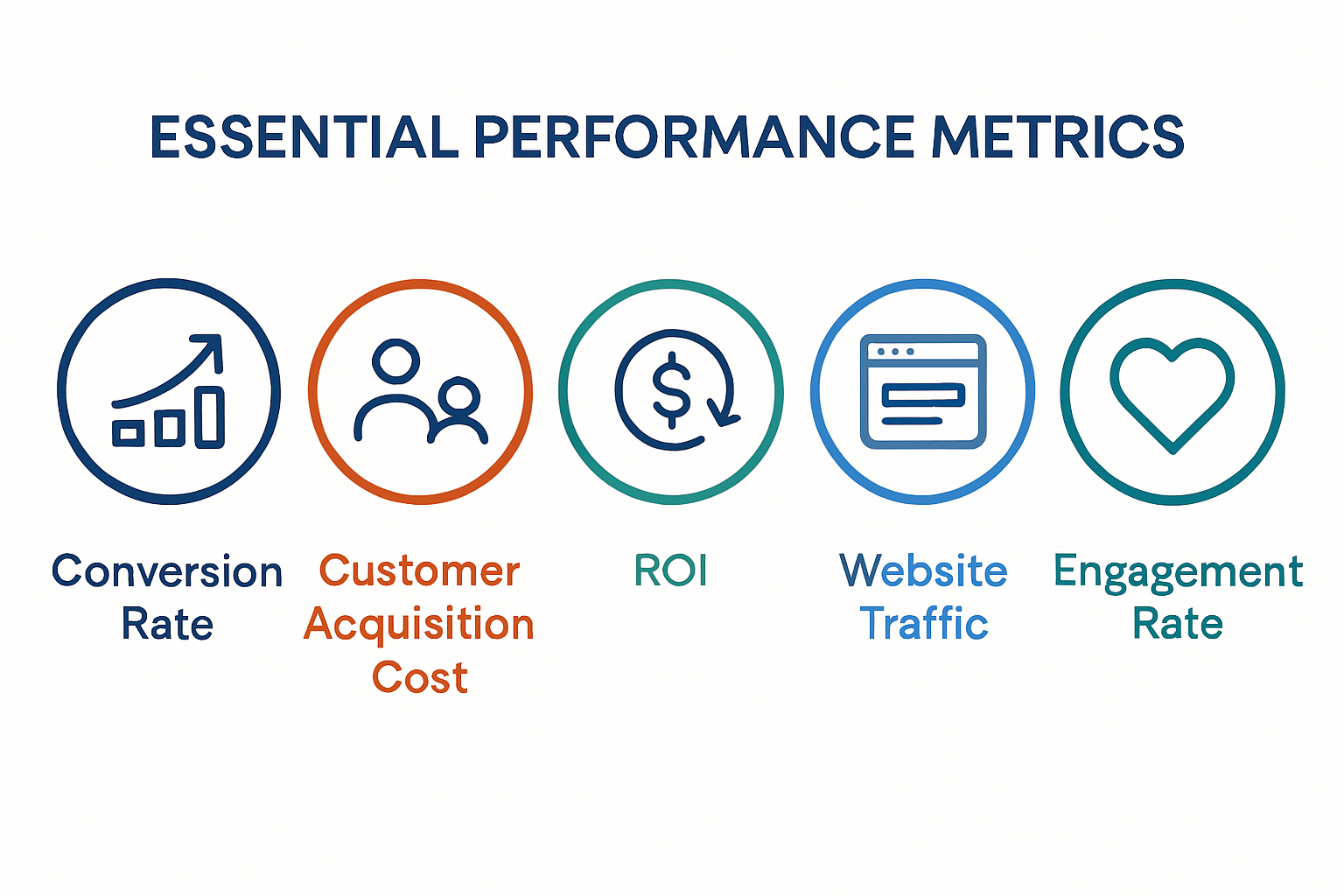
- Conversion Rate: Percentage of visitors completing desired actions
- Customer Acquisition Cost: Total expense of acquiring a new customer
- Return on Investment (ROI): Net profit generated from marketing expenditures
- Website Traffic: Volume and quality of site visitors
- Engagement Rate: User interaction and time spent on digital platforms
Strategic Measurement Approaches
Effective KPI tracking transcends mere number collection. Marketing teams must develop sophisticated measurement frameworks that contextualize raw data and translate metrics into actionable strategic insights.
For different business types, prioritized KPIs might include:
- E-commerce: Average order value, cart abandonment rate
- B2B Services: Lead generation rate, sales cycle length
- Content Marketing: Organic traffic, content shares
- Software Companies: Trial-to-paid conversion rate
Explore advanced SEO keyword optimization techniques that can enhance your performance tracking capabilities. By continuously monitoring and interpreting these critical metrics, businesses can refine their digital marketing strategies, maximize resource allocation, and drive sustainable growth.
To clarify the purpose and value of the most essential digital marketing KPIs, the following table summarizes each metric and what it measures.
| KPI | What It Measures |
|---|---|
| Conversion Rate | Percentage of visitors who complete a desired action |
| Customer Acquisition Cost | Total expense to acquire a new customer |
| Return on Investment (ROI) | Net profit generated from marketing expenditures |
| Website Traffic | Volume and quality of site visitors |
| Engagement Rate | User interaction and time spent on digital platforms |
| Average Order Value | Average amount spent per transaction (e-commerce) |
| Lead Generation Rate | Number of qualified leads generated (B2B, services) |
| Sales Cycle Length | Time taken to convert a prospect into a customer |
Understanding the Relationship Between KPIs and Business Goals
Digital marketing KPIs are more than isolated metrics they are strategic connectors bridging individual marketing activities with overarching business objectives. The alignment between KPIs and business goals creates a powerful framework for organizational success and sustainable growth.
Strategic Alignment Framework
Effective KPI development requires a systematic approach that translates broad business aspirations into measurable, actionable indicators. This process involves creating a direct, quantifiable link between marketing efforts and organizational outcomes.
Key considerations in establishing this alignment include:
- Goal Specificity: Clearly defined, measurable business objectives
- Metric Relevance: Direct correlation between KPIs and strategic targets
- Contextual Understanding: Recognizing how individual metrics contribute to broader outcomes
- Adaptive Measurement: Flexibility to modify KPIs as business landscapes evolve
Practical Implementation Strategies
Businesses can create meaningful KPI connections through a structured approach that breaks down complex goals into trackable components. For instance, a company seeking market expansion might develop KPIs that capture:
- New market penetration rates
- Customer acquisition costs in target segments
- Conversion rates across different demographic groups
- Revenue growth from emerging market channels
Discover advanced ranking strategies that can help refine your goal alignment process. By establishing a robust connection between marketing KPIs and business objectives, organizations can transform data into a strategic asset that drives informed decision making and sustainable competitive advantage.

Real-World Examples of Effective Use of Digital Marketing KPIs
MIT Sloan research reveals how leading companies transform digital marketing KPIs from abstract metrics into powerful strategic tools that drive measurable business outcomes.
Industry-Specific KPI Success Stories
Targeted KPI implementation demonstrates the profound impact of strategic metric tracking across diverse business sectors. By selecting precise performance indicators, organizations can unlock unprecedented insights and competitive advantages.
Notable examples showcase KPI effectiveness in various industries:
- E-commerce: Tracking customer lifetime value and conversion rates
- SaaS Companies: Monitoring user acquisition cost and retention metrics
- B2B Services: Analyzing lead generation and sales cycle length
- Digital Marketing Agencies: Measuring client ROI and campaign performance
Transformative KPI Implementation Strategies
This is the work we do for you. Every week, without exception.
Managing GBP at this level takes 6–8 hours a week when done right. Nova handles the entire system — posts, photos, reviews, Q&A, citations, heatmap tracking — so you can focus on running your business.
Successful companies approach KPI tracking as a dynamic, evolving process that requires continuous refinement and strategic alignment. Real-world implementations demonstrate how businesses can leverage digital marketing metrics to drive meaningful growth.
Companies like Slack and Adidas have demonstrated remarkable KPI strategies:
- Slack focuses on awareness metrics and sales pipeline acceleration
- Adidas America utilizes net promoter score to measure customer relationships
- Technology firms track user engagement and product adoption rates
- Global brands develop cross-channel performance measurement frameworks
Explore our proven marketing case studies to understand how strategic KPI implementation drives tangible business results. By treating digital marketing metrics as strategic assets, businesses can transform data into actionable insights that propel sustainable growth and competitive advantage.
Turn KPI Insights Into Powerful Growth With a Proven Agency Partner
If you are overwhelmed by scattered digital marketing metrics and can’t see how your KPIs translate into real business growth, you are not alone. Many businesses struggle to connect campaign data like conversion rates and ROI to actual improvements in visibility, leads, and revenue. You’ve learned in this article just how critical it is to track and align digital marketing KPIs with your actual business goals—now it’s time to act on those insights and get real results.

Unlock your growth potential with support from experts who transform raw performance data into actionable marketing strategies. Our team at 12AM Agency has helped businesses in legal, dental, automotive, franchise, and enterprise industries turn KPIs into winning strategies. Discover how our approach to SEO, PPC, and AI-driven solutions has changed outcomes for our clients by exploring our latest case studies. When you are ready to boost your ROI and see the benefits of data-driven marketing, schedule your consultation today and experience growth that is driven by your most important metrics. Now is the best time to move from understanding benchmarks to outperforming them.
Frequently Asked Questions
What are digital marketing KPIs?
Digital marketing KPIs (Key Performance Indicators) are measurable metrics that organizations use to evaluate the effectiveness of their online marketing strategies and track performance against business objectives.
Why are KPIs important for digital marketing?
KPIs are essential because they enable businesses to make informed decisions, optimize marketing expenditures, and demonstrate the return on investment (ROI) of their marketing efforts, ultimately driving business growth. setting marketing goals for small business is a crucial step in determining what success looks like. By clearly defining these objectives, entrepreneurs can align their strategies to meet specific targets and effectively allocate resources. This focus not only enhances accountability but also fosters a culture of continuous improvement within the organization.
How can businesses choose the right KPIs for their marketing campaigns?
Businesses should select KPIs that align closely with their specific business objectives, ensuring that each metric provides actionable insights into campaign performance and contributes to broader organizational goals.
What are some common digital marketing KPIs to track?
Common digital marketing KPIs include conversion rate, customer acquisition cost, return on investment (ROI), website traffic, and engagement rate. These metrics collectively provide a comprehensive view of marketing effectiveness.
Recommended
- Unlock Growth: Essential Digital Marketing Strategies for Small Business Owners in 2025 | 12AM Agency
- What Is Digital Marketing? Essential Guide for Business Growth 2025 | 12AM Agency
- Top Digital Marketing Trends 2025 for Business Growth | 12AM Agency
- SEO Keyword Analyzers: Tools to Boost Your Rankings | 12AM Agency

