




How to check keyword density is a question that intrigues many website owners looking to optimize their site’s SEO strategy. Checking keyword density involves evaluating how often a keyword appears on your webpage, expressed as a percentage in relation to other words. Although once a critical factor in SEO, keyword density has now taken a backseat due to algorithm updates. However, understanding and analyzing it is still vital to ensure you’re not inadvertently overusing keywords and risking penalties.
Here’s how you can effectively verify keyword density on your webpage:
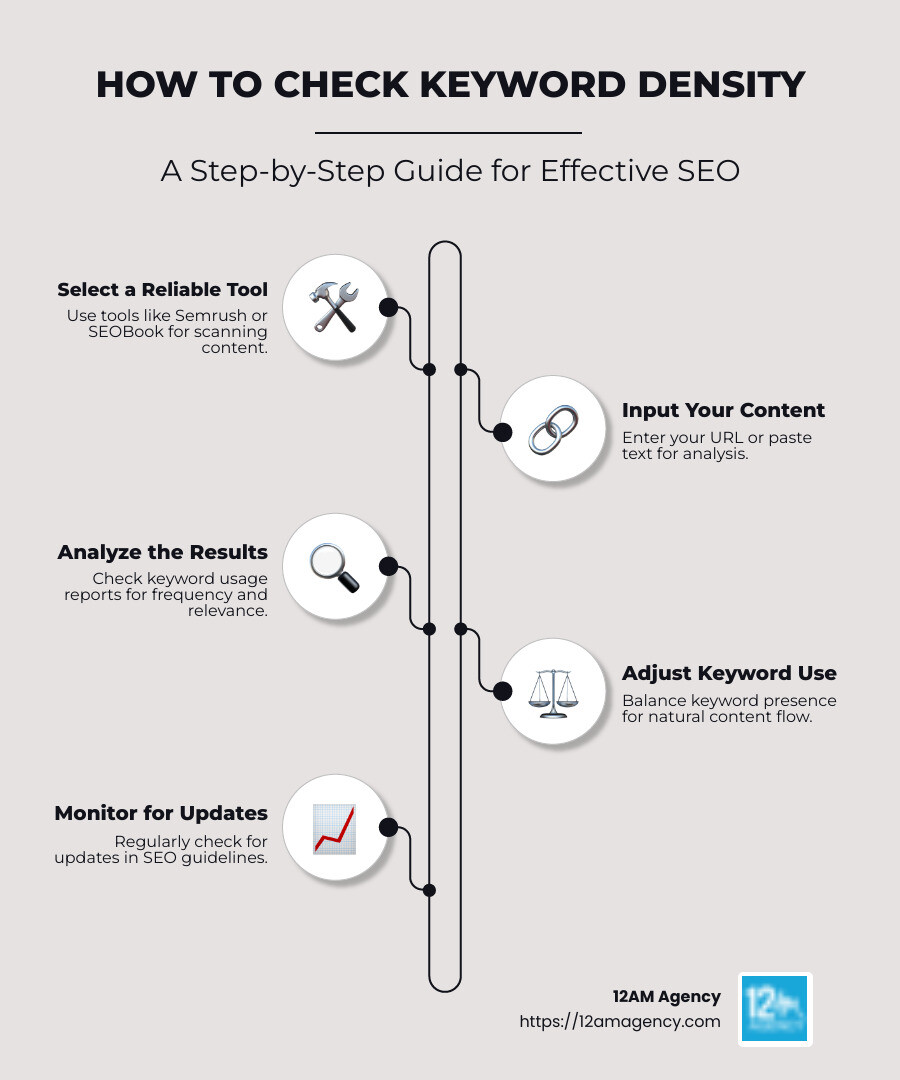
- Select a reliable SEO tool – Tools like Semrush or SEOBook can effortlessly scan your content.
- Input your URL or simply paste your text – Let the tool run an automatic analysis.
- Review the results – Look at keyword usage reports that show where your keywords are appearing too frequently or scarcely.
- Adjust accordingly – Balance your keyword presence to align it more naturally with your content flow.
Now, who am I? I’m Robert Portillo, your guide through this digital maze. With years of business and engineering expertise, I’ve helped many like you learn to efficiently steer challenges like how to check keyword density. Let’s dig deeper into optimizing your SEO blueprint.
Simple guide to how to check keyword density terms:
– how many keywords for seo
– seo keyword analyzer
– text analyzer tool
What is Keyword Density?
Keyword density, also known as keyword frequency, is a measure of how often a specific keyword appears on a webpage relative to the total word count. It’s usually expressed as a percentage. For instance, if your webpage contains 1,000 words and your keyword appears 10 times, the keyword density is 1%.
Why Does Keyword Density Matter?
Keywords are the backbone of any SEO strategy. They help search engines understand the content of your page and match it with user queries. However, keyword density alone isn’t the magic bullet it once was. Search engines like Google now use complex algorithms that consider various factors, not just keyword frequency, to rank webpages.
That said, maintaining an optimal keyword density can still help you avoid keyword stuffing, a practice that search engines penalize. Keyword stuffing is when a webpage is overloaded with keywords in an attempt to manipulate search rankings. This tactic can lead to penalties or even removal from search engine results pages (SERPs).
Understanding TF-IDF
A more nuanced approach to keyword analysis is the TF-IDF model, which stands for “term frequency-inverse document frequency.” This method assesses how important a keyword is by comparing its frequency on a specific page (TF) against its occurrence across multiple pages on your site (IDF).
- Term Frequency (TF): Measures how often a keyword appears on a single page.
- Inverse Document Frequency (IDF): Evaluates how unique or rare the keyword is across various pages.
The closer the IDF value is to 1, the more unique the keyword is to a specific page. Conversely, a value closer to 0 indicates that the keyword appears across many pages. This balance helps determine the relevance of a keyword for specific content.
By understanding both keyword density and TF-IDF, you can create content that is not only optimized for search engines but also valuable to your readers. This approach ensures that your website remains relevant and competitive in the changing digital landscape.
Next, we’ll explore the top tools available to check keyword density and how they can simplify this process.
See exactly where your profile stands right now.
Our GBP audit shows your current rank position across your market, how your profile completeness scores against competitors, and the specific gaps holding you back from the Map Pack.
Why Keyword Density Matters for SEO
Keyword density is more than just a number; it’s a crucial part of your SEO strategy. Let’s explore why it holds such significance:
The Role of Search Engines
Search engines, like Google, act as gatekeepers to the internet. They aim to deliver the most relevant and high-quality content to users. Keywords help search engines understand what your content is about. Although search algorithms have evolved, keywords remain a fundamental element.
High keyword relevance means your content is more likely to match what users are searching for. This relevance boosts your chances of appearing higher on search engine results pages (SERPs).
Keyword Relevance and User Intent
Understanding the intent behind a user’s search query is essential. For example, the keyword “best running shoes” suggests a user is looking for recommendations. If your content provides a comprehensive guide on running shoes, it aligns with this intent.
By aligning your content with user intent, you improve keyword relevance. This not only helps in ranking better but also in engaging users effectively.
Avoiding Keyword Stuffing
While keywords are important, overusing them can backfire. Known as keyword stuffing, this practice involves cramming keywords into your content to manipulate search rankings. It’s a black-hat SEO tactic and can lead to penalties from search engines.
Maintaining a balanced keyword density helps you avoid this pitfall. It ensures your content remains readable and valuable, both for search engines and users.
Case Study: Impact of Keyword Misuse
A website once relied heavily on keyword stuffing to rank for “cheap flights.” Initially, they saw a spike in traffic. However, after a Google algorithm update, their rankings plummeted. The site had to overhaul its content strategy, focusing on quality and relevance over sheer keyword frequency.
This example underscores the importance of using keywords wisely. Quality content that naturally incorporates keywords is more sustainable and effective in the long run.
Understanding why keyword density matters helps you craft an SEO strategy that is both effective and sustainable. Next, we’ll explore the top tools available to check keyword density and how they can simplify this process.
How to Check Keyword Density
Checking keyword density is a vital step in optimizing your content for search engines. It ensures you’re using keywords effectively without crossing into the dreaded field of keyword stuffing. Let’s look at some popular tools that can help you do this efficiently.
Keyword Density Checker Tools
Several tools are available to help you measure keyword density. These tools analyze your content to determine how often a keyword appears relative to the total word count. Here are some top choices:
- SEOBook: This tool provides a simple interface to calculate keyword density by analyzing the frequency of keywords in your text. It’s a straightforward option for those new to SEO.
- Copywritely: Known for its user-friendly design, Copywritely offers a quick overview of keyword density. It also provides suggestions for improving your content’s SEO performance.
- Semrush: A powerhouse in the SEO world, Semrush offers a comprehensive suite of tools. Its On-Page SEO Checker includes a keyword phrase usage feature, which assesses keyword density and compares it to your competitors. Although it comes at a premium, starting at $119.95/month, its robust features make it a worthy investment for serious marketers.
How to Use These Tools
Using a keyword density checker is straightforward:
- Enter Your Content: Paste your text or enter the URL of the webpage you want to analyze.
- Get Results: The tool will calculate the density of each keyword, showing how many times it appears.
- Analyze Suggestions: Some tools, like Semrush, provide optimization tips, such as adjusting keyword usage to match top-ranking pages.
Why Use These Tools?
Checking keyword density helps you maintain a balance. You want to ensure your content is keyword-rich enough to signal relevance to search engines, but not so dense that it becomes unreadable or triggers penalties.
By using these tools, you can refine your content strategy, ensuring it aligns with search engine guidelines and user expectations. This process not only improves your content’s SEO but also improves its overall quality, making it more engaging and informative for your audience.
Next, we’ll explore the top tools in more detail and how they can further aid in optimizing your keyword strategy.
Top Tools to Check Keyword Density
When it comes to checking keyword density, having the right tools can make all the difference. Let’s explore some of the top tools that can help you analyze and optimize your content effectively.
SEO Review Tools
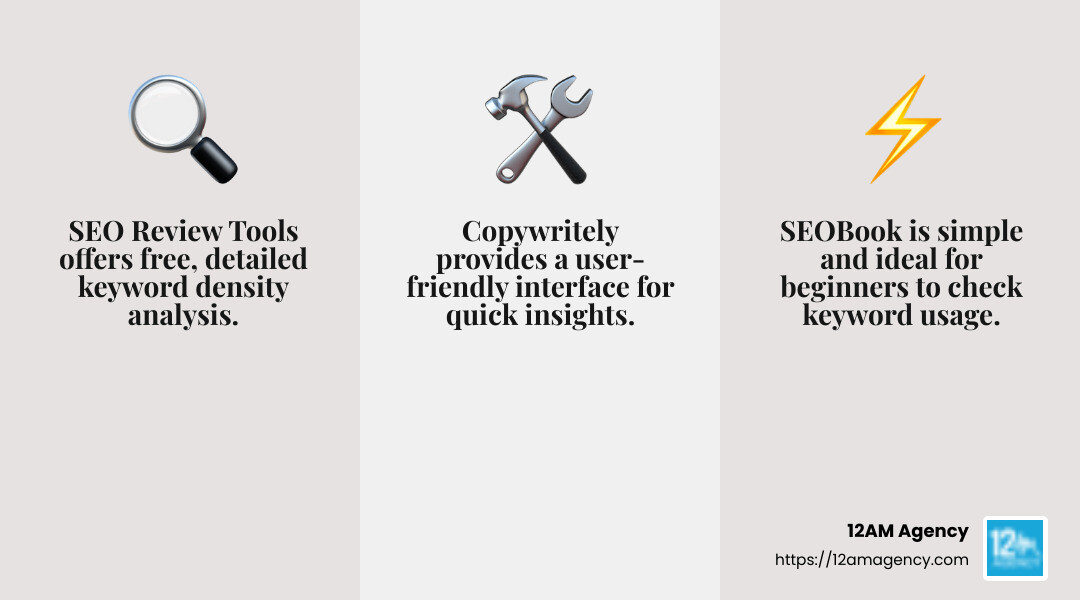
SEO Review Tools offers a free keyword density checker that is both simple and effective. It’s perfect for quick checks. Just paste your text or URL, and it will provide you with a detailed breakdown of keyword frequency and density. This tool is excellent for those who need a straightforward, no-frills approach to keyword analysis.
SEOBook
SEOBook provides a basic yet powerful keyword density tool. Known for its simplicity, it calculates the density by analyzing the frequency of keywords in your text. It’s particularly useful for beginners who are just getting started with SEO. You can quickly see which keywords are overused or underused, allowing for easy adjustments.
Copywritely
Copywritely stands out for its user-friendly interface and ease of use. It offers a quick snapshot of your keyword density and highlights areas for improvement. This tool is ideal for those who want a fast and intuitive way to check their content. You can even sign up for an account to gain insights into other SEO metrics and content errors.
Semrush
Semrush is a comprehensive SEO tool that offers much more than just keyword density checks. Its On-Page SEO Checker includes a feature called keyword phrase usage. This not only assesses your keyword density but also compares it with your competitors. While it comes at a premium price starting at $119.95/month, its extensive features make it a worthy investment for those serious about SEO.

How to Use These Tools
Using these tools is straightforward:
- Enter Your Content: Input your text or URL into the tool.
- Review Results: Examine the density of each keyword and see how often they appear.
- Follow Suggestions: Tools like Semrush offer tips on optimizing keyword usage based on top-ranking pages.
By leveraging these tools, you can ensure your content is optimized for search engines while maintaining readability and relevance. This balance is key to improving your site’s visibility and performance in search results.
Next, we’ll discuss how to improve your keyword density strategically.
How to Improve Your Keyword Density
Improving your keyword density is about balance. It’s not just about cramming as many keywords as possible into your content. Instead, aim for a natural flow that improves readability and search engine optimization.
Use Keyword Variants
Instead of repeating the same keyword, use keyword variants. These are slight variations or synonyms of your main keyword. For example, if your primary keyword is “organic traffic,” consider including variants like “natural website traffic” or “increase organic visitors.”
This approach not only helps in avoiding keyword stuffing but also broadens your content’s reach. It allows you to capture diverse search queries, appealing to a wider audience.
Write Natural Content
The most effective way to improve keyword density is by writing natural content. This means focusing on creating informative and engaging material. When your content flows naturally, keywords tend to fit in seamlessly.
Think about your audience and what they want to read. Answer their questions and address their needs. This way, keywords will naturally occur without feeling forced. Search engines like Google prioritize quality content that provides value to readers.
Avoid Keyword Stuffing
Keyword stuffing is an outdated SEO tactic where a webpage is overloaded with keywords. This can lead to penalties from search engines, causing your site to drop in rankings or even disappear from results.
To avoid this, follow a simple rule: aim for a keyword density of around 1-2%. This means your keyword should appear once or twice for every 100 words.
Example: If your article is 500 words long, your main keyword should appear 5-10 times. This keeps your content reader-friendly and SEO-compliant.
Balance and Optimize
Improving keyword density is about finding the right balance. Use tools like Semrush to analyze your content and get suggestions on keyword usage. Check how your competitors are doing it, and adjust your strategy accordingly.
By focusing on keyword variants and writing naturally, you can improve your keyword density without falling into the trap of keyword stuffing. This strategic approach will improve your content’s visibility and effectiveness in search engine results.
This is the work we do for you. Every week, without exception.
Managing GBP at this level takes 6–8 hours a week when done right. Nova handles the entire system — posts, photos, reviews, Q&A, citations, heatmap tracking — so you can focus on running your business.
Next, we’ll tackle some frequently asked questions about keyword density, including what a 2% keyword density means and how to check keyword consistency.
Frequently Asked Questions about Keyword Density
What is a 2% keyword density?
A 2% keyword density means that your chosen keyword appears twice for every 100 words in your content. To calculate this, use the keyword density formula: divide the number of times the keyword appears by the total number of words, then multiply by 100 to get a percentage.
Example: If you have a 500-word article and your keyword appears 10 times, the calculation is ( \frac{10}{500} \times 100 = 2\% ). This balance ensures your content is optimized without risking keyword stuffing.
How to check keyword consistency?
Keyword consistency is about maintaining a steady use of your keywords throughout your content. Tools like SERPWizz can help with keyword analysis, ensuring that your keywords are evenly distributed and relevant to your topic.
By analyzing your content with these tools, you can see if your keywords are used consistently and make adjustments as needed. This helps in maintaining a natural flow and avoiding overuse, which can lead to penalties from search engines.
What is keyword stuffing?
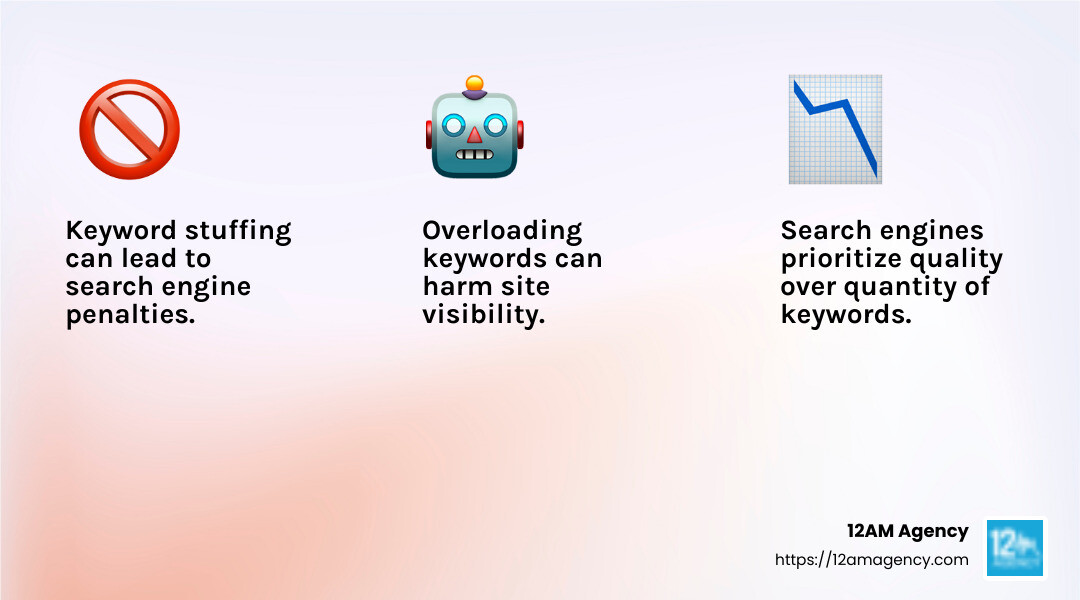
Keyword stuffing is a black-hat SEO technique where a webpage is overloaded with keywords to manipulate search rankings. This outdated strategy can lead to search engine penalties, causing your page to drop in rankings or be removed from results entirely.
Search engines like Google are smart. They prioritize quality content over keyword-laden text. So, it’s crucial to avoid stuffing your content with keywords. Instead, aim for a natural keyword density—around 1-2%—to keep your content reader-friendly and compliant with SEO best practices.
These FAQs cover the essentials of keyword density. Next, we’ll explore how to leverage top tools to check your keyword density and optimize your content effectively.
Conclusion
As we wrap up our exploration of keyword density and its role in SEO, it’s clear that understanding and managing this aspect of your content is crucial for digital success. At 12AM Agency, we specialize in crafting personalized, results-driven strategies that cater to your unique business needs. Our expertise in digital marketing, including SEO, PPC, website design, and mobile app development, positions us as your ideal partner in navigating the complexities of online visibility.
Our approach is simple: we focus on creating high-quality, user-friendly content that naturally incorporates keywords. By doing so, we help you avoid the pitfalls of keyword stuffing and ensure that your digital presence aligns with search engine best practices.
If you’re looking to improve your SEO strategy and improve your online presence, let us guide you with our custom solutions. Find how we can help you achieve your business goals with our comprehensive digital marketing services.
Ready to take your SEO to the next level? Explore our Keyword Density Checker and see how we can optimize your content for better search engine rankings.

