




Every digital success story starts with the right keywords. It sounds simple, but 72 percent of businesses target the wrong search terms and miss out on valuable traffic. Most people assume keyword selection is all about guessing popular phrases or chasing high search volumes, but the truth is, strategic keyword planning is less about luck and more about precise, data-driven steps that directly impact real business growth.
Table of Contents
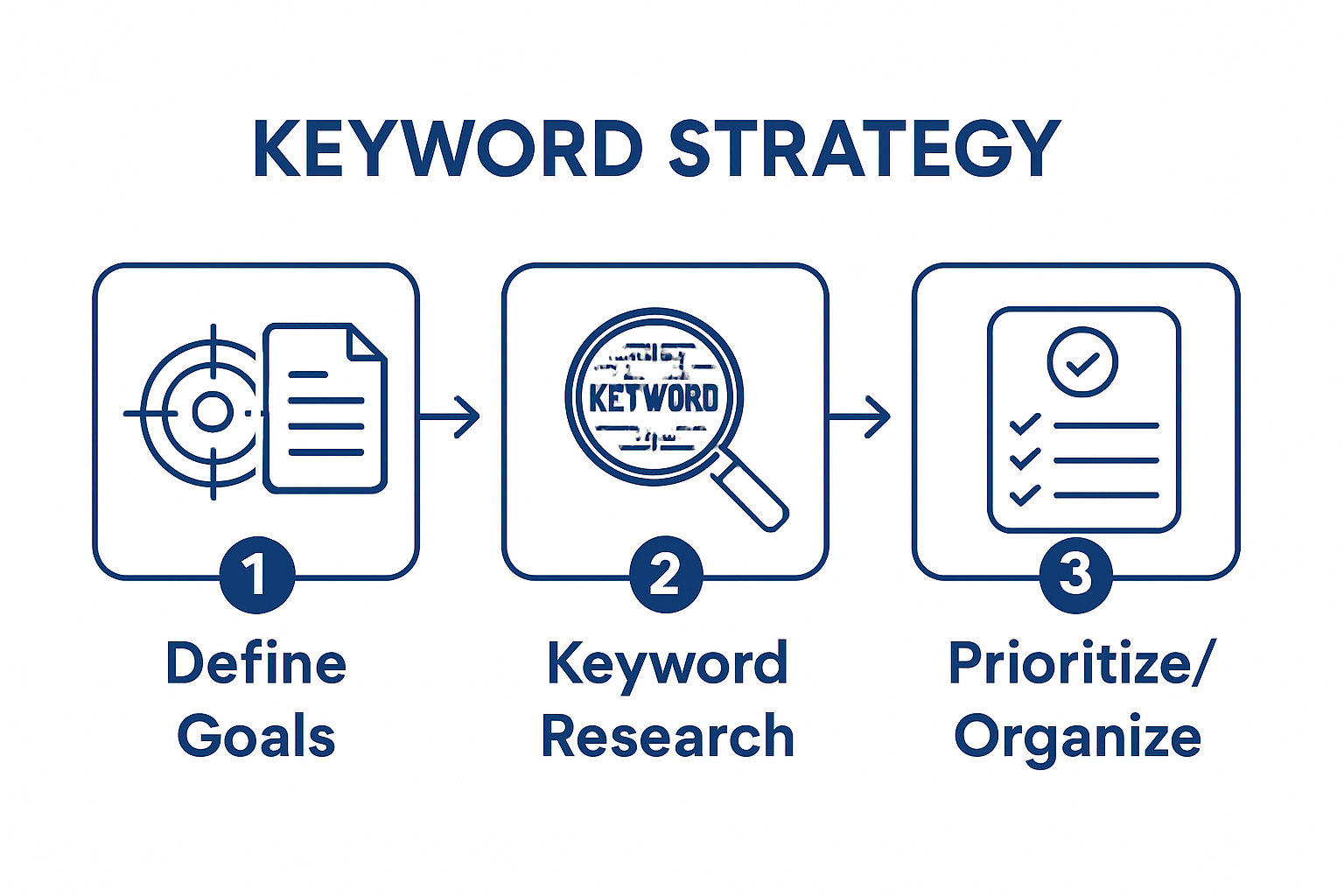
- Step 1: Define Your Business Goals And Target Audience
- Step 2: Conduct Comprehensive Keyword Research
- Step 3: Analyze Competitor Keyword Strategies
- Step 4: Evaluate Keyword Relevance And Search Intent
- Step 5: Prioritize And Organize Your Selected Keywords
- Step 6: Implement And Monitor Keyword Performance
Quick Summary
| Key Point | Explanation |
|---|---|
| 1. Define Clear Business Goals | Articulate specific objectives to guide keyword research effectively. This ensures targeted strategies that align with desired outcomes. |
| 2. Conduct Thorough Keyword Research | Use tools like Google Keyword Planner to identify relevant keywords that reflect user intent. This forms the basis of a strategic marketing approach. |
| 3. Analyze Competitor Keywords | Evaluate the keywords your competitors rank for, revealing opportunities for differentiation and better content strategies. |
| 4. Assess Keyword Relevance and Intent | Match keywords with user intent to ensure your content meets audience expectations and achieves business goals effectively. |
| 5. Monitor and Adapt Keyword Performance | Regularly evaluate keyword effectiveness and adapt strategies based on performance data to ensure ongoing digital growth. |
Step 1: Define Your Business Goals and Target Audience
Successful keyword selection starts with crystal clear strategic planning. Before diving into complex digital marketing tactics, you must understand exactly what you want to achieve and who you want to reach. This foundational step transforms random keyword hunting into a precision-targeted approach that drives meaningful business growth.
Begin by articulating your specific business objectives with surgical precision. Are you seeking to increase online sales, generate qualified leads, boost brand awareness, or establish thought leadership in your industry? Each goal demands a nuanced keyword strategy. For instance, lead generation keywords differ dramatically from transactional purchase-intent keywords. Precise goal definition is the compass that guides your entire keyword research process.
Next, construct a detailed target audience profile that goes beyond basic demographics. Understand not just age and location, but psychographic characteristics including pain points, aspirations, online behaviors, and information consumption patterns. Professional service providers in legal, dental, automotive, and franchise sectors need granular audience insights. Consider creating a comprehensive persona that represents your ideal customer.
To refine your audience understanding, leverage tools like Google Analytics, social media audience insights, and customer surveys. Learn more about creating comprehensive audience personas in our DIY SEO audit guide. These resources help you uncover critical details about how your potential customers search, what language they use, and what solutions they seek online.
Verification is crucial. Your goals and audience profile are complete when you can answer these key questions:
- What specific, measurable outcome are you targeting?
- Who exactly are the customers most likely to help you achieve this outcome?
- What keywords would this specific audience use to find solutions like yours?
This meticulous preparation transforms keyword research from a guessing game into a strategic science, setting the stage for targeted digital growth that connects directly with your most valuable potential customers.
Below is a checklist table to help you verify if your business goals and audience profiles are sufficiently defined before moving ahead with keyword research.
| Verification Criteria | Completion Indicator |
|---|---|
| Specific, measurable business outcome targeted | Yes/No |
| Exact profile of most likely customers identified | Yes/No |
| List of keywords your audience would use to find solutions | Yes/No |
| Clear understanding of audience pain points and behaviors | Yes/No |
| Business objectives align with keyword strategy | Yes/No |
Step 2: Conduct Comprehensive Keyword Research
Keyword research transforms your digital strategy from guesswork into precision targeting. This critical step bridges the gap between your business goals and the actual search behaviors of your potential customers. Strategic keyword research uncovers the exact language your audience uses when seeking solutions like yours.
Start by generating an initial keyword list using multiple research approaches. Leverage tools like Google Keyword Planner, SEMrush, and Ahrefs to discover search volumes, competition levels, and related search terms. Pay special attention to long-tail keywords that reveal specific user intent. These more specific phrases often have lower competition and higher conversion potential, making them strategic gold for businesses in competitive sectors like legal services, automotive sales, and professional franchises.
See exactly where your profile stands right now.
Our GBP audit shows your current rank position across your market, how your profile completeness scores against competitors, and the specific gaps holding you back from the Map Pack.
Explore our comprehensive guide on keyword analysis tools to understand which platforms provide the most actionable insights for your specific industry. Remember that keyword research is not a one-time task but an ongoing process of refinement and adaptation.
Dive deeper by analyzing your competitors’ keyword strategies. Examine the search terms driving traffic to their websites, identifying gaps and opportunities in their approach. Look beyond direct competitors and study industry leaders who consistently rank high in search results. Tools like SpyFu and Moz can provide detailed competitive keyword intelligence that reveals nuanced search strategies.
Verify the quality of your keyword research by checking these critical indicators:
- Average monthly search volume above 50 searches
- Keyword relevance to your specific business objectives
- Alignment with your target audience’s search intent
- Reasonable competition levels for your domain authority
Your keyword research is complete when you have a robust list of terms that balance search volume, relevance, and strategic alignment with your business goals. This meticulously curated keyword collection becomes the foundation for all subsequent content and digital marketing efforts.
Step 3: Analyze Competitor Keyword Strategies
Competitor keyword analysis transforms your digital strategy from reactive to proactive. By understanding what keywords your competitors successfully target, you gain strategic insights that can dramatically accelerate your own digital growth. This step is not about copying, but about discovering untapped opportunities and understanding the competitive landscape.
Begin by identifying your top 3-5 direct competitors in the digital space.
Focus on businesses offering similar services or targeting comparable audience segments. Use tools like SEMrush, Ahrefs, and SpyFu to perform a comprehensive competitive keyword audit. These platforms reveal not just the keywords your competitors rank for, but also their content strategies, backlink profiles, and search engine positioning.
Discover advanced techniques for keyword analysis with our SEO keyword analyzer guide. Pay special attention to the types of keywords your competitors prioritize. Are they targeting broad, high-volume terms or specific long-tail keywords? Analyze their page titles, meta descriptions, content headings, and URL structures to understand their keyword integration strategies.
Look beyond surface-level rankings and examine the user intent behind competitor keywords. Professional service providers in legal, dental, automotive, and franchise sectors often miss nuanced search behaviors. For instance, a dental practice might discover that competitors are successfully targeting keywords around patient education, treatment explanations, or financing options – revealing content gaps you can strategically fill.
Verify the depth of your competitive keyword analysis by ensuring you can answer these critical questions:
- What keywords are driving the most organic traffic to competitor websites?
- Are there high-value keywords with moderate competition that your competitors have overlooked?
- How do your target keywords align with or differ from competitor strategies?
Successful competitor keyword analysis provides a roadmap for differentiation. It helps you identify content opportunities, understand market positioning, and develop a keyword strategy that sets you apart from the competition.
Step 4: Evaluate Keyword Relevance and Search Intent
Keyword relevance goes far beyond simple search volume. True digital growth emerges when you align keywords precisely with user intent and your specific business objectives. This critical step transforms random keyword selection into a strategic targeting mechanism that connects directly with potential customers.
Classify search intent into four primary categories: informational, navigational, commercial, and transactional. Understanding these nuanced intent levels allows you to match keywords with content that meets exact user expectations. For professional service providers in legal, dental, automotive, and franchise sectors, this means crafting content that speaks directly to potential clients at different stages of their decision-making journey.
Learn more about optimizing keyword density and relevance in our comprehensive SEO guide. Leverage tools like Google Search Console and Google Analytics to understand how users currently interact with your content. Examine metrics like click-through rates, time on page, and bounce rates to validate keyword relevance and alignment with user expectations.
Develop a sophisticated keyword scoring system that evaluates potential terms across multiple dimensions. Consider factors like search volume, competition level, commercial intent, and alignment with your specific business goals. A keyword scoring matrix helps you objectively rank and prioritize terms, moving beyond gut feeling to data-driven decision making.
Verify the effectiveness of your keyword relevance evaluation by confirming these critical indicators:
- Keywords directly reflect your target audience’s language and search behaviors
- Content matching selected keywords provides genuine value and answers user questions
- Selected keywords demonstrate clear commercial or informational intent
- Chosen keywords have reasonable competition levels relative to your domain authority
Successful keyword relevance evaluation creates a strategic bridge between user search behaviors and your digital content, ensuring that every piece of content you create has a precise, targeted purpose in your overall digital growth strategy.
Below is a table summarizing the four primary search intents and how they align with different types of user needs based on information in the guide.
| Search Intent Type | Description | Content Example |
|---|---|---|
| Informational | Seeks knowledge or answers to questions | Blog posts, guides |
| Navigational | Looks for a specific website or page | Company homepage |
| Commercial | Researches products or services for possible purchase | Product comparisons |
| Transactional | Ready to complete a purchase or take action | Service booking, online buying |
Step 5: Prioritize and Organize Your Selected Keywords
Keyword organization transforms raw data into a strategic digital marketing roadmap. This crucial step converts your extensive keyword research into a targeted, actionable plan that maximizes your digital growth potential. Think of this process as creating a precise navigation system for your content strategy.
Begin by developing a sophisticated keyword hierarchy that segments terms based on strategic importance, search volume, and user intent. Categorize keywords into primary, secondary, and supporting tiers. Primary keywords represent your core business offerings, secondary keywords target specific service variations, and supporting keywords capture long-tail search opportunities. For professional service providers in legal, dental, automotive, and franchise sectors, this nuanced approach ensures comprehensive digital coverage.
Explore our comprehensive guide on finding the perfect keyword balance. Use advanced spreadsheet techniques to create a keyword matrix that tracks critical metrics. Include columns for search volume, competition level, potential click-through rates, and alignment with specific business objectives. This data-driven approach allows you to make informed decisions about keyword prioritization and content strategy.

Implement a dynamic keyword mapping strategy that assigns specific keywords to individual web pages, blog posts, and content assets. Avoid keyword cannibalization by ensuring each page targets unique keyword clusters. This prevents internal competition and helps search engines understand the precise focus of each piece of content. Professional marketers use tools like Google Sheets or specialized SEO platforms to maintain this intricate keyword mapping system.
Verify the effectiveness of your keyword organization by confirming these critical indicators:
- Each keyword is strategically mapped to a specific content asset
- Keywords are prioritized based on business goals and search potential
- No duplicate keyword targeting exists across your digital content
- Keyword distribution supports a comprehensive content strategy
Successful keyword organization creates a strategic framework that guides your entire digital marketing approach, transforming random keyword selection into a precision-targeted growth mechanism.
Step 6: Implement and Monitor Keyword Performance
Keyword implementation is a dynamic process that transforms strategic research into measurable digital growth. This critical phase moves beyond planning, actively deploying your carefully selected keywords across digital platforms while establishing robust monitoring mechanisms to track performance and adapt strategies in real-time.
Begin by integrating keywords strategically across your digital ecosystem. This means thoughtfully incorporating primary, secondary, and supporting keywords into website content, blog posts, meta descriptions, page titles, and headers. Professional service providers in legal, dental, automotive, and franchise sectors must ensure keyword placement feels natural and provides genuine value to readers. Avoid keyword stuffing by maintaining a conversational, authentic tone that prioritizes user experience over search engine manipulation.
This is the work we do for you. Every week, without exception.
Managing GBP at this level takes 6–8 hours a week when done right. Nova handles the entire system — posts, photos, reviews, Q&A, citations, heatmap tracking — so you can focus on running your business.
Explore our comprehensive guide on checking and improving keyword density. Leverage advanced analytics tools like Google Search Console, SEMrush, and Google Analytics to track keyword performance metrics. Monitor key indicators such as organic search rankings, click-through rates, page views, and conversion rates. These data points reveal how effectively your chosen keywords connect with target audiences and drive meaningful engagement.
Establish a quarterly keyword performance review process that allows for strategic pivots. Digital marketing demands continuous adaptation. Regularly analyze which keywords generate the most valuable traffic, identify emerging search trends, and be prepared to refine your approach. Professional marketers treat keyword strategy as a living document, making incremental adjustments based on real-world performance data.
Verify the effectiveness of your keyword implementation by confirming these critical indicators:
- Keywords consistently appear in top 20 search engine results
- Organic traffic increases month over month
- Conversion rates demonstrate positive correlation with keyword strategy
- Content remains engaging and valuable to human readers
Successful keyword performance monitoring transforms your digital strategy from a static plan into a dynamic, responsive growth mechanism that continuously evolves with your business and market conditions.
Transform Keyword Strategy Into Real Digital Growth
Are you feeling overwhelmed by the complex process of choosing keywords that actually move the needle for your business? You are not alone. Many businesses struggle to turn research and analysis into results. The article highlights the frustration of random keyword hunting, missed user intent, and the pitfalls of generic, unfocused strategies. If you have spent time defining your goals, researching competitors, and organizing keywords but still are not seeing growth or high-value leads, it is time for a partner that turns insights into revenue.
Let your keywords work harder for you. At 12AM Agency, our expert team takes your audience data and keyword insights and turns them into SEO strategies that rank, convert, and scale. We blend industry experience with cutting-edge AI tools to prioritize high-intent search terms, maximize your online visibility, and outsmart the competition. Do not let another quarter go by without a clear, actionable plan. Connect with us today to unlock tailored solutions designed for your industry and business goals. Make your next step the most confident one yet—reach out now and discover how we can help you achieve measurable digital growth.
Frequently Asked Questions
How do I define my business goals for keyword selection?
To define your business goals for keyword selection, clearly articulate what you wish to achieve, such as increasing online sales, generating leads, or enhancing brand awareness. This clarity is essential for aligning keywords with your specific business objectives.
What tools can I use for keyword research?
You can use tools like Google Keyword Planner, SEMrush, and Ahrefs to conduct keyword research. These platforms help identify search volumes, competition levels, and related terms that can inform your keyword strategy effectively.
How can I analyze my competitors’ keyword strategies?
To analyze your competitors’ keyword strategies, identify your top competitors and use tools like SEMrush or Ahrefs to perform a keyword audit. This will reveal the keywords they rank for and provide insights into their content and positioning strategies in the market.
How do I evaluate keyword relevance and search intent?
You can evaluate keyword relevance and search intent by categorizing keywords into informational, navigational, commercial, and transactional intents. Use analytics tools to assess user engagement, click-through rates, and content alignment with user expectations.

