




Two patients in Dallas search “best dentist near me” at the same moment from the same neighborhood. Both logged into Google accounts. Both on iPhones.
Patient A sees Dr. Martinez at the top.
Patient B sees Dr. Chen.
Neither dentist outranked the other in any way that a rank tracker would catch. They both ranked #1. For different people.
That’s Personal Intelligence. It rolled out at Google I/O 2026 to roughly 200 countries. And it just made the central metric of the SEO industry — keyword rank position — partially obsolete.
What Personal Intelligence actually does
Personal Intelligence is Google’s framework for pulling a user’s own data into the AI’s answer-generation process. The system is now reading from four primary sources:
Gmail. What the user has been corresponding about, what businesses they’ve already engaged with, what topics they care about right now.
Google Photos. Where they’ve been, what they own, what they’ve recently photographed. (A photo of your bathroom remodel changes what “best contractor” looks like for you.)
YouTube history. What they watch, what creators they trust, what topics they’ve shown sustained interest in.
See exactly where your profile stands right now.
Our GBP audit shows your current rank position across your market, how your profile completeness scores against competitors, and the specific gaps holding you back from the Map Pack.
Search history. Every prior query, every prior click, every prior session.
All four streams feed into the AI that generates the answer. Two users with different histories asking the same question now get different answers — different sources cited, different businesses surfaced, different framing entirely.
Google’s head of Search, Liz Reid, said it directly on the I/O stage: “The results that I see are going to be totally different from the results that you see for a lot of queries.”
Universal rankings, as a concept, are over.
Why this breaks rank tracking
The SEO industry has been built on a measurement assumption: that there’s a stable, observable, universal ranking position for any given query, and that moving up that ranking causes traffic. Rank trackers exist because of that assumption. Half the SEO industry’s reporting exists because of that assumption.
Personal Intelligence doesn’t just bend the assumption. It breaks it.
When two users get materially different results for the same query, “your rank” stops being a single number. It becomes a distribution. You might be #1 for users whose Gmail mentions you, #4 for users in your direct geographic area, #11 for users with prior history in your competitive set, and absent entirely for users who don’t match any signal Google reads as relevant to you.
Rank trackers still report something. They report your position for an idealized, history-free test user — basically a fresh browser with no prior signals. That’s a useful baseline. It’s not what real customers see.
This is why a client can rank #1 in every tool you check and still lose 25% of their organic traffic year over year. The tool is measuring something that no longer correlates well with the thing you care about.
The five metrics that matter now
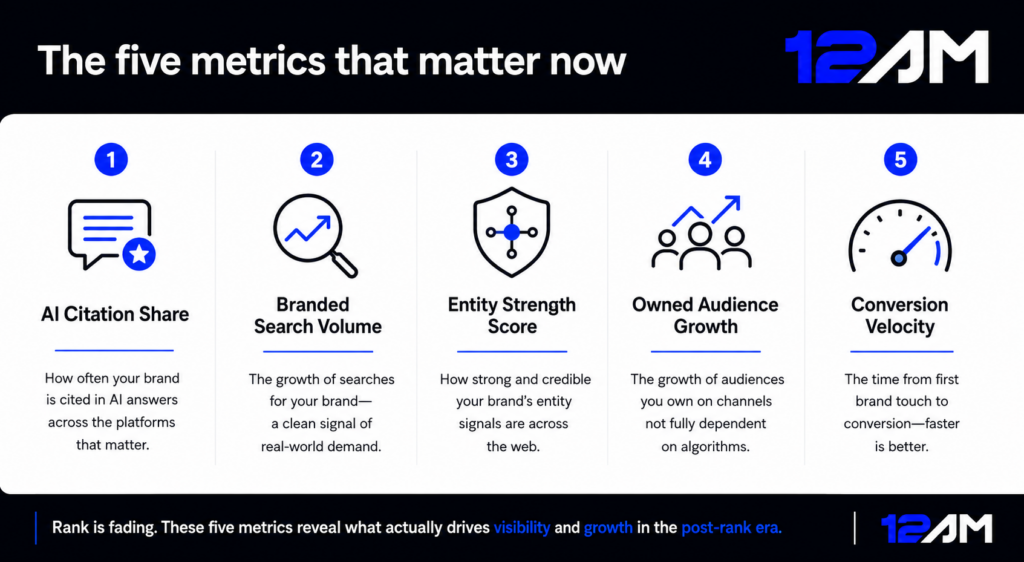
If rank position is partially obsolete, what replaces it? After a year of working with clients in legal, dental, home services, and franchise, we’ve settled on a five-metric framework that actually tracks visibility in the post-rank era.
1. AI Citation Share
How often is your brand cited inside AI answers across the systems that matter? Google AI Mode, Gemini, ChatGPT, Perplexity, and now Ask YouTube.
We measure this by running a defined set of target queries (typically 50-200 per client, covering the topics they want to own) against each AI system on a rolling cadence. We track citation frequency, citation position within answers, and citation context (positive, neutral, or comparative).
This is the new #1 ranking. If you’re not measuring it, you’re not measuring what matters.
2. Branded Search Volume
Even in a personalized world, branded queries are a clean signal. When someone types your business name specifically, they’re showing intent that Personal Intelligence didn’t manufacture for them. They knew you already.
Tracked through Google Search Console, Google Trends, and direct branded query volume, this is the leading indicator of how well your brand presence is compounding outside of Google’s own AI surfaces. Strong branded volume growth means your content and PR work is building a name that sticks in users’ heads independently. That’s durable in any algorithmic future.
3. Entity Strength Score
A composite of the signals that determine whether Google’s AI recognizes you as a credible entity at all. We weight:
- Knowledge Graph presence and completeness
- Schema coverage across the site (against the eight types in our schema guide)
- Third-party citations on credible domains
- Author and team-level entity signals (verified people, real bios, external profiles)
- Wikidata entries where applicable
- NAP consistency across the web
This is the foundation metric. Without entity strength, no amount of content or links will get you cited in AI answers. With it, every other metric becomes easier to move.
4. Owned Audience Growth
Email subscribers, SMS subscribers, app downloads, social followers on platforms where your reach isn’t fully algorithm-dependent.
When Google keeps the click, the only durable traffic is traffic you don’t need Google to deliver. Tracking this growth monthly is the single best way to insulate a business from whatever Google does next, including whatever they announce at I/O 2027.
5. Conversion Velocity
The time from first brand touch to conversion. Counterintuitive metric, but it’s the one that matters most in personalized search.
Here’s why: when AI answers reduce raw click volume, the clicks you do get are higher intent. The user has already been pre-qualified by the AI. They’ve already seen your brand cited. The conversion path shortens. If your conversion velocity is dropping (faster path to sale) while top-of-funnel traffic is also dropping, your AI visibility is working even when your rank tracker disagrees.
This is the metric that resolves the “we’re ranking but losing traffic” panic. Sometimes the loss is real. Sometimes it’s just a leaner funnel doing more with less.
Building the new measurement stack
If you’re a marketing leader or business owner reading this, here’s the practical setup.
Replace your monthly rank-tracking report with a monthly AI Visibility Report covering: AI citation share against your target query set, branded search volume trends, entity strength delta, owned audience growth, and conversion velocity.
This is the work we do for you. Every week, without exception.
Managing GBP at this level takes 6–8 hours a week when done right. Nova handles the entire system — posts, photos, reviews, Q&A, citations, heatmap tracking — so you can focus on running your business.
Keep rank tracking — but downgrade it. Track it quarterly for baseline diagnostic purposes, not monthly for performance assessment. It’s a vital sign, not a scoreboard.
Add quarterly review of competitive AI citation share. Who else is getting cited for your priority queries, and what’s changed? This is the equivalent of a competitive backlink audit, but for the layer that now matters more.
Set up persona-based test accounts. Create three or four Google profiles representing different customer types (different locations, different histories, different demographics) and periodically query your priority terms from each. This gives you a rough view of what your range of users actually sees, instead of the sanitized incognito view your old rank tracker delivers.
Why this matters for your service business
If you’re in legal, dental, home services, or franchise, here’s the specific implication.
Your highest-intent customers are increasingly going to find you through AI answers that were shaped by their own prior history. A patient who’s been researching dental implants for three weeks gets a different SERP than someone who’s never thought about it. A homeowner whose Gmail mentions a recent storm gets different storm-damage contractor results than someone with no such history.
You can’t game any of that. You can only build the entity strength, the topical depth, the schema foundation, and the AI citation share that gets you considered no matter which user the query came from. That’s the work.
The agencies still selling “we’ll get you to page one” are selling a metric that means less every quarter. The agencies measuring what we’ve laid out above are selling a strategy that compounds.
How 12AM measures what matters now
For every active 12AM client, we’ve moved to AI Visibility Reporting as the primary monthly deliverable. Rank tracking still shows up in the appendix, but the headline numbers are the ones we’ve described above.
If you’d like an honest look at how your business currently measures against this framework — and where you’d score on AI citation share, entity strength, and the rest — we’ll run a free AI Visibility Audit and walk you through the results.


