




Every business wants to stand out, but building a strong brand identity goes way beyond just picking a logo. Most people think branding is just about colors and fonts. But the truth is, defining your brand mission and values can set the entire direction for your company and actually drive every decision you make. The right brand identity is what turns a forgettable company into a name people trust and remember.
Table of Contents
- Step 1: Define Your Brand Mission And Values
- Step 2: Research Your Target Audience And Competitors
- Step 3: Create Your Unique Brand Voice And Messaging
- Step 4: Design Your Visual Brand Elements
- Step 5: Implement Your Brand Across All Platforms
- Step 6: Evaluate And Refine Your Brand Identity
Quick Summary
| Key Point | Explanation |
|---|---|
| 1. Define your brand mission clearly | Articulate not just what you do, but also why you do it to resonate with your audience’s core values. |
| 2. Conduct in-depth audience research | Develop detailed customer personas to understand motivations and challenges, enhancing your strategic brand approach. |
| 3. Establish a unique brand voice | Create a consistent brand voice that reflects your personality and aligns with your mission and audience preferences. |
| 4. Design cohesive visual elements | Ensure your color palette, typography, and imagery align with your brand’s identity for instant recognition. |
| 5. Regularly evaluate and refine your brand | Monitor brand performance with KPIs and adapt your strategy to stay relevant and aligned with market changes. |
Step 1: Define Your Brand Mission and Values
Creating a strong brand identity begins with understanding your fundamental purpose and core principles. Your brand mission and values serve as the foundational blueprint that guides every strategic decision and communication your business makes. This initial step is critical because it transforms your business from a mere transactional entity into a meaningful organization with a compelling narrative.
To effectively define your brand mission, start by asking yourself profound questions that probe the deeper motivations behind your business. What problem are you solving? Who are you serving? What unique perspective or approach do you bring to your industry? These questions help crystallize the authentic core of your business beyond just making money.
Consider crafting a mission statement that is concise yet powerful. This statement should articulate not just what you do, but why you do it. For example, instead of saying “We sell marketing services,” a more impactful mission might read: “We empower small businesses to achieve digital growth through innovative, data-driven marketing strategies.” Notice how this mission communicates purpose, target audience, and unique value proposition.
Defining your core values requires deep introspection about the principles that guide your business behaviors and decisions. These values represent your organizational personality and ethical framework. They might include commitments like integrity, innovation, customer-centricity, continuous learning, or social responsibility. Explore our guide on local business branding to understand how these foundational elements differentiate your brand.
To validate your mission and values, test them against real-world scenarios. Would these principles genuinely guide your team’s actions during challenging business decisions? Can your entire organization rally around these statements? If the answer is yes, you have successfully completed this crucial first step in creating a strong brand identity.
Remember, your brand mission and values are not static documents but living guidelines that should evolve with your business while maintaining their core authenticity. Regularly revisit and refine them to ensure they continue to reflect your organization’s evolving purpose and impact.
Step 2: Research Your Target Audience and Competitors
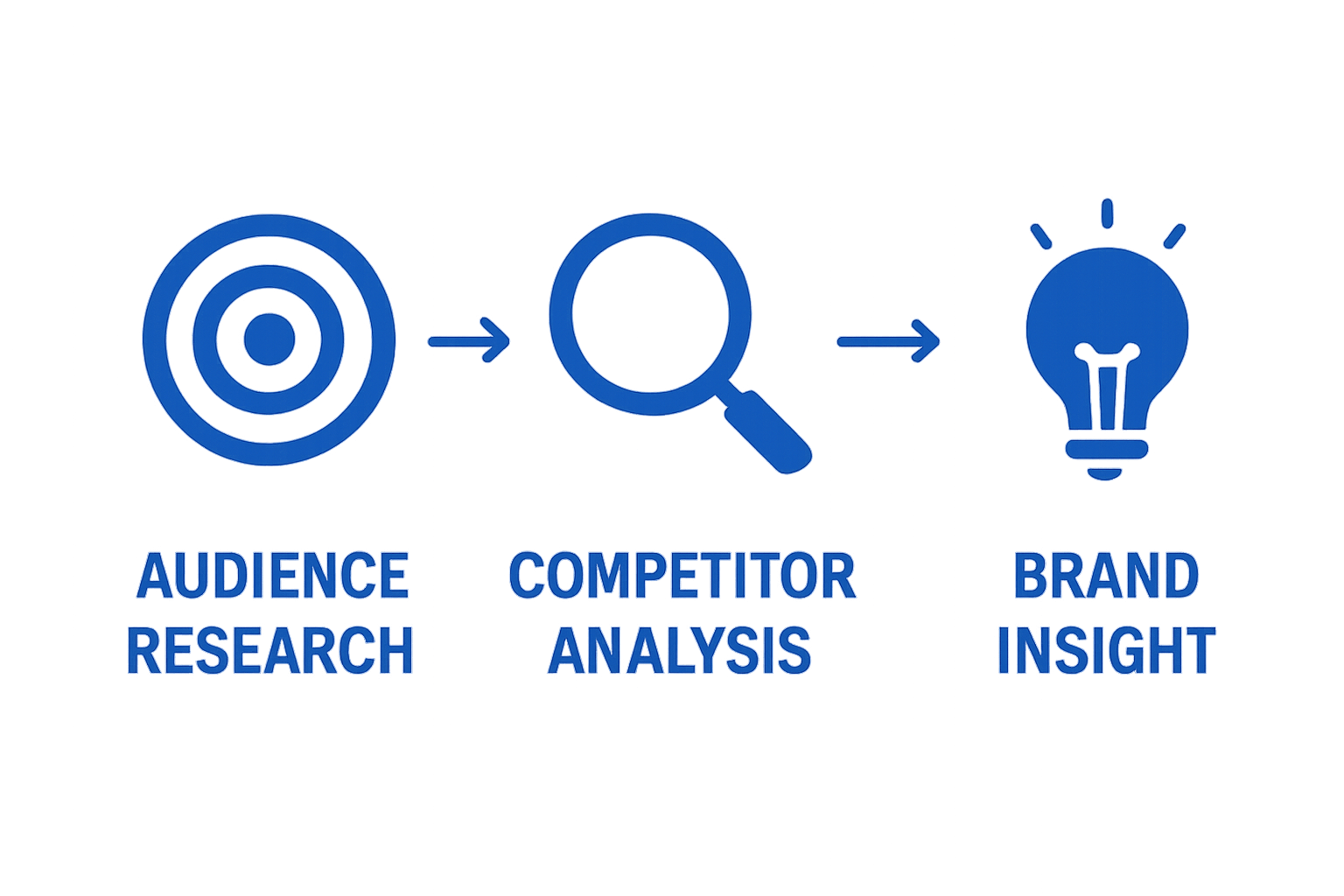
After establishing your brand mission and values, the next critical step in creating a strong brand identity is conducting comprehensive research on your target audience and competitive landscape. This step transforms your foundational vision into a strategic approach that resonates with potential customers and differentiates you in the marketplace.
Begin by developing detailed customer personas that go beyond basic demographic information. Understand not just who your customers are, but what drives their decisions, challenges, and aspirations. This means diving deep into psychographic elements like motivations, pain points, lifestyle preferences, and communication styles. Conduct surveys, interview existing customers, analyze social media interactions, and review customer support conversations to gather nuanced insights.
See exactly where your profile stands right now.
Our GBP audit shows your current rank position across your market, how your profile completeness scores against competitors, and the specific gaps holding you back from the Map Pack.
Simultaneously, engage in a thorough competitive analysis that examines not just direct competitors, but also peripheral brands that might indirectly compete for your audience’s attention. Learn more about advanced competitive analysis techniques to uncover strategic insights. Examine their brand messaging, visual identity, communication channels, and positioning. What narratives are they using? Where are potential gaps in their approach that your brand could uniquely fill?
Utilize digital tools to augment your research. Google Analytics, social media insights, customer relationship management (CRM) platforms, and specialized market research tools can provide quantitative data to supplement your qualitative research. Look for patterns in customer behavior, engagement metrics, and sentiment analysis that reveal deeper truths about your target market.
The goal of this research is not just to collect data, but to develop a nuanced understanding that allows you to craft a brand identity which speaks directly to your audience’s core needs and aspirations. Your research should reveal clear insights about communication preferences, emotional triggers, and the specific value propositions that will make your brand compelling.
To verify the effectiveness of your research, assess whether you can now articulate your ideal customer’s journey, challenges, and desires with remarkable clarity. If you can describe your target audience in rich, multidimensional terms that go far beyond basic demographics, you have successfully completed this crucial step in building a strong brand identity.
Use this table as a reference checklist to verify that each core stage in building a strong brand identity is completed and aligned with the article’s guidance.
| Step | What to Verify | Completion Criteria |
|---|---|---|
| 1 | Brand mission and values | Clear, authentic, and actionable statements understood by the team |
| 2 | Audience and competitor research | Detailed customer personas and thorough competitor analysis documented |
| 3 | Brand voice and messaging | Consistent voice guidelines and messaging pillars implemented across materials |
| 4 | Visual brand elements | Comprehensive style guide with established color, typography, and logo usage |
| 5 | Brand implementation | Unified brand presence across digital and physical platforms; team trained |
| 6 | Brand evaluation and refinement | Ongoing feedback collection, KPI tracking, and scheduled brand review cycles |
Step 3: Create Your Unique Brand Voice and Messaging
With a solid understanding of your mission and target audience, the next pivotal step in creating a strong brand identity is developing a unique brand voice and messaging strategy. This is where your brand transforms from a concept into a living, breathing personality that connects emotionally with your audience.
Your brand voice is more than just the words you choose. It represents the emotional undertone and communication style that will distinguish your brand across all interactions. Think of it as your brand’s personality distilled into communication. Are you authoritative and professional? Playful and innovative? Compassionate and supportive? The voice you develop must align seamlessly with your mission, resonate with your target audience, and feel authentic to your organization’s core values.
To craft this voice, start by creating a comprehensive brand messaging framework. Discover advanced branding techniques that can help refine your approach. Develop a set of key messaging pillars that encapsulate your brand’s unique value proposition. These pillars should articulate what makes your brand different, addressing the specific pain points and aspirations you uncovered during your audience research.
Consider creating a brand voice guide that provides clear guidelines for communication across all channels. This document should outline specific dos and donts. For instance, if your brand voice is professional yet approachable, your guide might specify using clear, direct language while avoiding overly technical jargon. Include examples of preferred language, tone modulation for different platforms, and specific words or phrases that capture your brand’s essence.
Test your brand voice by applying it across various communication channels. Write sample social media posts, website copy, email communications, and marketing materials using your new voice. Ask yourself: Does this sound like a consistent, genuine representation of our brand? Seek feedback from team members and a select group of customers to ensure the voice feels authentic and engaging.
The ultimate verification of a successful brand voice is its ability to create genuine connection. When your messaging feels so natural that customers can recognize your communication without seeing your logo, you have successfully created a powerful, distinctive brand identity that goes beyond mere words.
Step 4: Design Your Visual Brand Elements
Visual brand elements are the silent ambassadors of your brand, communicating your identity instantly before a single word is read. After establishing your mission, audience, and voice, designing cohesive visual elements becomes the crucial step that transforms abstract concepts into tangible brand recognition.
Color, typography, and imagery work together to create a visual language that speaks volumes about your brand’s personality. Begin by selecting a color palette that reflects the emotional essence of your brand. Each color carries psychological implications. Blues communicate trust and professionalism, while warm oranges suggest energy and creativity. Your chosen colors should not only align with your brand’s personality but also resonate with the preferences of your target audience.
Typography is equally powerful in expressing brand character. The fonts you select communicate subtle messages about your brand’s nature. A sleek, modern sans-serif font might suggest innovation and technology, while a classic serif font could indicate tradition and reliability. Explore advanced visual content strategies to enhance your brand’s visual communication. Establish strict guidelines about font usage, including specific typefaces for headings, body text, and digital versus print applications.
Develop a comprehensive visual style guide that serves as a blueprint for consistent brand representation. This document should detail precise color hex codes, acceptable logo variations, minimum clear space around logos, preferred image styles, and guidelines for photography or illustration. Consistency is the key to building brand recognition. Even minor variations can dilute your visual identity, so create clear, implementable rules that any team member can follow.
Create versatile logo variations that work across different platforms and sizes. Your primary logo might be elaborate, but you will need simplified versions for small digital applications like favicon or social media profile pictures. These variations should maintain core design elements that make your brand instantly recognizable. For added personalization and digital integration, consider using a QR code generator that fully represents your business, allowing users to instantly access your website, portfolio, or promotional materials directly from your printed or digital assets.
To verify the effectiveness of your visual brand elements, conduct a simple test. Show your visual materials to individuals unfamiliar with your brand and ask what emotions or characteristics they perceive. If their descriptions align with your intended brand personality, you have successfully created a compelling visual identity that communicates your brand’s essence at a glance.

Step 5: Implement Your Brand Across All Platforms
Implementing your brand consistently across every platform is the critical bridge between strategic planning and real-world brand experience. This step transforms your carefully crafted brand identity from a conceptual framework into a living, breathing presence that interacts with your audience. Your goal is to create a seamless, recognizable experience whether a customer encounters your brand on social media, your website, print materials, or in physical locations.
Start by conducting a comprehensive brand audit of all existing touchpoints. This means meticulously reviewing every channel where your brand appears digital and physical. Your website, social media profiles, email templates, business cards, marketing collateral, signage, packaging, and customer communication channels must reflect a unified visual and tonal approach. Learn more about extending your brand’s visual identity to ensure comprehensive representation.
Develop a systematic implementation plan that prioritizes platforms based on audience engagement. Begin with your most critical channels like your website and primary social media platforms. Ensure that your visual style guide is rigorously applied, including precise color usage, typography, logo placement, and messaging tone. Create templated designs for recurring content like social media posts, email newsletters, and presentations that maintain brand consistency while allowing slight variations for context.
Consistency is about more than visual uniformity it’s about creating a coherent brand experience that feels intentional and professional. Train your team thoroughly on brand guidelines. This means not just sharing a document, but conducting workshops that help everyone understand the reasoning behind your brand elements. Employees from customer service to marketing should be able to articulate and embody your brand’s core message.
Implement a robust digital asset management system that makes brand assets easily accessible to your team. This could be a cloud-based platform where logos, color palettes, approved imagery, and messaging templates are stored and regularly updated. Such a system ensures that everyone has access to the most current brand materials and reduces the risk of off-brand communications.
To verify successful implementation, conduct a brand consistency test. Have an external party review your brand’s presence across different platforms and provide feedback. If they can describe your brand’s personality, values, and unique positioning consistently across these platforms, you have successfully implemented your brand identity.
Step 6: Evaluate and Refine Your Brand Identity
Creating a strong brand identity is not a one-time event but an ongoing process of continuous refinement and adaptation. Your brand is a living entity that must evolve with changing market dynamics, customer preferences, and your own business growth. This final step focuses on establishing a systematic approach to monitoring, measuring, and meaningfully adjusting your brand strategy.
Begin by implementing a comprehensive feedback mechanism that captures insights from multiple stakeholders. This means gathering perspectives not just from customers, but also from employees, partners, and even external market observers. Explore strategies for avoiding common branding pitfalls to ensure your evaluation process is robust and insightful. Utilize a combination of quantitative metrics and qualitative feedback to create a holistic view of your brand’s performance.
This is the work we do for you. Every week, without exception.
Managing GBP at this level takes 6–8 hours a week when done right. Nova handles the entire system — posts, photos, reviews, Q&A, citations, heatmap tracking — so you can focus on running your business.
Develop a dashboard of key performance indicators (KPIs) that directly measure brand health. These metrics might include brand recognition surveys, customer loyalty rates, social media sentiment analysis, website engagement statistics, and comparative brand perception studies. Track these indicators consistently, looking for both incremental shifts and significant trends that suggest deeper changes in market perception or brand effectiveness.
The most successful brands view evaluation not as a defensive mechanism, but as an opportunity for strategic innovation. When you uncover areas for improvement, approach them with curiosity and creativity. This might mean subtle adjustments to your visual identity, refining your messaging to better resonate with evolving audience needs, or even more substantial pivots that reflect emerging market opportunities.
Establish a regular brand review cycle, ideally quarterly or semi-annually, where your leadership team conducts a comprehensive assessment of your brand’s performance. During these sessions, critically examine whether your current brand identity still authentically represents your organization’s mission, values, and strategic objectives. Are you communicating effectively with your target audience? Do your visual and verbal brand elements still feel contemporary and compelling?
To verify the effectiveness of your brand evaluation process, look for tangible signs of positive brand evolution. These might include increased customer engagement, improved brand recall, more consistent brand perception across different platforms, and alignment between your internal team’s understanding of the brand and external market perception. A successful brand evaluation process transforms your brand identity from a static concept into a dynamic, responsive strategic asset.
Turn Your Brand Identity Into Measurable Growth
You have just learned how to build your brand mission and values, research your audience, develop a voice, and roll out your visual elements. But are you struggling to bridge these strategies with real-world results? Many businesses find that even with careful planning, their brand identity fails to generate leads, build trust, or deliver the online visibility they need. The honest truth is that smart branding requires the right digital marketing execution. Without skilled guidance and advanced technology, your story can get lost in a crowded marketplace. protecting innovation with intellectual property is crucial in today’s competitive environment. By safeguarding your unique ideas and creations, you can foster a culture of creativity that differentiates your brand. This not only enhances your market presence but also instills confidence among your customers, knowing that your offerings are original and protected.
Stop letting inconsistent messaging or weak online presence hold you back. At 12 AM Agency, we specialize in transforming the top branding principles from your strategy into powerful actions—like AI-driven SEO, Google My Business optimization, and targeted web design—that push your business ahead of competitors. Want to see how your branding can drive engagement and growth right now? Connect with us for a strategic consultation by visiting our contact page or explore more about custom branding services. Your journey to a stronger brand and better results starts with one click. Let us help you build a brand identity that delivers lasting impact.
Frequently Asked Questions
What is the first step in creating a strong brand identity?
The first step is to define your brand mission and values. This involves understanding your business’s core purpose and principles, which guide all strategic decisions and communications.
How can I effectively research my target audience?
To research your target audience, develop detailed customer personas that include not just demographics but also psychographic information like motivations, pain points, and communication preferences. Conduct surveys, interviews, and analyze data from social media and customer interactions.
What constitutes a unique brand voice?
A unique brand voice is the emotional undertone and communication style that reflects your brand’s personality. It includes the words you use, the tone of your messaging, and how you engage with your audience across different platforms.
Why is consistency important when implementing brand elements?
Consistency in brand elements creates a recognizable and cohesive experience for your audience. It reinforces your brand identity and ensures that customers can identify your brand across all platforms, which builds trust and loyalty.
Recommended
- Local Business Branding: Stand Out with These Proven Strategies | 12AM Agency
- Custom Branding Services: Your Path to a Unique Brand Identity | 12AM Agency
- Local Business Branding: Stand Out with These Proven Strategies | 12AM Agency
- 8 Branding Mistakes to Avoid for Business Growth | 12AM Agency
- Mastering the Product Marketing Approach: Proven Strategies to Elevate Your Brand


