

The world of SEO as you know it is obsolete.
For years, the game was simple: rank #1 on Google. But a seismic shift is underway. Google is no longer just a list of links; it’s rapidly becoming a curated answer engine powered by sophisticated AI. According to recent data, Google’s daily search volume has exploded, not just from more users, but from the AI’s ability to handle complex, conversational queries.
What does this mean for you, the ambitious business owner? It means that even if you have a top-ranking page, you could be completely invisible. If your brand isn’t directly cited within Google’s new AI Overviews, you don’t exist for a growing majority of high-intent searches.
This isn’t SEO anymore. This is Generative Engine Optimization (GEO), and mastering it is the single most important marketing task for 2025. It’s about systematically training Google’s AI to recognize your brand as an authority worth quoting. This guide provides the definitive blueprint to do just that.
See exactly where your profile stands right now.
Our GBP audit shows your current rank position across your market, how your profile completeness scores against competitors, and the specific gaps holding you back from the Map Pack.
 Part 1: The New Reality – Understanding Generative Engine Optimization (GEO)
 Part 1: The New Reality – Understanding Generative Engine Optimization (GEO)
First, you must accept that the battlefield has changed. Traditional SEO focused on keywords. GEO focuses on semantic positioning. Your goal is no longer to rank for “best running shoes.” It’s to train the AI to understand that your brand is the definitive answer to the entire thought process around buying running shoes.
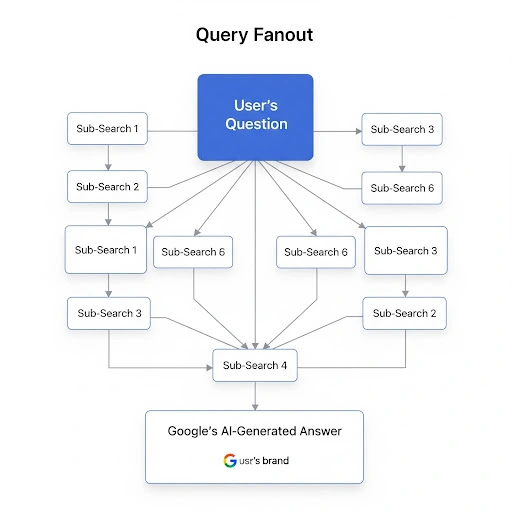
When a user asks Google a question, the AI performs dozens of hidden sub-searches—a “query fanout”—to construct its answer. It pulls data, compares facts, and synthesizes information from sources it trusts. Being one of those trusted sources is the new #1 ranking.
SEO is now a brand discovery channel. Every time Google’s AI cites you, it builds brand memory and authority, even if the user doesn’t click. This is how you win the customers of tomorrow.
Part 2: The 7-Step Process for Creating AI-Citable Content
Now for the actionable framework. This isn’t about guesswork; it’s a proven process adapted from the master strategists at Ahrefs for this new AI era.
Step 1: Identify High-Potential, Low-Difficulty Keywords
Your time is limited. Don’t boil the ocean. Use a tool like Ahrefs’ Keyword Explorer or Semrush’s Keyword Magic Tool to find keywords with a difficulty score under 10 and a search volume over 100. This is your path of least resistance to getting the AI’s attention.
Step 2: Pinpoint the Exact Search Intent
Once you have your keyword, you need to understand the question behind the question. Ahrefs’ AI Content Helper can automatically analyze top-ranking content to reveal the multiple search intents behind a query. Are users trying to buy, learn, or compare? You must align your content with this primary intent.
Step 3: Craft a High-Impact, SEO-Optimized Title
Your title is your first promise to the user and the AI. Use AI tools to generate five unique title options based on the search intent and competitor analysis. The goal is a title that is both compelling to a human and perfectly clear to a machine.
Step 4: Build a Comprehensive, Gap-Free Outline
Don’t write a single word until you have a rock-solid outline. Generate an outline based on the main topics covered by competitors. Then, critically, perform a “content gap” analysis. Identify the sub-headings and topics your competitors missed and strategically insert them into your outline. This is where you start building a superior resource.
Step 5: Enrich with Your Unique E-E-A-T (Experience, Expertise, Authoritativeness, Trustworthiness)
This is the most critical step. AI can generate text, but it cannot generate your unique experience. This is your moat. While you can use AI to expand on your outline, you must enrich it with your own experiments, data, and real-world expertise. Add diagrams, personal case studies, and infographics. This multi-format approach makes your content more valuable and highly citable for the AI.
Step 6: Optimize for Topical Gaps
This is the work we do for you. Every week, without exception.
Managing GBP at this level takes 6–8 hours a week when done right. Nova handles the entire system — posts, photos, reviews, Q&A, citations, heatmap tracking — so you can focus on running your business.
Once your draft is about 80% complete, use an SEO content tool to analyze its topical coverage. These tools will show you which related concepts you’ve failed to address. Go back and weave these topics into your content naturally. This ensures you’ve created the most comprehensive resource on the subject.
Step 7: Fact-Check Relentlessly
AI can “hallucinate” and present incorrect information as fact. You are the final line of defense for your brand’s credibility. Read through every line. Check every statistic. Ensure every source you cite is authoritative. Your goal is to become a trusted source, and trust is built on accuracy.
Part 3: Supercharging Your GEO with an AI Toolkit
Once you’ve mastered the content creation process, it’s time to scale your efforts with a dedicated AI toolkit. Leading platforms like Semrush now offer a suite of AI-powered features designed for this new landscape.
- AI Overview Tracking: You need to know if you’re being cited. Tools now exist that allow you to track your brand’s visibility directly within Google’s AI answers. This is your new primary KPI.
- Keyword Strategy Builder: Instead of researching keywords one by one, AI can now generate entire content plans, including pillar pages and topic clusters, from a single seed keyword.
- Personalized Keyword Difficulty: Get AI-powered analysis on how difficult it will be for your specific website to rank for a keyword, providing a much more accurate picture of your true potential.
Conclusion: Your Mandate for 2025
The shift to an AI-first search world is intimidating, but it presents a monumental opportunity for those willing to adapt. Small, agile businesses can now build authority faster than ever before. By abandoning the outdated rules of traditional SEO and embracing the strategic framework of Generative Engine Optimization, you can transform Google’s AI from a threat into your most powerful channel for customer acquisition.
The process is clear: understand the new reality of GEO, create demonstrably superior content using a proven framework, and leverage AI tools to scale your strategy. Start today, and by the time your competitors realize the game has changed, you’ll already be the name the AI trusts.

