



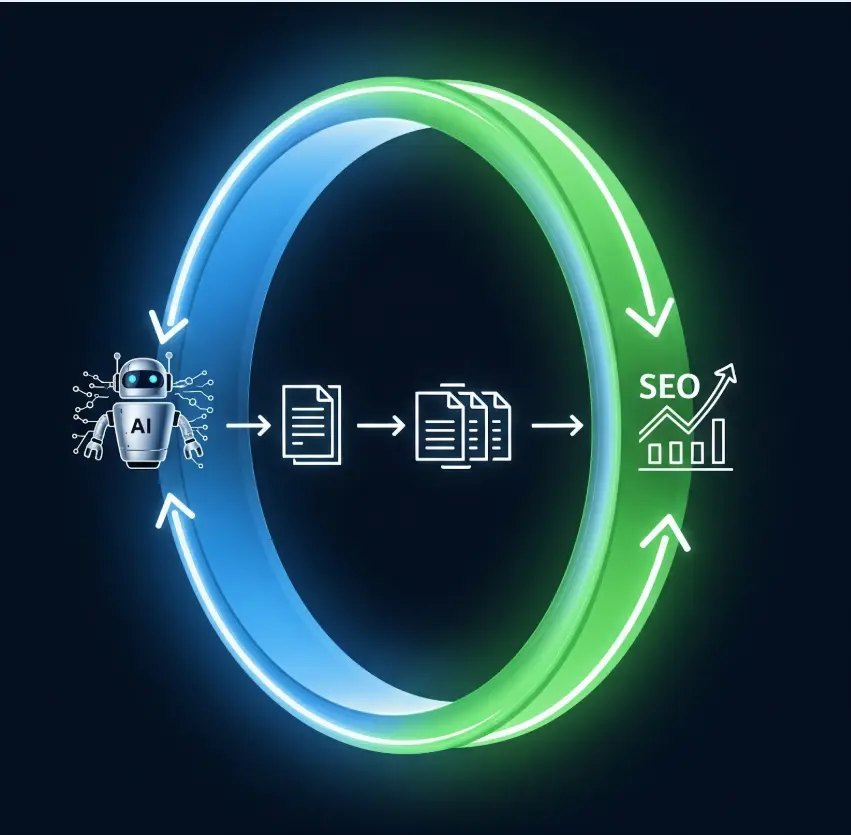
What if you could create 21 high-quality blog posts in the time it normally takes to write one? That’s not a hypothetical; it’s the new reality for businesses leveraging artificial intelligence. For “DIY Dan,” the time-strapped small business owner, this isn’t just an advantage—it’s a revolution. The old model of painstakingly crafting one article per week is dead.
In a world where 4.6 billion pieces of content are created daily, the game has shifted from pure manual effort to smart, AI-powered systems. This guide will provide you with the exact, data-backed framework to build your own AI content flywheel, saving you hundreds of hours while dramatically scaling your SEO and lead generation.
The Mindset Shift: AI Isn’t a Replacement, It’s a Multiplier
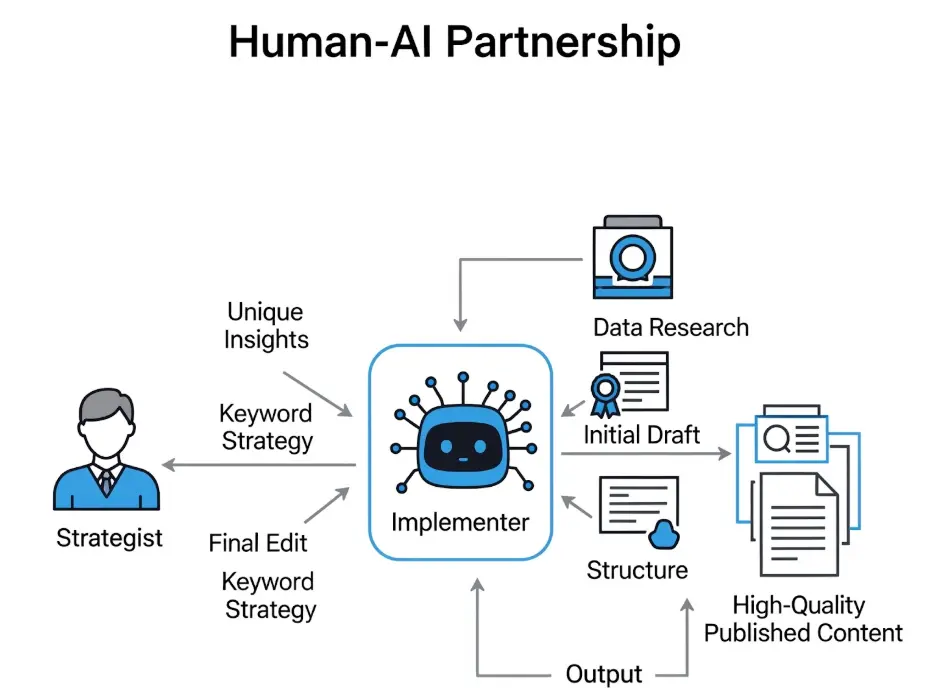
The biggest mistake small businesses make is viewing AI as a simple “on/off” switch for content creation. The narrative that “AI kills SEO” is fundamentally wrong. AI doesn’t kill SEO; lazy marketing kills SEO. The truth, as marketing authority Neil Patel confirms, is that the future is a hybrid model. Your goal isn’t to have AI replace you; it’s to have AI augment your expertise.
Think of yourself as the architect and AI as your construction crew. You provide the strategy, the unique insights, and the final quality control. AI does the heavy lifting: the research, the drafting, and the structural assembly. This Human-AI partnership is what allows you to achieve unprecedented scale without sacrificing the quality and authenticity that Google’s Helpful Content Update demands.
Step 1: The “Content Pac-Man” Strategy for Topic Domination
You can’t afford to guess what content will work. You need a systematic way to identify and dominate entire topic clusters. This is where the “Content Pac-Man” strategy comes in. Instead of picking one-off keywords, you’re going to use AI to map out and consume every relevant sub-topic your audience cares about.
Here’s the process:
- Identify Your Core “Pillar” Topics: What are the 3-5 main categories of problems you solve for your customers? For a local plumber, this might be “Emergency Repairs,” “Water Heaters,” and “Drain Cleaning.”
- Use AI for Keyword Expansion: Go to a tool like ChatGPT or Google’s Gemini and use the following prompt: “Act as an SEO strategist for a [Your Business Type]. My main content pillar is ‘[Pillar Topic].’ Generate a list of 50 long-tail keywords and question-based queries that a potential customer would search for related to this pillar.”
- Validate with Data: Take that list and plug it into a free tool like Ahrefs’ Keyword Generator or Google Keyword Planner to check for search volume. You don’t need massive volume; for a small business, keywords with 50-200 monthly searches can be incredibly valuable and have low competition.
- Create a Content Calendar: You now have a data-validated list of dozens of article ideas. This is your content roadmap for the next 6-12 months.
Step 2: The 90%-Off Workflow for Rapid Content Creation
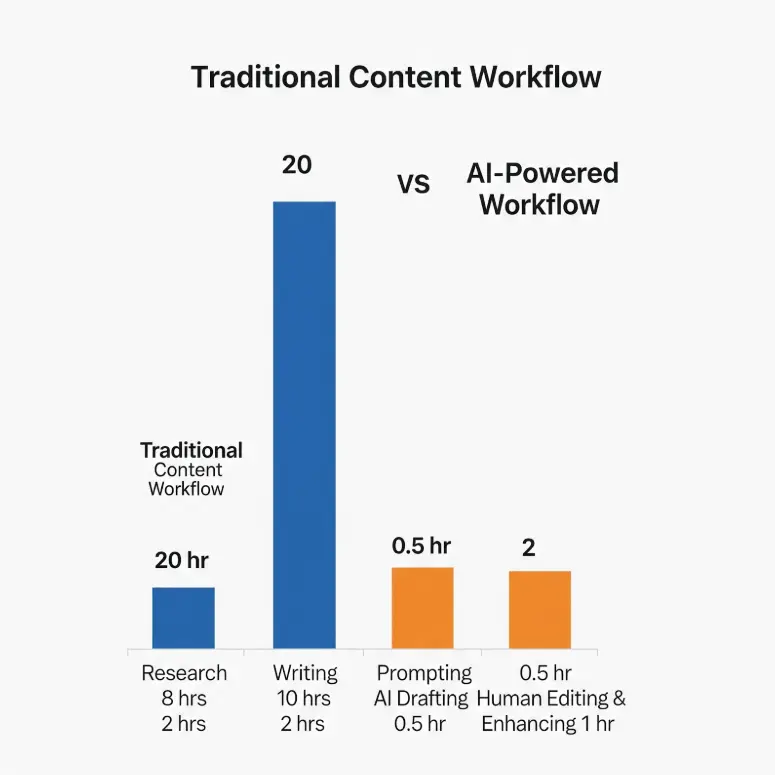
Eric Siu, founder of the agency Single Grain, has a framework that cuts content production time by up to 90%. This isn’t about creating low-quality “AI slop.” It’s about building a repeatable system for creating good content, fast.
The Framework:
- The “Expert” Prompt: Before you ask AI to write anything, you need to give it a role. Start your prompt with: “Act as a world-class [Your Topic] expert and SEO copywriter. Your audience is [Describe DIY Dan]. You write in a clear, authoritative, and helpful tone.”
- Provide the Structure: Never ask AI for a full article at once. Guide it. Give it the H2s and H3s from your outline. For each section, prompt it to write the content, providing specific instructions.
- Example Prompt: “Now, write the ‘Step 2’ section of my blog post. The H2 is ‘The 90%-Off Workflow for Rapid Content Creation.’ Explain Eric Siu’s framework. Include a numbered list for the steps. Make it actionable for a small business owner.”
- Inject Your “Human” Element: This is the most critical part. AI will generate a solid draft, but it lacks personal experience and unique brand voice. Your job is to:
- Add Anecdotes: Share a quick story about a client or your own business.
- Insert Data-Backed Opinions: AI can state facts; you can provide a strong take on what those facts mean.
Rewrite Key Paragraphs: The introduction, conclusion, and any critical strategic points should be heavily edited or rewritten in your own voice.
Step 3: “Search Everywhere Optimization” – Why Google is Only Half the Battle
Neil Patel makes a powerful point: SEO is no longer just “Search Engine Optimization.” It’s “Search Everywhere Optimization.” Your customers aren’t just looking for you on Google. They’re searching on YouTube, LinkedIn, Facebook, and industry forums. Relying solely on Google is a losing battle when you could be capturing the other 73% of daily searches happening elsewhere.

How to Apply This:
- Content Atomization: Your core blog post is just the beginning. Use AI to “atomize” it into content for other platforms.
- The “Atomization” Prompt:“Take the key ideas from the blog post above and transform them into the following assets:
- A 5-part LinkedIn post series.
- A 3-minute YouTube video script.
- 10 engaging tweets with relevant hashtags.
- A concise email newsletter summary.”
This turns one major content effort into dozens of touchpoints across the channels where your audience spends their time, massively increasing your brand’s visibility and authority.
Conclusion: Build Your System Before Your Competitors Do
The rise of AI in content marketing is not a threat; it’s the single biggest opportunity for small businesses to level the playing field. By shifting your mindset from a manual creator to a strategic operator, you can build a content flywheel that consistently produces high-quality, SEO-rich content at a scale that was previously unimaginable.
The process is clear:
- Adopt the Human-AI Partnership: You are the strategist; AI is the implementer.
- Use the “Content Pac-Man” Strategy: Systematically identify and plan your topic domination.
- Implement the 90%-Off Workflow: Create more content in less time by guiding, not just commanding, AI.
- Practice “Search Everywhere Optimization”: Atomize your core content to be visible across all relevant platforms.
Stop trading time for content. Start building your system today, and watch your traffic, leads, and authority grow.