



Email marketing is still one of the most powerful tools for business success and it is not just talk. For every dollar spent, email marketing returns an average of $42. That sounds almost too good to be true, right? The surprise is that most brands never get close to these results and it is not because email is outdated. The real reason sits in the strategies and secrets you are about to learn.
Table of Contents
- Building A Strong Email List For Your Brand
- Crafting Engaging Email Campaigns That Convert
- Personalization And Automation In Email Marketing
- Measuring Success: Key Email Marketing Metrics
Quick Summary
| Takeaway | Explanation |
|---|---|
| Build an engaged email list | Focus on organic growth through ethical list building strategies for better engagement. |
| Use targeted opt-in forms | High-converting forms and lead magnets can significantly increase subscription rates. |
| Craft personalized email content | Personalization enhances engagement by addressing individual subscriber preferences and behaviors. |
| Implement automated email systems | Automate responses to subscriber actions to improve timely communication and conversions. |
| Track key email marketing metrics | Monitor metrics like open rates and conversion rates to optimize future campaigns effectively. |
Building a Strong Email List for Your Brand
Creating a robust email list is the foundation of successful email marketing strategies. Unlike purchasing generic contact lists, building an organic and engaged subscriber base requires strategic planning and genuine value proposition.
The Art of Ethical List Building
Email list growth starts with understanding legal and ethical boundaries. The U.S. Federal Trade Commission’s CAN-SPAM Act provides critical guidelines for responsible email marketing. Businesses must prioritize obtaining explicit consent from potential subscribers, ensuring transparency and respect for user preferences.
Successful list building involves multiple strategic approaches. Targeted opt-in methods are paramount. This means creating compelling reasons for potential subscribers to willingly share their email addresses. Consider offering exclusive content, special discounts, or valuable resources that directly address your audience’s needs and pain points.
Conversion-Driven Opt-In Strategies
Designing high-converting opt-in forms requires careful consideration. Website pop-ups, sidebar forms, and dedicated landing pages can dramatically increase email capture rates. According to Campaign Monitor, businesses that implement strategic opt-in techniques can see conversion rates improve by up to 40%.
Key opt-in strategies include:
To help you quickly compare the main opt-in strategies for growing your email list, here’s a summary table highlighting their features and benefits:
| Opt-In Strategy | Key Feature | Benefit to Business |
|---|---|---|
| Lead Magnets | High-value downloadable resources | Attract subscribers with immediate value |
| Exit-Intent Popups | Offer triggered when user is about to exit | Recover potential leads before they leave |
| Progressive Profiling | Collect minimal info at first, more over time | Increases engagement and trust gradually |
- Lead Magnets: Develop high-value downloadable resources like ebooks, checklists, or industry reports that subscribers can access immediately after providing their email.
- Exit-Intent Popups: Capture potential subscribers who are about to leave your website by presenting a compelling offer.
- Progressive Profiling: Collect minimal information initially, allowing subscribers to provide more details over time, which increases engagement and trust.
Maintaining List Quality and Engagement
Building an email list is not just about quantity but quality. Regular list maintenance ensures high deliverability and engagement rates. This means periodically cleaning your list by removing inactive subscribers and maintaining a healthy sender reputation. To make this process easier, you can use an email verifier to quickly identify invalid or inactive addresses and keep your list clean
Implement segmentation strategies to personalize content and improve relevance. By categorizing subscribers based on demographics, behavior, or interests, you can create more targeted and effective email campaigns. Read more about our targeted email marketing approach to understand how precision targeting can transform your digital communication strategy.
See exactly where your profile stands right now.
Our GBP audit shows your current rank position across your market, how your profile completeness scores against competitors, and the specific gaps holding you back from the Map Pack.
Remember, a strong email list is a dynamic asset. Continuously test, refine, and adapt your list-building strategies to stay ahead in the competitive digital marketing landscape.
Crafting Engaging Email Campaigns That Convert
Email marketing success depends on creating campaigns that not only capture attention but drive meaningful action. Beyond basic communication, effective email campaigns require strategic design, compelling content, and precise targeting.
Understanding Campaign Architecture
Digital.gov emphasizes the critical importance of strategic send timing and audience segmentation. Successful email campaigns are meticulously constructed to deliver the right message to the right audience at the most opportune moment.
Effective campaign architecture involves multiple strategic components. Personalization stands at the forefront of modern email marketing. This means moving beyond generic mass emails to create highly targeted communications that speak directly to individual subscriber needs and preferences.
Design and Content Optimization
Email design plays a pivotal role in conversion rates. According to Santa Clara University’s research, segmenting subscribers based on demographics, purchasing behavior, and customer journey stages can dramatically improve click-through rates.
Key design principles include:
- Visual Hierarchy: Create clear, scannable layouts that guide readers’ eyes toward key messages and call-to-action buttons.
- Mobile Responsiveness: Ensure emails render perfectly across all device types, recognizing that over 60% of emails are first opened on mobile devices.
- Compelling Subject Lines: Craft concise, intriguing subject lines that spark curiosity and promise value.
Measuring and Refining Campaign Performance
Data-driven refinement separates exceptional email campaigns from mediocre ones. Implement robust tracking mechanisms to monitor key performance indicators like open rates, click-through rates, and conversion metrics. Learn more about our targeted email marketing approach to understand how precision analytics can transform your digital communication strategy.
Constant iteration is crucial. A/B test different elements of your campaigns regularly – from subject lines and send times to design layouts and content tone. This continuous optimization ensures your email marketing remains adaptive and effective in an ever-changing digital communication environment.
Remember, engaging email campaigns are not about sending more emails, but about sending smarter, more targeted communications that genuinely resonate with your audience.
Personalization and Automation in Email Marketing
Personalization and automation represent the cutting edge of modern email marketing strategies. By leveraging advanced technologies and data-driven insights, businesses can create highly targeted communication experiences that resonate deeply with individual subscribers.
The Science of Personalized Messaging
Research from the National Library of Medicine demonstrates that tailored digital marketing approaches significantly elevate customer engagement and business performance metrics. Personalization goes far beyond inserting a subscriber’s first name into an email template. It involves creating dynamic content that adapts to individual user behaviors, preferences, and interaction history.
Behavioral Segmentation is the cornerstone of effective personalization. This means tracking and analyzing how subscribers interact with previous emails, website content, and purchasing patterns. By understanding these nuanced interactions, businesses can craft messages that feel individually crafted rather than mass-produced.
Advanced Automation Strategies
Automation transforms email marketing from a static communication channel into a responsive, intelligent system. Triggered email sequences can now respond to specific user actions with remarkable precision. For instance, an abandoned cart email sent within hours of a potential customer leaving a website can dramatically increase conversion rates.
Key automation techniques include:
- Lifecycle Emails: Automatically send targeted messages based on specific stages of customer journey
- Predictive Personalization: Use machine learning algorithms to predict and recommend content
- Real-time Behavior Tracking: Dynamically adjust email content based on most recent user interactions
Implementing Smart Personalization Systems
Successful personalization requires a sophisticated technological infrastructure. Learn more about our small business automation strategies to understand how advanced systems can transform your marketing approach.
Implementing these strategies requires a holistic approach. Businesses must invest in robust customer data platforms, integrate multiple data sources, and continuously refine their segmentation models. The goal is not just to send emails, but to create a seamless, intelligent communication ecosystem that feels intuitive and valuable to each individual recipient.
Remember, the future of email marketing lies in treating each subscriber as a unique individual with specific needs, preferences, and potential interests. Automation and personalization are not just technological tools, but strategic approaches to building genuine, responsive customer relationships.
Measuring Success: Key Email Marketing Metrics
Effective email marketing is not just about sending messages but understanding their impact through precise, strategic measurement. By tracking the right metrics, businesses can continuously refine their email marketing approach and drive meaningful results.
Essential Performance Indicators
According to the Foundations in Digital Marketing textbook, email marketing delivers an impressive average return on investment of $42 for every dollar spent. This remarkable statistic underscores the importance of meticulously tracking key performance metrics.
The primary metrics that demand attention include:
This table summarizes key email marketing performance metrics mentioned in the article, with brief explanations to clarify their importance:
| Metric | What It Measures | Typical Benchmark |
|---|---|---|
| Open Rate | Percentage of subscribers who open your emails | ~21% (varies by industry) |
| Click-Through Rate | Proportion of recipients who click links in the email | ~6% (varies by industry) |
| Conversion Rate | Number who complete a desired action from the email | Not specified in article |
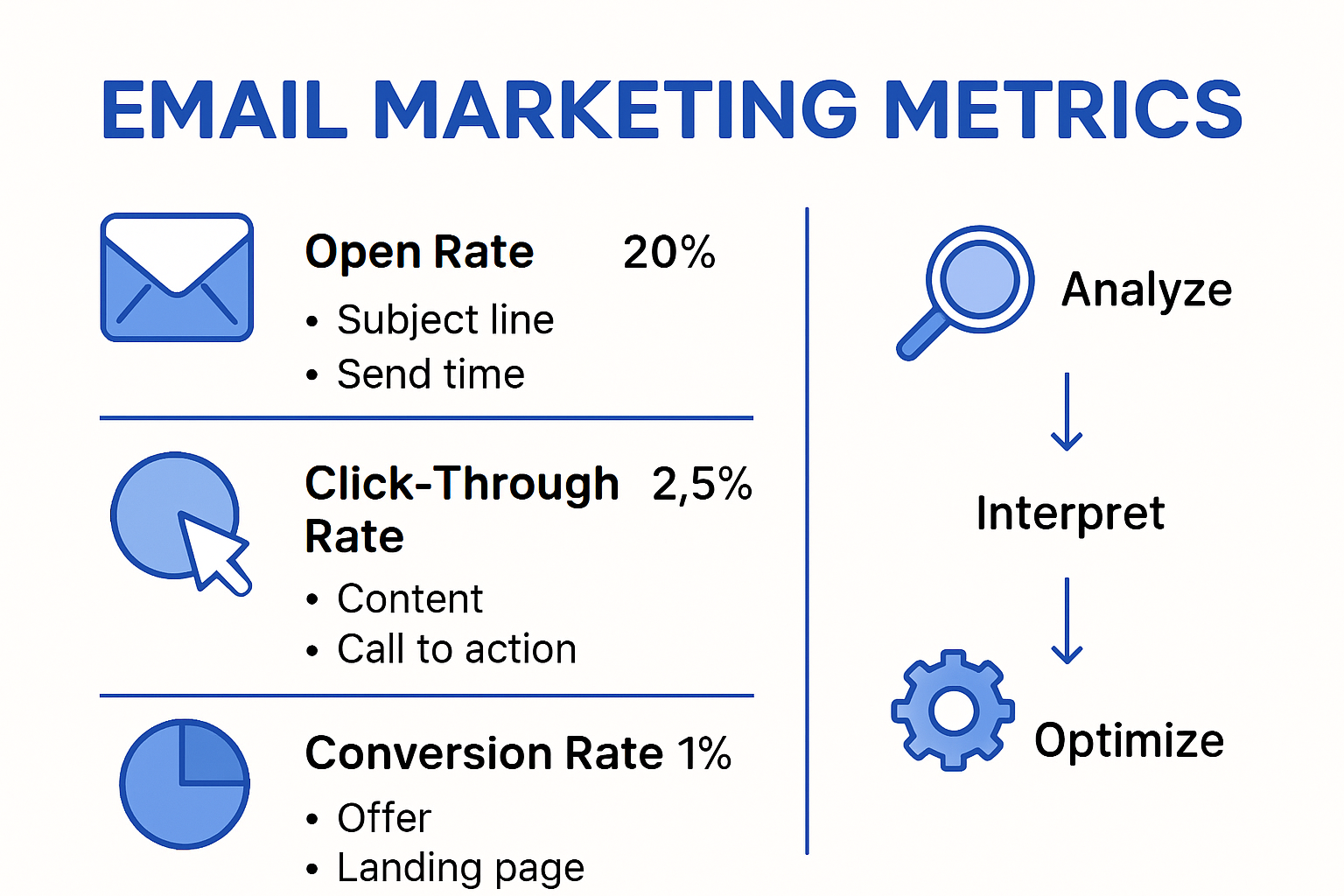
- Open Rate: Indicates the percentage of subscribers who actually open your emails
- Click-Through Rate: Measures the proportion of recipients who click on links within the email
- Conversion Rate: Tracks the number of recipients who complete a desired action
Advanced Metric Analysis
Research published in the Public Library of Science reveals critical insights into email engagement. The study highlights that metrics go beyond simple numbers, examining factors like subject line effectiveness, sender reputation, and timing.
Benchmarking Performance requires understanding industry standards. For instance, average open rates hover around 21%, with click-through rates typically around 6%. However, these numbers vary significantly across industries and campaign types. Contextual interpretation is key to meaningful analysis.
Strategic Metric Optimization
Learn more about targeted email marketing strategies to understand how to translate metrics into actionable insights. Successful email marketing involves more than tracking numbers – it requires a holistic approach to understanding subscriber behavior.
Advanced analysis techniques include:
- Segmentation performance tracking
- A/B testing result evaluation
- Longitudinal campaign effectiveness studies
This is the work we do for you. Every week, without exception.
Managing GBP at this level takes 6–8 hours a week when done right. Nova handles the entire system — posts, photos, reviews, Q&A, citations, heatmap tracking — so you can focus on running your business.
Implementing a robust measurement framework allows businesses to move beyond surface-level metrics. By diving deep into subscriber interactions, businesses can create increasingly sophisticated and targeted email marketing strategies.
Remember, metrics are not just numbers – they are a narrative of your audience’s engagement, preferences, and potential. Treat each metric as a valuable piece of insight that can drive your marketing strategy forward.

Frequently Asked Questions
What are the most effective strategies for building an email list?
Building a strong email list can be achieved through ethical list building techniques such as creating high-value lead magnets, using exit-intent popups, and implementing progressive profiling. These methods encourage potential subscribers to willingly share their email addresses.
How can personalization improve email campaign engagement?
Personalization enhances email engagement by tailoring content to individual subscribers’ preferences and behaviors. This involves utilizing data to create dynamic content that reflects the recipient’s past interactions and specific needs.
What key metrics should I track to assess email marketing performance?
Important email marketing metrics to track include open rates, click-through rates, and conversion rates. Monitoring these metrics helps in understanding subscriber engagement and can guide improvements in future campaigns.
How can automation benefit my email marketing strategy?
Automation allows businesses to send timely, relevant messages based on subscriber actions, such as abandoned cart reminders or personalized follow-ups. This responsiveness can significantly increase conversion rates and improve customer relationships.
Unlock Email Marketing Success With the Power of True Personalization
Are you frustrated with low open rates or weak subscriber engagement, even after following all the so-called proven email marketing strategies? Many businesses struggle to turn their email list into real growth. Generic campaigns and outdated tactics often lead to missed opportunities, poor conversions, and wasted resources. You want your emails to be seen, clicked, and acted on. You need advanced personalization, smart segmentation, and high-converting automation to cut through the noise and drive business results. Most importantly, you want measurable progress, not just empty numbers.
Experience the results that modern, AI-driven marketing can deliver. At 12AM Agency, we transform your email campaigns using data-backed automation and industry-specific strategies. Build a better digital presence and move beyond guesswork. Let our experts create customized solutions that address your unique business needs and pain points. Connect your proven strategies to powerful action now—let’s talk about your goals and see how we can accelerate your growth today. Don’t let another potential customer slip away. Reach out for your personal consultation and unlock your full marketing potential.
Recommended
- Email Marketing for Local Businesses: Strategies for Growth | 12AM Agency
- Top Local Business Marketing Ideas for 2025 Growth | 12AM Agency
- Unlock Growth: Essential Digital Marketing Strategies for Small Business Owners in 2025 | 12AM Agency
- The Ultimate Guide to Small Business Automation: A 2025 Playbook for The Chief Everything Officer | 12AM Agency
- Email Marketing Essentials: Strategies for Business Growth – Solution for Guru
- Email Marketing Essentials for Modern Business Success|BM

