


Local businesses are always searching for smarter ways to connect with their community and drive real results. Most people assume social media steals the spotlight, yet the most effective tool often sits quietly behind the scenes. Email marketing brings in around $45 for every $1 spent and that simple statistic turns everything you thought about digital outreach upside down.
Table of Contents
- Why Email Marketing Works For Local Businesses
- Building A Local Email List That Converts
- Crafting Emails That Engage Your Community
- Measuring Success And Optimizing Results
Quick Summary
| Takeaway | Explanation |
|---|---|
| Email marketing offers high ROI. | Businesses can generate approximately $45 for every $1 spent, making it a financially sound strategy for local growth. |
| Build a high-quality email list. | Focus on organic list building through permissions and incentives to ensure engagement and compliance. |
| Customize emails for target segments. | Use customer behavior and preferences to create personalized emails that resonate with specific audience groups. |
| Measure key performance indicators. | Track metrics like open rates and conversions to refine your email marketing strategies successfully. |
| Continuously optimize campaigns. | Implement A/B testing and feedback loops to improve engagement and adapt to audience preferences over time. |
Why Email Marketing Works for Local Businesses
Local businesses need powerful yet cost-effective marketing strategies that deliver direct results. Email marketing emerges as a critical tool for connecting with customers, driving sales, and building lasting relationships without breaking the bank.
The Economic Advantage of Email Marketing
Email marketing represents an incredibly efficient channel for local businesses seeking maximum return on investment. Research from the Chamber of Commerce reveals a staggering statistic: businesses can generate approximately $45 for every $1 spent on email marketing. This extraordinary ROI makes it one of the most financially prudent marketing strategies available to small and medium enterprises.
The cost-effectiveness stems from minimal overhead. Unlike traditional advertising channels that require significant upfront expenses, email marketing allows businesses to reach hundreds or thousands of customers with minimal financial investment. Entrepreneurs can leverage affordable email marketing platforms, design compelling campaigns, and track performance metrics in real-time.
Direct Customer Engagement and Personalization
Email marketing transcends traditional advertising by enabling highly personalized communication. According to Penn State Extension, businesses can engage directly with customers, providing timely information and targeted promotions that resonate with individual preferences.
Modern email marketing tools allow segmentation based on customer behaviors, purchase history, and demographic information. This means a local restaurant can send lunch specials to daytime customers, while a boutique clothing store can recommend seasonal collections tailored to specific customer styles. Such precision targeting increases the likelihood of conversion and customer loyalty.
Measurable Results and Strategic Insights
Unlike traditional marketing methods, email campaigns offer unprecedented transparency and analytical depth. Businesses can track open rates, click-through rates, conversion metrics, and customer interactions with extraordinary precision. These insights enable continuous refinement of marketing strategies, helping local businesses understand their audience better and optimize their messaging.
For instance, if an email about a weekend sale receives higher engagement from a specific age group or neighborhood, businesses can adjust future campaigns accordingly. This data-driven approach transforms email marketing from a simple communication tool into a strategic growth mechanism.
By embracing email marketing, local businesses unlock a powerful channel that combines affordability, personalization, and measurable results. It’s not just a marketing strategy—it’s a direct line of communication with your most valuable asset: your customers. Learn more about local business marketing strategies to complement your email efforts and drive sustainable growth.
Building a Local Email List That Converts
Successful email marketing starts with building a high-quality, engaged local subscriber base. Unlike purchased lists that often lead to low engagement and potential legal issues, organic list building focuses on attracting genuinely interested local customers who want to hear from your business.
See exactly where your profile stands right now.
Our GBP audit shows your current rank position across your market, how your profile completeness scores against competitors, and the specific gaps holding you back from the Map Pack.
Strategic List Building Techniques
According to the U.S. Small Business Administration, obtaining explicit permission from individuals before adding them to your email list is crucial. This approach ensures compliance with regulations and builds trust with potential subscribers.
The Rhode Island Small Business Development Center recommends several effective strategies for capturing email addresses. Businesses can create compelling opt-in incentives such as exclusive discounts, free local guides, or special promotions that provide immediate value to potential subscribers. For instance, a local restaurant might offer a welcome coupon, while a fitness studio could provide a free workout guide specific to local fitness trends.
Website optimization plays a critical role in list building. Implement strategically placed sign-up forms, including exit-intent pop-ups, sidebar widgets, and dedicated landing pages that clearly communicate the benefits of subscribing. Make the sign-up process simple, requesting only essential information to reduce friction.
Leveraging Local Touchpoints
Local businesses have unique opportunities to collect email addresses through in-person interactions. Point-of-sale systems can include optional email collection, while physical locations can use tablet sign-up forms or business card collection bowls with clear opt-in messaging. The Community Tool Box from the University of Kansas emphasizes the importance of creating multiple touchpoints for information collection.
Events, local partnerships, and community involvement provide excellent list-building opportunities. Hosting local workshops, participating in community fairs, or collaborating with other local businesses can help expand your email list naturally. Consider creating joint promotions or cross-marketing initiatives that encourage email sign-ups.
Maintaining List Quality and Compliance
Building an email list is not just about quantity but quality. Regularly clean your list by removing inactive subscribers and ensuring all contacts have explicitly opted in. Implement a double opt-in process that requires subscribers to confirm their email address, which helps maintain list integrity and compliance with email marketing regulations.
Offer clear value in every communication. Each email should provide meaningful content that keeps subscribers engaged and reduces unsubscribe rates. This might include local event information, exclusive offers, helpful tips, or insider insights that are specific to your business and local community.
The article outlines several best practices for building and maintaining an effective local email list. The following checklist table summarizes key strategies to ensure your list is high-quality, compliant, and optimized for engagement.
| Best Practice | Description | Compliance Focus |
|---|---|---|
| Obtain Explicit Permission | Add only those who have opted in | Yes |
| Offer Valuable Opt-In Incentives | Use discounts, guides, or promotions to attract signups | No |
| Website Sign-Up Optimization | Use forms, pop-ups, and landing pages | No |
| Leverage In-Person Touchpoints | Collect emails at POS or events | No |
| Use Double Opt-In | Require confirmation of email address | Yes |
| Clean List Regularly | Remove inactive subscribers | Yes |
| Provide Ongoing Value | Share helpful content to reduce unsubscribes | No |
Discover more strategies for local business growth that can complement your email marketing efforts. Remember, a well-curated email list is a powerful asset that can drive consistent engagement and revenue for local businesses.
Crafting Emails That Engage Your Community
Email marketing is more than sending generic messages—it’s about creating meaningful connections that resonate with your local community. Successful email campaigns transform communication from transactional interactions into genuine relationship-building opportunities.
Personalization and Relevance
Research analyzing promotional email strategies reveals that segmentation and targeted messaging significantly enhance customer engagement. Local businesses must move beyond one-size-fits-all approaches and craft emails that speak directly to specific customer segments.
Personalization goes beyond inserting a customer’s first name. It involves understanding local customer preferences, purchasing behaviors, and community interests. For example, a local bakery might segment emails based on customers’ past purchases—sending gluten-free subscribers different content compared to those who regularly purchase traditional pastries. This nuanced approach demonstrates that you understand and value individual customer needs.
Consider creating customer personas representing different segments of your local market. A fitness studio could have personas like "early morning workout enthusiast," "weekend warrior," and "wellness beginner." Each persona receives tailored content that speaks directly to their fitness journey and motivations.
Storytelling and Community Connection
According to research on digital communication, email marketing allows businesses to deliver personalized messages that foster a sense of intimacy and direct connection. Local businesses have a unique advantage in storytelling—they can share narratives that reflect their community’s spirit and values.
Incorporate local elements that create emotional resonance. Highlight community events, showcase local team sponsorships, or share stories about how your business contributes to neighborhood initiatives. A restaurant might feature a monthly spotlight on local farmers who supply their ingredients, or a retail store could share stories about supporting local artisans.
Use email content to position your business as more than a service provider—make it a community partner. Share behind-the-scenes glimpses, introduce team members, and demonstrate your commitment to local values. This approach transforms emails from marketing materials into community conversations.

Strategic Content and Design
Effective emails balance informative content with compelling design. Use clear, scannable layouts that work seamlessly across mobile and desktop platforms. Implement a consistent color palette that reflects your brand while remaining easy to read.
Develop a content mix that provides genuine value. This might include:
- Exclusive local event announcements
- Seasonal promotions relevant to your community
- Helpful tips or how-to guides related to your business
- Customer success stories and testimonials
- Early access to sales or special offerings
Maintain a balanced email frequency that keeps subscribers engaged without overwhelming their inbox. Monitor metrics like open rates, click-through rates, and unsubscribe rates to continuously refine your approach.
Explore advanced local marketing strategies to complement your email efforts and create deeper community connections. Remember, great email marketing is about building relationships, not just sending messages.
Measuring Success and Optimizing Results
Email marketing for local businesses is not a set-it-and-forget-it strategy. Continuous measurement and optimization are crucial for transforming initial campaigns into long-term marketing success. Understanding which metrics matter and how to interpret them can dramatically improve your email marketing performance.
Key Performance Indicators for Email Marketing
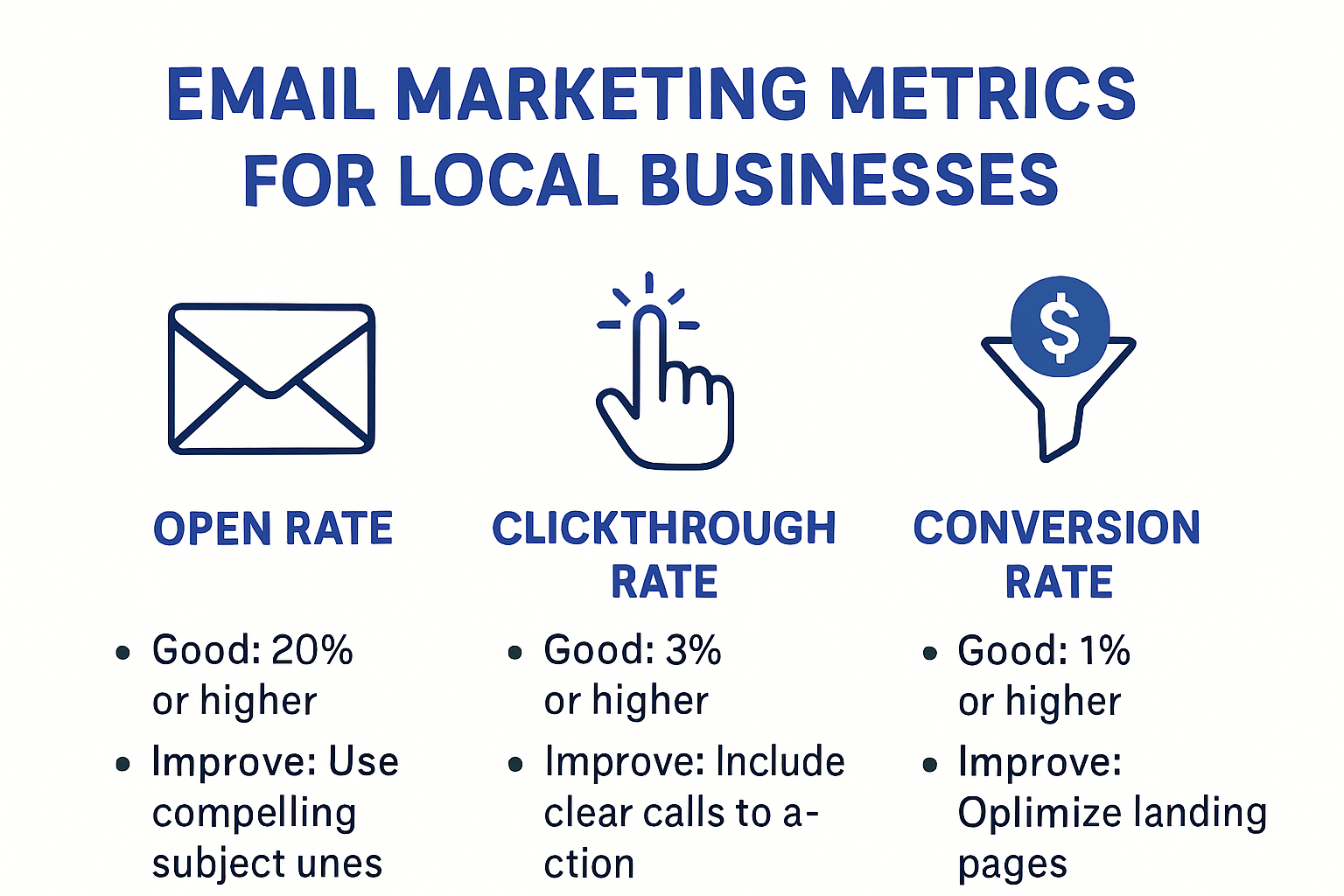
Successful email marketing hinges on tracking the right metrics. Open rates, click-through rates, conversion rates, and unsubscribe rates provide critical insights into campaign effectiveness. Local businesses should focus on metrics that directly correlate with business goals.
Open Rates: Indicate how compelling your subject lines are and how well you’ve segmented your audience. A healthy open rate for local businesses typically ranges between 15-25%. If your rates fall below this, it’s time to reassess your subject line strategies and list segmentation.
Click-Through Rates (CTR): Measure the percentage of subscribers who clicked on links within your email. This metric reveals how relevant and engaging your content is to your audience. For local businesses, a CTR above 2.5% is considered good performance.
Conversion Rates: The ultimate measure of email marketing success. This tracks how many subscribers take a desired action—making a purchase, booking an appointment, or visiting your physical location. Conversion rates help you understand the direct financial impact of your email campaigns.
To help local businesses effectively track their email marketing success, here’s a summary of essential Key Performance Indicators (KPIs) discussed in the article, including suggested benchmark ranges and their importance.
| KPI | Description | Typical Benchmark | Importance |
|---|---|---|---|
| Open Rate | % of subscribers who open your email | 15-25% (local business) | Measures subject line and segmentation effectiveness |
| Click-Through Rate | % who click links within the email | >2.5% | Indicates content relevance and engagement |
| Conversion Rate | % taking desired action (purchase, booking, etc.) | Not specified | Shows direct business impact |
| Unsubscribe Rate | % who opt out from your list | Not specified | Monitors list quality and email frequency |
Advanced Analytics and Segmentation
This is the work we do for you. Every week, without exception.
Managing GBP at this level takes 6–8 hours a week when done right. Nova handles the entire system — posts, photos, reviews, Q&A, citations, heatmap tracking — so you can focus on running your business.
Modern email marketing platforms offer sophisticated analytics that go beyond basic metrics. Dive deeper by analyzing:
- Engagement Time: How long subscribers spend reading your emails
- Device Usage: Understanding which devices your audience uses
- Geographic Performance: Tracking engagement across different local neighborhoods
Segmentation becomes powerful when combined with advanced analytics. Create targeted campaigns based on detailed customer behaviors. A local gym might send different emails to morning class attendees versus evening workout enthusiasts, dramatically improving engagement and conversion rates.
Continuous Improvement Strategies
Optimization is an ongoing process. Implement these strategies to continuously improve your email marketing performance:
-
A/B Testing: Regularly test different elements of your emails
- Subject line variations
- Send times
- Email design layouts
- Call-to-action placement
-
List Hygiene: Regularly clean your email list
- Remove inactive subscribers
- Verify email addresses
- Maintain a high-quality, engaged audience
-
Feedback Loops: Actively seek subscriber input
- Conduct periodic surveys
- Encourage direct feedback
- Understand changing customer preferences
Email marketing is a dynamic channel that requires constant attention and refinement. By embracing data-driven strategies, local businesses can transform their email campaigns from simple communications to powerful customer engagement tools.
Explore our comprehensive guide to small business marketing automation to take your email marketing strategies to the next level. Remember, successful email marketing is about continuous learning and adaptation.
Frequently Asked Questions
What are the benefits of email marketing for local businesses?
Email marketing offers high ROI, allowing businesses to generate approximately $45 for every $1 spent. It enables direct engagement with customers through personalized messages and provides measurable results through analytics.
How do I build a high-quality email list for my local business?
Focus on organic list-building strategies by obtaining explicit permission from subscribers, offering valuable opt-in incentives, and leveraging local touchpoints such as in-person sign-ups at events or your physical location.
What types of content should I include in my email marketing campaigns?
Include a mix of content such as exclusive local event announcements, seasonal promotions, helpful tips, customer success stories, and behind-the-scenes insights to engage your audience effectively.
How can I measure the success of my email marketing campaigns?
Track key performance indicators (KPIs) such as open rates, click-through rates, conversion rates, and unsubscribe rates. This data will help you refine your strategies and understand your audience better.
Ready to Turn Your Local Email List Into Real Revenue?
Local businesses like yours often struggle to move from collecting emails to seeing actual returns. Maybe you have built a list by following strategies from our guide but engagement and conversions still feel out of reach. You want every campaign to mean more sales and real business growth. What holds you back is lack of personalization and expert implementation. That leads to wasted effort and untapped potential in your community.
Let our team at 12AM Agency help you bridge the gap from strategy to measurable results. We use proven email marketing best practices along with advanced digital solutions like AI-driven review management and Google My Business optimization to keep your outreach sharper than ever. Take action now and see how a tailored plan can transform your engagement numbers while unlocking new leads for your local business. Visit our website to request a custom email marketing strategy and start converting subscribers into loyal, local customers today.

