




Minor details often make the biggest difference when it comes to digital marketing. Agencies are spending a lot of money on strategy, creative direction, paid campaigns and analytics. However, there is one aspect that is still affecting interaction across all platforms: the presentation of text.
In Instagram bios and LinkedIn headlines, captions on paid advertisements, or other formatting aspects, formatting makes a small yet significant impact on how the audience views the brand. Even a slight change in visual presentation in a highly congested feed can affect click-through rates, engagement, and brand recall.
Text styling is not merely decorative for growth-oriented teams and agencies. It is a conversion layer.
Why Text Presentation Impacts Marketing Performance
Users scroll fast. Engagement is rewarded by algorithms. Attention spans shrink. The performance is influenced by presentation in this environment.
Text that is well formatted can assist in creating:
- Clear visual hierarchy within brief captions.
- Instant contrast in crowded feeds.
- Clearer division between offers, calls to action, and brand messages.
- Better recall of bios and profile descriptions.
Refinement of such micro-elements by agencies tends to assist in better engagement signals and ultimately lead to better campaign outcomes. It is not about gimmicks. It is about strategic differentiation.
What Is a Small Text Generator?
A Small Text Generator is a format utility that transforms regular text into formatted variations that could include small caps, superscript, subscript, or strikethrough. These variations are created with the help of Unicode characters and that is why they can be used with the majority of social media services and browsers.
See exactly where your profile stands right now.
Our GBP audit shows your current rank position across your market, how your profile completeness scores against competitors, and the specific gaps holding you back from the Map Pack.
Marketers are also able to produce subtle style within text-based content, as opposed to redrawing graphics or editing photos. This comes in handy especially when dealing with organic posting, comment strategy, bios, and short-form campaigns.
Step by Step: How to Use a Small Text Generator in Marketing
A small text generator involves a number of simple steps, but may significantly contribute to presenting the brand.
Step 1: Paste Your Text
Enter your caption, tagline, call to action or promotional message into the input field. This may be some sort of limited-time offer, brand description or a brief campaign hook.
Step 2: Select a Formatting Style
Select the format that suits your purpose. For example:
- It is possible to develop Instagram bios with aesthetic branding made using small caps.
- Superscript is well suited to either a disclaimer or a subtle reference text.
- Stylized creative effects can be added using subscript.
Promotional campaigns usually take advantage of the strikethrough technique in pricing.
Step 3: Generate the Formatted Version
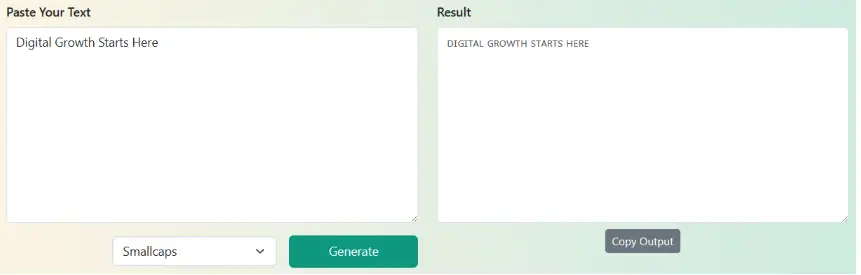
Once the style has been picked, create the new one. The formatted text can be immediately seen in the results field.
Step 4: Copy and Apply Across Channels
The formatted text can then be copied into social media bios, X posts, LinkedIn headlines, ad copy variations or email subject lines.
To teams that want to simplify this process, a good small text generator can be used to simplify formatting without interrupting the workflow. Once incorporated as a strategic element of content planning, it becomes a minor optimization effort rather than a new feature.
Marketing Use Cases That Deliver Real Value
Text formatting can be used effectively. Competitive niches on Instagram enable brands to distinguish themselves in terms of their bios, which tend to look similar. The small caps brand description should be subtle enough to enhance memorability without making it look excessive.
Strikethrough can be used in visual advertising to show discounts on organic posts. Marketers do not need to use graphics alone and can make pricing contrast right in captions.
In personal branding, stylized text can be used to ensure founders, consultants and agency leaders stand out in LinkedIn headlines without being too casual.
Such changes can seem insignificant, yet when they are multiplied across numerous campaigns, they add to the consistency of brands and desired engagement trends.
Leveraging Repetition for Engagement Campaigns
In addition to styling, another text-based tactic employed in digital engagement strategies is repetition. There is also a tendency to organize the comment prompts of giveaways, community posts, or engagement within a campaign. As an example, visibility and interaction could be enhanced by asking users to comment a keyword multiple times.
Under these circumstances, an effective Text Repeater may assist in organizing repetitive words or phrases effectively and posting them. Instead of manually copying content, teams are able to create clean, formatted sequences that are in line with campaign objectives.
Repetition may be encouraged to:
- Comment-based interactive funnels.
- Formatted marketing descriptions.
- Formatting of chat triggers, which are automated.
- Bulk message preparation.
Once again, quality lies not in overuse but in strategic use in accordance with bigger marketing objectives.
SEO and Branding Implications
Though the formatting of text has no direct impact on search rankings, engagement metrics do. Increased click-through rates, better dwell time and enhanced user interaction lead to good content performance indicators.
This is the work we do for you. Every week, without exception.
Managing GBP at this level takes 6–8 hours a week when done right. Nova handles the entire system — posts, photos, reviews, Q&A, citations, heatmap tracking — so you can focus on running your business.
Readability can also be enhanced by clear formatting in short-form environments, in particular on mobile devices. In the case of agencies which deal with a number of brands, uniformity in micro-presentation enhances the perception of the brand as a whole.
Minor improvements across dozens of posts and campaigns add up over the years.
Best Practices for Agencies and Marketing Teams
The use of text style must aim at making the text more understandable but not distracting. Excessive formatting lowers credibility rates and can seem unprofessional. During campaigns, consistency is important to ensure the integrity of the brand.
Prior to using stylized formats on a large scale, measure engagement through testing. Monitor audience response. Compare engagement rates between formatted and standard captions. The experience of data refinement will make sure that formatting is a strategic and not merely an aesthetic decision.
Conclusion
In competitive online spaces, brands prevail when both the macro and micro aspects are fine-tuned. The foundation consists of creative direction, paid acquisition, and SEO structures. However, a small execution layer like text presentation may affect how messaging is received.
Smart formatting tools provide a minor yet effective benefit to agencies that are more performance-oriented and brand-driven. As a part of social media strategy, promotional campaigns, and engagement funnels, they help brands stand out without losing professionalism.
Today, perception in marketing can be influenced by even the slightest visual change.


