




Digital marketing prices are changing fast as new technologies reshape the way businesses invest in growth. Agencies with premier reputations now charge up to $149 per hour for specialized services, while monthly digital marketing budgets for many companies can swing from $50 to $6,000. You might expect rigid costs to make planning easier. Instead, the real opportunity is for those who stay flexible and invest in experimentation—since companies that dedicate just 5 to 10 percent of their budgets to innovation are finding stronger returns over time.
Table of Contents
- Key Factors Influencing Digital Marketing Costs
- Average Pricing Models for Various Businesses
- How to Budget for Digital Marketing Success
- Tips to Maximize ROI on Marketing Spend
Quick Summary
| Takeaway | Explanation |
|---|---|
| Agency expertise impacts pricing. | Higher rates are often charged by agencies with proven success and robust strategic insights due to their ability to deliver results. |
| Budget flexibility is essential. | Businesses should view digital marketing expenditures as investments, allowing budgets to adapt based on performance and strategic goals. |
| Performance metrics drive ROI. | Establishing clear KPIs such as customer acquisition cost and conversion rates helps track and optimize marketing effectiveness. |
| Diverse budgeting improves outcomes. | Allocate budgets across multiple channels like SEM, social media, and content marketing to optimize reach and engagement. |
| Innovation budgets foster growth. | Reserve a portion of the budget for testing new technologies and strategies, ensuring adaptability in a changing landscape. |
Key Factors Influencing Digital Marketing Costs
Navigating the complex landscape of digital marketing costs requires a strategic understanding of multiple interconnected variables. Businesses must recognize that pricing is not a one-size-fits-all scenario but a nuanced calculation influenced by numerous critical factors.
Agency Expertise and Reputation
The digital marketing service provider’s track record plays a significant role in determining pricing structures. Experienced agencies with proven success typically command higher rates due to their demonstrable ability to deliver measurable results. According to Summit Productions, agencies with established credibility can charge premium rates based on their portfolio of successful campaigns.
Agency reputation is not just about past achievements but also about the depth of strategic insights they bring. Businesses should expect to pay more for agencies that offer comprehensive, data-driven approaches rather than generic marketing solutions. The geographic location of an agency also impacts pricing, with urban-based agencies often charging higher rates due to increased operational costs and access to specialized talent pools.
Service Complexity and Technological Integration
The scope and complexity of digital marketing services significantly influence cost structures. Interpretive Economics highlights that service costs vary dramatically based on campaign requirements. Small to medium-sized businesses might invest between $1,125 to $2,625 monthly for social media management, while larger enterprises could allocate $2,625 to $6,650 per month.
Technological integration, particularly with AI tools, is reshaping the digital marketing value proposition. The emergence of advanced AI technologies means businesses are no longer just purchasing standard marketing services but investing in sophisticated, data-driven strategies that can provide exponential returns. This technological complexity directly translates to higher service costs, as agencies incorporate machine learning, predictive analytics, and intelligent automation into their service offerings.
Budget Allocation and ROI Considerations
Understanding digital marketing expenditure goes beyond immediate costs and requires a holistic view of potential returns. Harvard Business School emphasizes the importance of tracking expenses against revenue to determine strategy effectiveness. Their research indicates a projected increase in social media spending by 19 percent in 2024 and an anticipated 24 percent growth over the next five years.
Businesses must approach digital marketing budgets with flexibility and strategic foresight. The most successful organizations view these expenses not as costs but as investments in their digital infrastructure. This means considering factors such as potential lead generation, brand visibility, customer acquisition costs, and long-term market positioning when evaluating digital marketing service pricing.
Average Pricing Models for Various Businesses
See exactly where your profile stands right now.
Our GBP audit shows your current rank position across your market, how your profile completeness scores against competitors, and the specific gaps holding you back from the Map Pack.
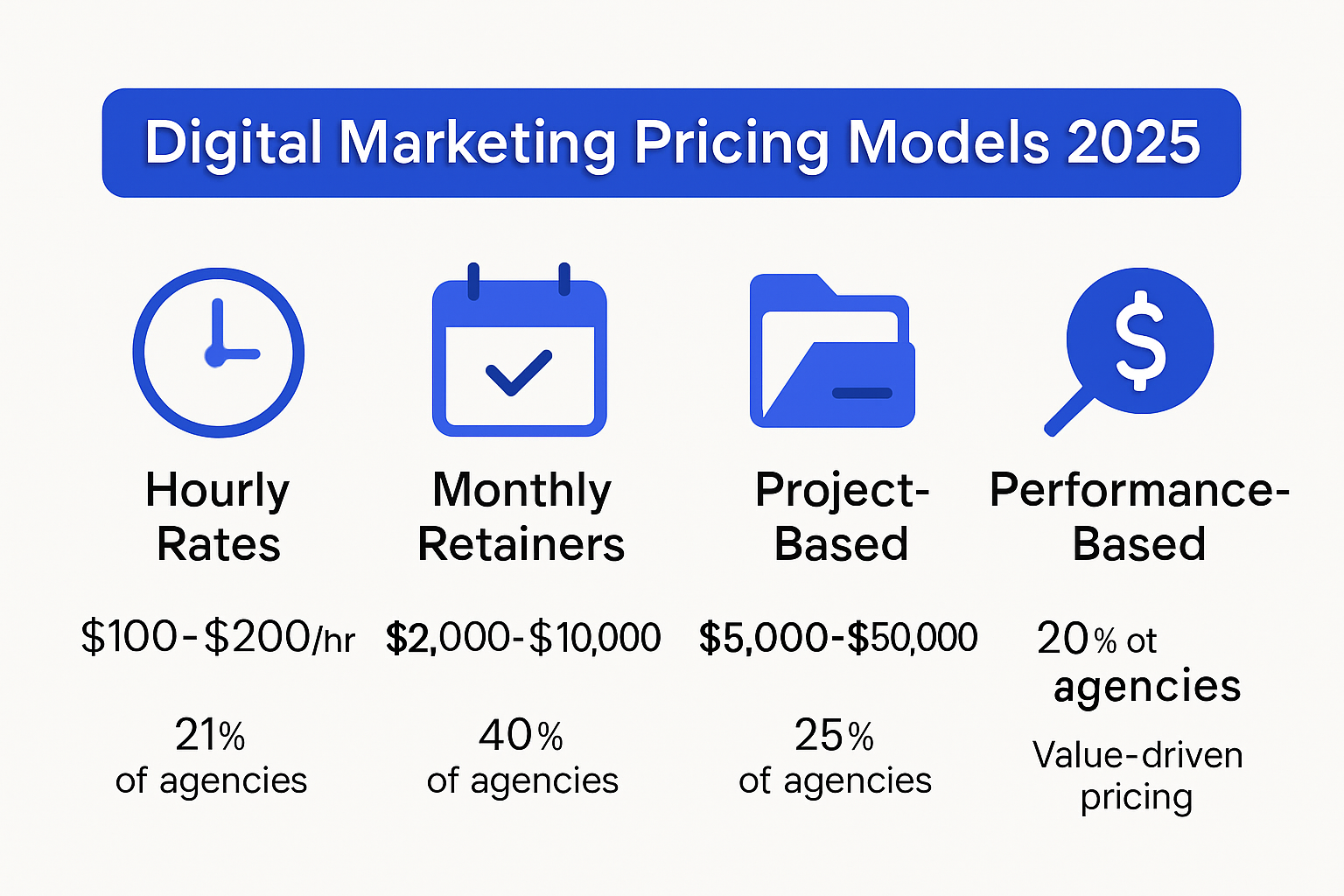
Understanding digital marketing pricing models is crucial for businesses seeking strategic investments in their online growth. Different industries and company sizes require tailored approaches to digital marketing expenditures, making it essential to comprehend the nuanced pricing landscape.
Hourly and Project-Based Pricing Structures
Clutch’s July 2025 Digital Marketing Agency Pricing Guide reveals comprehensive insights into current pricing models. Digital marketing agencies typically charge between $25 and $49 per hour, with specialized services like Social Media Marketing, Content Marketing, Email Marketing, Pay-Per-Click (PPC), and Search Engine Optimization (SEO) generally ranging from $100 to $149 per hour.
Project-based pricing remains popular, with research indicating that most agencies employ flexible pricing methods. Digital marketing projects frequently cost between $10,000 and $49,999, depending on complexity, scope, and required technological integration. Businesses must carefully evaluate their specific needs and align them with appropriate pricing models.
Here is a summary table highlighting the key digital marketing service pricing models and their ranges for 2025, to help businesses quickly compare their options: As companies plan their financial strategies, understanding marketing budget benchmarks for 2026 will be crucial for optimizing their digital campaigns. It is important to stay ahead of industry trends and adjust allocations accordingly. By examining previous years’ data, businesses can make informed decisions that drive growth and enhance ROI.
| Pricing Model | Typical Cost Range in 2025 | Examples / Details |
|---|---|---|
| Hourly (Standard) | $25 – $49/hour | General agency services |
| Hourly (Specialized) | $100 – $149/hour | SMM, Content, Email, PPC, SEO |
| Project-Based | $10,000 – $49,999/project | Depends on scope & complexity |
| Monthly Retainer | $50 – $6,000/month | 67% of businesses in 2025 fall within this range |
| SEO (Monthly) | $500 – $7,500/month | 68% of businesses invest within this range |
| PPC Advertising (Monthly) | $100 – $10,000/month | 45% of businesses in 2025 |
| Email Marketing (Monthly) | $51 – $1,000/month | 60% of businesses |
Monthly Retainer and Performance-Based Models
WebFX’s 2025 digital marketing pricing guide provides illuminating data on monthly digital marketing investments. Approximately 67% of businesses spend between $50 and $6,000 monthly on digital marketing services. Breaking this down further, 68% invest $500 to $7,500 in SEO, 45% allocate $100 to $10,000 for PPC advertising, and 60% spend $51 to $1,000 on email marketing.
Interestingly, performance-based and value-based pricing remain relatively rare. According to Promethean Research, only 2% of agencies use pure value-based pricing, while performance-based pricing appears in just 5% of agency pricing models. This suggests that most agencies prefer more predictable and transparent pricing structures.
Industry-Specific Pricing Considerations
Pricing models vary significantly across different business sectors. Service industries like legal, medical, and professional services often require more comprehensive and customized digital marketing approaches. Our specialized digital marketing strategies can help businesses navigate these nuanced pricing landscapes.
Small businesses might opt for more affordable, package-based solutions, while enterprise-level organizations typically require extensive, tailored digital marketing strategies with corresponding higher investment levels. The key is not just finding the lowest price, but identifying the most effective value proposition that aligns with specific business objectives and growth targets.
Businesses should approach digital marketing pricing as an investment rather than an expense, focusing on potential returns, strategic alignment, and long-term growth potential. Transparent communication with potential digital marketing partners and a clear understanding of expected outcomes remain critical in selecting the most appropriate pricing model.
How to Budget for Digital Marketing Success
Successful digital marketing budgeting requires a strategic approach that balances financial constraints with growth objectives. Businesses must develop a comprehensive framework that allows for flexibility, measurement, and continuous optimization.
Strategic Budget Allocation and Goal Setting
Harvard Business School Online emphasizes the critical importance of aligning digital marketing budgets with specific business goals and objectives. Companies should begin by clearly defining their key performance indicators (KPIs), such as customer acquisition cost (CAC) and return on investment (ROI). This approach transforms marketing spending from a mere expense into a strategic investment.
Unlock essential strategies for small business growth by understanding that budget allocation is not about spending the most money, but spending smartly. Businesses should typically allocate their digital marketing budget across multiple channels, with a recommended distribution that might include:
- Search Engine Marketing (SEM): 25-30% of budget
- Social Media Advertising: 20-25% of budget
- Content Marketing: 15-20% of budget
- Email Marketing: 10-15% of budget
- Emerging Technologies and Experimental Channels: 5-10% of budget
Below is a table summarizing the recommended digital marketing budget allocation by channel, to help businesses visualize suggested percentages:
| Channel | Recommended % of Digital Marketing Budget |
|---|---|
| Search Engine Marketing (SEM) | 25–30% |
| Social Media Advertising | 20–25% |
| Content Marketing | 15–20% |
| Email Marketing | 10–15% |
| Emerging Tech/Experimental Channels | 5–10% |
Data-Driven Budgeting and Performance Tracking
The Digital Marketing Institute recommends a data-driven approach to budgeting that goes beyond traditional spending models. This involves continuous monitoring and adjustment of marketing investments based on real-time performance metrics. Businesses should implement robust analytics tools that provide granular insights into campaign performance, allowing for rapid reallocation of resources to high-performing channels.
Key considerations for data-driven budgeting include:
- Tracking conversion rates across different marketing channels
- Analyzing customer acquisition costs
- Measuring engagement metrics
- Identifying the most profitable customer segments
Flexibility and Innovation Budget
The Digital Marketing Institute’s toolkit highlights the importance of reserving a portion of the marketing budget for innovation and experimentation. In the rapidly evolving digital landscape, businesses cannot afford to become stagnant. Approximately 5-10% of the total marketing budget should be allocated to exploring emerging platforms, testing new technologies, and investigating innovative marketing approaches.
This flexible budget allows businesses to:
- Experiment with emerging social media platforms
- Invest in AI-driven marketing technologies
- Develop innovative content strategies
- Pilot cutting-edge marketing automation tools
Successful digital marketing budgeting is not about achieving perfection but maintaining a dynamic, responsive approach. Businesses must remain agile, continuously learning and adapting their strategies based on market changes, technological advancements, and performance data. Regular quarterly reviews and mid-year budget adjustments can help ensure that marketing investments remain aligned with broader business objectives and market opportunities.
Tips to Maximize ROI on Marketing Spend
Maximizing return on investment (ROI) in digital marketing requires a strategic, data-driven approach that goes beyond traditional spending metrics. Businesses must develop sophisticated strategies that transform marketing expenditures into measurable growth opportunities.
Establishing Clear Performance Metrics
Noble Desktop emphasizes the critical importance of establishing clear Key Performance Indicators (KPIs) aligned with specific business objectives. Companies should implement SMART (Specific, Measurable, Achievable, Relevant, Time-bound) goals that provide actionable insights into marketing performance.
Effective KPI tracking should include:
- Conversion Rates: Measuring the percentage of potential customers taking desired actions
- Customer Acquisition Cost: Calculating the total expense of acquiring a new customer
- Customer Lifetime Value: Evaluating the long-term revenue potential of each customer
- Engagement Metrics: Assessing interaction quality across different marketing channels
Maximize your advertising potential by implementing robust tracking mechanisms that provide granular insights into campaign performance. This approach allows businesses to make data-driven decisions and quickly reallocate resources to high-performing marketing strategies.
Strategic Channel Optimization
Washington Technology highlights that high-growth firms differentiate themselves by conducting frequent market research and making their expertise visible. This involves a multi-faceted approach to channel optimization:
- Continuously analyze performance across different marketing channels
- Invest in platforms that demonstrate consistent high returns
- Develop targeted content that resonates with specific audience segments
- Leverage emerging technologies to improve marketing efficiency
Channels should be evaluated not just on immediate returns but on their potential for long-term customer engagement and brand building. This might mean investing in channels that provide slower but more sustainable growth rather than chasing quick, short-term gains.
Technological Integration and Continuous Learning
Successful ROI maximization requires embracing technological innovations and maintaining a culture of continuous learning. Businesses should:
- Implement advanced analytics and AI-driven marketing tools
- Regularly update skills and knowledge of marketing technologies
- Experiment with emerging platforms and marketing approaches
- Create a flexible marketing strategy that can quickly adapt to market changes
This is the work we do for you. Every week, without exception.
Managing GBP at this level takes 6–8 hours a week when done right. Nova handles the entire system — posts, photos, reviews, Q&A, citations, heatmap tracking — so you can focus on running your business.
The most successful organizations view marketing spend as an investment in ongoing business transformation. This means being willing to experiment, fail quickly, and learn from data-driven insights. Regular performance reviews, quarterly strategy adjustments, and a commitment to technological innovation are crucial for maintaining a competitive edge in the rapidly evolving digital marketing landscape.
Ultimately, maximizing marketing ROI is not about cutting costs but about creating a strategic, intelligent approach to resource allocation. By combining rigorous performance tracking, strategic channel optimization, and a commitment to technological innovation, businesses can transform their marketing spend into a powerful engine for sustainable growth.

Frequently Asked Questions
What are the average costs of digital marketing services in 2025?
The costs of digital marketing services in 2025 vary widely, with agencies charging between $25 and $149 per hour. Monthly budgets for businesses generally range from $50 to $6,000, depending on service complexity and agency reputation.
How does agency reputation affect digital marketing pricing?
Agencies with proven success and robust strategic insights charge higher rates due to their ability to deliver measurable results. Established agencies often ask premium prices for their services based on their track record in the industry.
What factors should businesses consider when budgeting for digital marketing?
Businesses should consider factors like agency expertise, service complexity, potential ROI, and flexibility in budget allocation. Allocating 5-10% of the budget for experimentation and innovation is also recommended to adapt to changing technological landscapes.
How can businesses maximize ROI on their digital marketing spend?
To maximize ROI, businesses should establish clear performance metrics such as conversion rates and customer acquisition costs, optimize marketing channels for efficiency, and integrate technological advancements to maintain a data-driven approach.
Take Control of Your Digital Marketing Budget and Results
Are you tired of guessing where your digital marketing dollars go or feeling uncertain about the value of your investment? The article highlights how unpredictable pricing and fast-changing technologies can make planning difficult, especially when you are under pressure to deliver measurable ROI. Many businesses struggle to balance innovation with predictable returns, and without the right partner, it’s easy to overspend or miss out on what works best.
At 12AM Agency, we solve these challenges by providing transparent digital marketing strategies tailored to your industry and budget. Our expertise spans SEO management, PPC, AI-driven analytics, and proven tactics for local business growth. With a focus on real performance metrics like customer acquisition cost and conversion rates, we help you adapt, scale, and maximize every dollar spent. If you are ready to transform uncertainty into a data-backed growth plan, visit our team today and request your customized digital marketing consultation.
Recommended
- SEO Cost in 2025: What Your Business Should Expect
- Top Digital Marketing Trends 2025 for Business Growth | 12AM Agency
- What Is Digital Marketing? Essential Guide for Business Growth 2025 | 12AM Agency
- Unlock Growth: Essential Digital Marketing Strategies for Small Business Owners in 2025 | 12AM Agency


