





Digital advertising has completely changed the way businesses reach people online. Brands that use digital advertising can grow revenues up to 3 times faster than those sticking to old methods. That sounds like easy money, right? The real surprise is that the secret to this growth is not just about flashy ads or bigger budgets. It is about using smart technology to predict what you want before you even search for it.
Table of Contents
- What Is Digital Advertising And Its Evolution?
- Why The Future Of Digital Advertising Matters For Businesses
- Key Technologies Influencing Digital Advertising Trends
- Consumer Behavior: Adapting To Changing Digital Landscapes
- The Role Of Data Privacy In Future Advertising Strategies
Quick Summary
| Takeaway | Explanation |
|---|---|
| Digital advertising enables precise audience targeting. | Businesses can utilize digital platforms to tailor their marketing efforts directly to specific consumer groups, enhancing engagement. |
| AI drives personalization in digital campaigns. | Artificial intelligence allows for the creation of tailored advertising experiences that respond to user behavior and preferences in real-time. |
| Data privacy is crucial for future advertising strategies. | With increasing regulatory requirements, companies must prioritize consumer privacy while delivering targeted ads, building trust with their audiences. |
| Businesses benefit from adapting to digital trends. | Companies that reinvent their marketing approaches stand to gain competitive advantages and experience faster growth in a digital marketplace. |
| Measuring performance is more straightforward with digital tools. | Digital advertising provides immediate insights and analytics, allowing businesses to evaluate the success of their campaigns dynamically. |
What is Digital Advertising and Its Evolution?
Digital advertising represents a dynamic and transformative approach to marketing that leverages online platforms and technologies to connect businesses with their target audiences. Unlike traditional advertising methods, digital advertising allows for precise targeting, real-time performance tracking, and unprecedented levels of audience engagement.
Below is a table comparing traditional advertising and digital advertising, helping clarify their key differences as discussed in the article.
| Feature | Traditional Advertising | Digital Advertising |
|---|---|---|
| Audience Targeting | Broad, less precise | Highly specific, granular |
| Performance Tracking | Delayed, less measurable | Real-time, immediate insights |
| Adaptability | Static, limited changes | Dynamic, adaptable campaigns |
| Cost Effectiveness | Higher costs, less flexible | More cost-effective, scalable |
| Personalization Capabilities | Generic messaging | Hyper-personalized experiences |
The Foundational Concept of Digital Advertising
At its core, digital advertising is the practice of delivering promotional content through digital channels such as websites, social media platforms, mobile applications, and search engines. Digital marketing strategies have dramatically shifted how businesses communicate and interact with potential customers.
Key characteristics of digital advertising include:
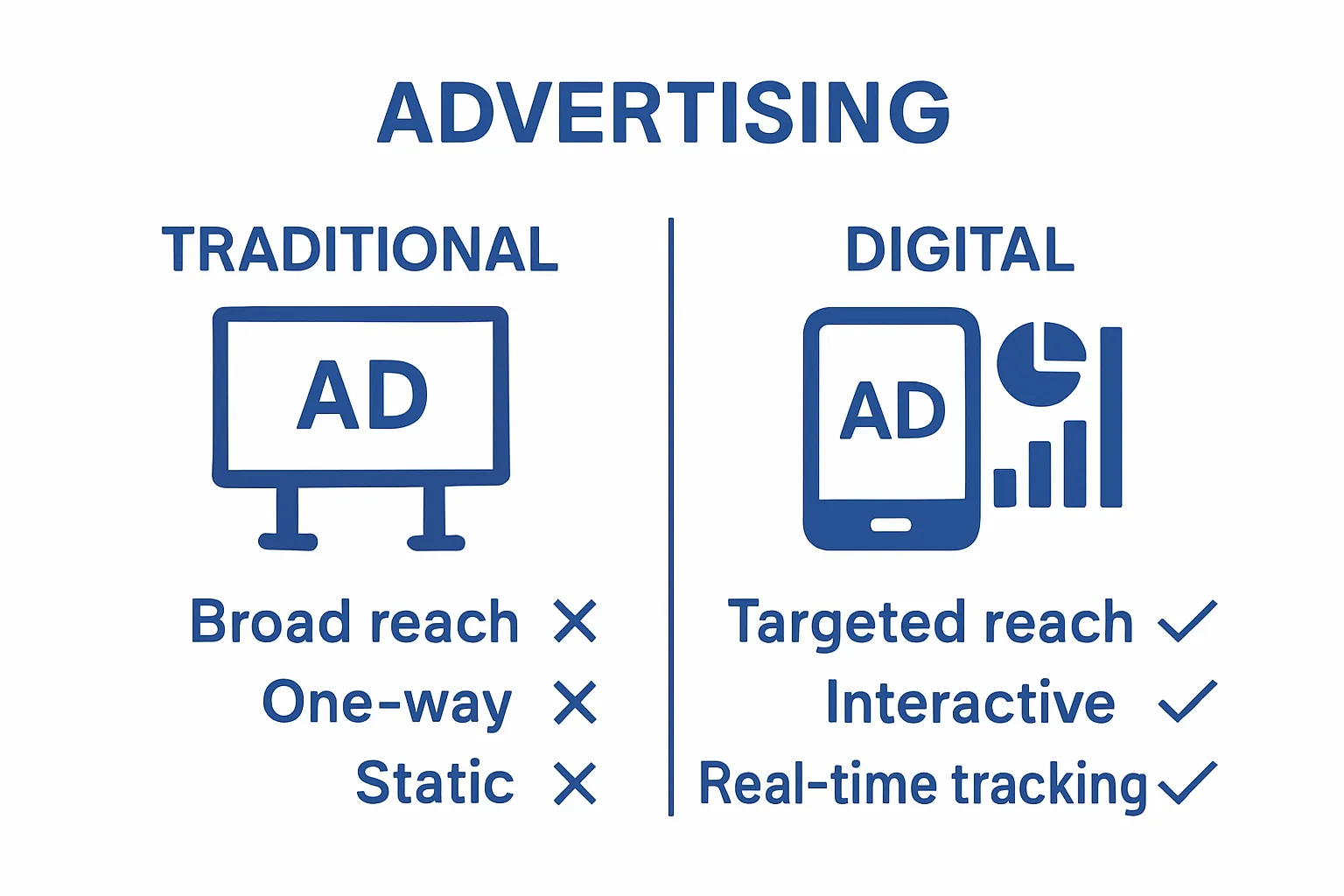
- Immediate and measurable reach
- Granular audience targeting capabilities
- Cost-effective compared to traditional media
- Dynamic and adaptable campaign structures
Historical Progression and Technological Innovation
The evolution of digital advertising traces a remarkable journey from simple banner ads to sophisticated, AI-driven marketing ecosystems. According to Deloitte’s Digital Media Trends Report, the digital advertising landscape has undergone radical transformations driven by technological advancements.
Early digital advertising primarily consisted of static display advertisements and rudimentary targeting techniques. Today, machine learning algorithms and real-time bidding platforms enable hyper-personalized advertising experiences that adapt instantaneously to user behaviors and preferences.
Modern digital advertising integrates multiple technologies including programmatic ad buying, predictive analytics, and cross-platform tracking mechanisms.
The following table outlines the key technologies currently driving the evolution of digital advertising, with their main functions as described in the article.
| Technology | Function in Digital Advertising |
|---|---|
| Artificial Intelligence | Enables predictive targeting, personalization, automation |
| Machine Learning | Powers dynamic content, predictive analytics |
| Programmatic Ad Buying | Automates real-time bidding for ad placement |
| Advanced Data Analytics | Delivers actionable marketing insights |
| Blockchain | Ensures secure and transparent data tracking |
| Privacy-Enhancing Technologies | Enables user consent and privacy controls |
Why the Future of Digital Advertising Matters for Businesses
The future of digital advertising represents a critical strategic imperative for businesses seeking sustainable growth and competitive advantage in an increasingly digital marketplace. Organizations that recognize and adapt to emerging digital advertising trends will position themselves to capture market share and drive meaningful customer engagement.
Strategic Business Transformation
Digital advertising is no longer a supplementary marketing strategy but a fundamental mechanism for business survival and expansion. Digital marketing trends for 2025 indicate that companies investing in sophisticated digital advertising approaches will experience significant competitive advantages.
Key strategic implications include:
- Direct connection with target audiences
- Reduced customer acquisition costs
- Enhanced brand visibility and recognition
- Measurable and trackable marketing performance
- Ability to pivot strategies based on real-time data
Economic and Competitive Advantages
According to McKinsey Global Institute, businesses that effectively leverage digital advertising can experience up to 3x faster revenue growth compared to their less digitally adaptive competitors. Technological innovations like artificial intelligence and machine learning are transforming digital advertising from a broadcasting medium to a precision engagement tool.
The future of digital advertising transcends traditional marketing boundaries. By integrating advanced targeting technologies, predictive analytics, and personalized content delivery, businesses can create more meaningful connections with potential customers. These sophisticated approaches enable companies to move beyond generic messaging and develop hyper-personalized marketing experiences that resonate deeply with individual consumer preferences and behaviors.
Key Technologies Influencing Digital Advertising Trends
The digital advertising landscape continues to evolve rapidly, driven by groundbreaking technological innovations that reshape how businesses connect with their audiences. These emerging technologies are not just incremental improvements but transformative forces that fundamentally alter marketing strategies and consumer interactions.
Artificial Intelligence and Machine Learning
Artificial intelligence has become the cornerstone of modern digital advertising, enabling unprecedented levels of personalization and predictive targeting. Digital marketing trends for emerging technologies reveal that AI-powered systems can analyze complex user behavior patterns with remarkable accuracy.
Key AI applications in digital advertising include:
- Automated audience segmentation
- Real-time content personalization
- Predictive customer behavior modeling
- Dynamic pricing and ad placement optimization
- Intelligent chatbot interactions
Advanced Data Analytics and Tracking Technologies
According to Gartner’s Digital Marketing Research, the future of digital advertising hinges on sophisticated data analytics capabilities. Blockchain technologies and enhanced privacy frameworks are creating more transparent and secure data tracking mechanisms that respect user privacy while delivering precise marketing insights.
Modern digital advertising technologies integrate complex data processing techniques that transform raw information into actionable marketing strategies. These advanced systems can track user interactions across multiple platforms, creating comprehensive user profiles that enable hyper-targeted advertising experiences without compromising individual privacy rights.
 By leveraging machine learning algorithms and real-time data processing, businesses can now create marketing campaigns that are not just reactive but predictive, anticipating consumer needs before they are explicitly expressed.
Consumer Behavior: Adapting to Changing Digital Landscapes
The digital landscape continually transforms consumer expectations, creating a complex ecosystem where traditional marketing approaches struggle to maintain relevance. Understanding these evolving consumer behaviors has become paramount for businesses seeking meaningful engagement and sustainable growth.
Shifting Digital Consumption Patterns
Consumer interactions with digital platforms have fundamentally changed, driven by technological accessibility and generational shifts. Digital transformation strategies highlight the critical need for businesses to understand these emerging behavioral trends.
Key characteristics of modern digital consumer behavior include:
- Preference for personalized experiences
- Increased demand for instant gratification
- Higher expectations for transparent brand interactions
- Multi-platform engagement strategies
- Value-driven consumption decisions
Privacy and Personalization Dynamics
According to Pew Research Center, consumers are simultaneously seeking personalization while becoming more protective of their digital privacy. This nuanced approach requires businesses to develop sophisticated engagement strategies that balance targeted marketing with respect for individual data boundaries.
Modern consumers navigate digital landscapes with unprecedented complexity. They demand authentic, contextually relevant interactions that transcend traditional demographic segmentation. Successful brands will be those that can create adaptive, intelligent marketing ecosystems that anticipate consumer needs while maintaining transparent, consent-based communication protocols. Emotional intelligence in digital marketing has emerged as a critical differentiator, enabling businesses to connect with audiences through genuine, meaningful digital experiences.
The Role of Data Privacy in Future Advertising Strategies
Data privacy has emerged as a critical cornerstone in modern digital advertising, fundamentally reshaping how businesses collect, utilize, and protect consumer information. The evolving regulatory landscape and increasing consumer awareness have transformed data privacy from a technical compliance requirement to a strategic business imperative.
Regulatory Frameworks and Consumer Protection
Comprehensive data protection regulations are dramatically restructuring digital advertising practices worldwide. Understanding ethical digital marketing reveals the complex intersection between technological innovation and consumer rights protection. As businesses navigate this evolving landscape, implementing search engine reputation management strategies becomes crucial for maintaining brand integrity. These strategies not only help mitigate negative perceptions but also enhance consumer trust in the digital space. By focusing on transparency and accountability, companies can better align their marketing efforts with the principles of ethical digital practices.
Key regulatory considerations include:
The table below summarizes the main regulatory considerations for digital advertising data privacy mentioned in the article.
| Regulatory Consideration | Description |
|---|---|
| User Consent Mechanisms | Mandatory opt-in before data collection |
| Transparent Data Collection Practices | Clear disclosure of what data is gathered |
| Data Access and Deletion Rights | Consumers can view and erase their data |
| Non-Compliance Penalties | Fines or actions for breaking regulations |
| Cross-Border Data Transfer Restrictions | Limitations on moving data between countries |
- Mandatory user consent mechanisms
- Transparent data collection practices
- Right to data access and deletion
- Strict penalties for non-compliance
- Cross-border data transfer restrictions
Balancing Personalization and Privacy
According to International Association of Privacy Professionals, businesses must develop sophisticated strategies that respect individual privacy while maintaining effective targeting capabilities. Advanced anonymization technologies are enabling marketers to derive meaningful insights without compromising personal identifiable information.
The future of digital advertising demands a nuanced approach that prioritizes user trust and data sovereignty. Successful organizations will leverage privacy-enhancing technologies that enable granular consent management, real-time data control, and transparent communication about data usage. By transforming data privacy from a compliance burden to a competitive advantage, businesses can build deeper, more meaningful relationships with increasingly privacy-conscious consumers.
Ready to Lead in the Future of Digital Advertising?
As digital advertising rapidly transforms, many businesses struggle to keep up with advanced targeting, privacy demands, and the need for truly personalized marketing. If your current strategy feels outdated or fails to deliver measurable results, you are not alone. This article highlights the urgent need for AI-driven solutions, data privacy integration, and hyper-personalized campaigns. Staying ahead requires more than just awareness—it demands real innovation and a partner who is already mastering these new frontiers.

Do not get left behind as digital marketing evolves. Connect with a team who specializes in cutting-edge strategies built around your industry needs. Reach out now for a consultation at Contact Us and discover how our AI-powered review management, advanced web design and SEO solutions, and real-time PPC advertising can transform your digital presence. Take the next step toward proven, future-focused marketing excellence today—opportunity favors those who act first.
Frequently Asked Questions
What is digital advertising?
Digital advertising is the practice of delivering promotional content through digital channels such as websites, social media, mobile applications, and search engines, allowing for precise targeting and real-time tracking.
How has digital advertising evolved over the years?
Digital advertising has evolved from simple banner ads to sophisticated, AI-driven marketing strategies. Innovations like machine learning, programmatic ad buying, and predictive analytics have transformed how businesses engage with consumers.
Why is data privacy important in digital advertising?
Data privacy is crucial in digital advertising as it affects how businesses collect and use consumer information. Compliance with regulations and respecting user privacy builds trust and helps maintain a positive brand image.
What technologies are shaping the future of digital advertising?
Key technologies influencing digital advertising include artificial intelligence, advanced data analytics, and tracking technologies, which enable hyper-personalized advertising experiences and more effective marketing strategies.
Recommended
- Top Digital Marketing Trends 2025 for Business Growth | 12AM Agency
- 8 Digital Marketing Trends in 2020 | 12AM Agency
- What Is Digital Marketing? Essential Guide for Business Growth 2025 | 12AM Agency
- The Agentic AI Revolution: How to Automate $16k of Work in 2025 | 12AM Agency
- What is Digital Marketing? Understanding Its Importance