




Enterprise digital solutions promise to completely reshape how organizations operate and compete, combining powerful software, hardware, and service platforms under one strategy. But some companies are seeing up to 23 percent higher operational efficiency and even 26 percent faster revenue growth after making these shifts. Most people think the magic is all in the tech stack, but the real difference comes from how these tools wipe away old silos and create surprising new ways for businesses to adapt and win.
Table of Contents
- What Are Enterprise Digital Solutions?
- The Importance Of Enterprise Digital Solutions In Today’s Market
- How Enterprise Digital Solutions Function
- Key Concepts And Technologies Behind Digital Solutions
- Real-World Applications Of Enterprise Digital Solutions
Quick Summary
| Takeaway | Explanation |
|---|---|
| Enterprise digital solutions streamline business operations | These solutions integrate technologies that optimize processes, enhancing productivity across departments. |
| Real-time data analytics drive faster decision-making | Access to immediate insights allows for timely responses to market changes and customer needs. |
| Customized implementation ensures strategic relevance | Each solution is tailored to fit unique organizational structures and goals, maximizing its impact. |
| Cloud computing fosters scalability and adaptability | This technology enables efficient resource management, supporting growth and operational flexibility. |
| Automation reduces operational costs and increases efficiency | Implementing automated systems minimizes manual tasks, resulting in significant cost savings and improved productivity. |
What Are Enterprise Digital Solutions?
Enterprise digital solutions represent comprehensive technological strategies designed to transform how businesses operate, compete, and deliver value in the digital age. These integrated software, hardware, and service platforms enable organizations to streamline operations, enhance productivity, and create measurable competitive advantages across multiple business functions.
Core Components of Enterprise Digital Solutions
At their foundation, enterprise digital solutions encompass a wide range of interconnected technologies and strategic approaches that address complex organizational challenges. They typically include:
- Advanced data analytics platforms that provide real-time insights
- Cloud-based infrastructure and management systems
- Automated workflow and process optimization tools
- Cybersecurity and risk management frameworks
- Artificial intelligence and machine learning integrations
The primary objective of these solutions is to break down traditional organizational silos, creating seamless communication and data exchange across departments. By implementing enterprise digital marketing strategies, companies can transform how they interact with customers, manage internal processes, and make strategic decisions.
Below is a table summarizing the core components of enterprise digital solutions and their primary functions, helping clarify their role in transforming business operations.
| Component | Primary Function |
|---|---|
| Data Analytics Platforms | Provide real-time insights for strategic decision-making |
| Cloud-Based Infrastructure | Enable scalable, efficient resource and data management |
| Automated Workflow Tools | Streamline and optimize business processes |
| Cybersecurity and Risk Management Frameworks | Protect data and systems; mitigate security threats |
| Artificial Intelligence & Machine Learning | Enhance automation, prediction, and adaptive capabilities |
Strategic Implementation and Business Impact
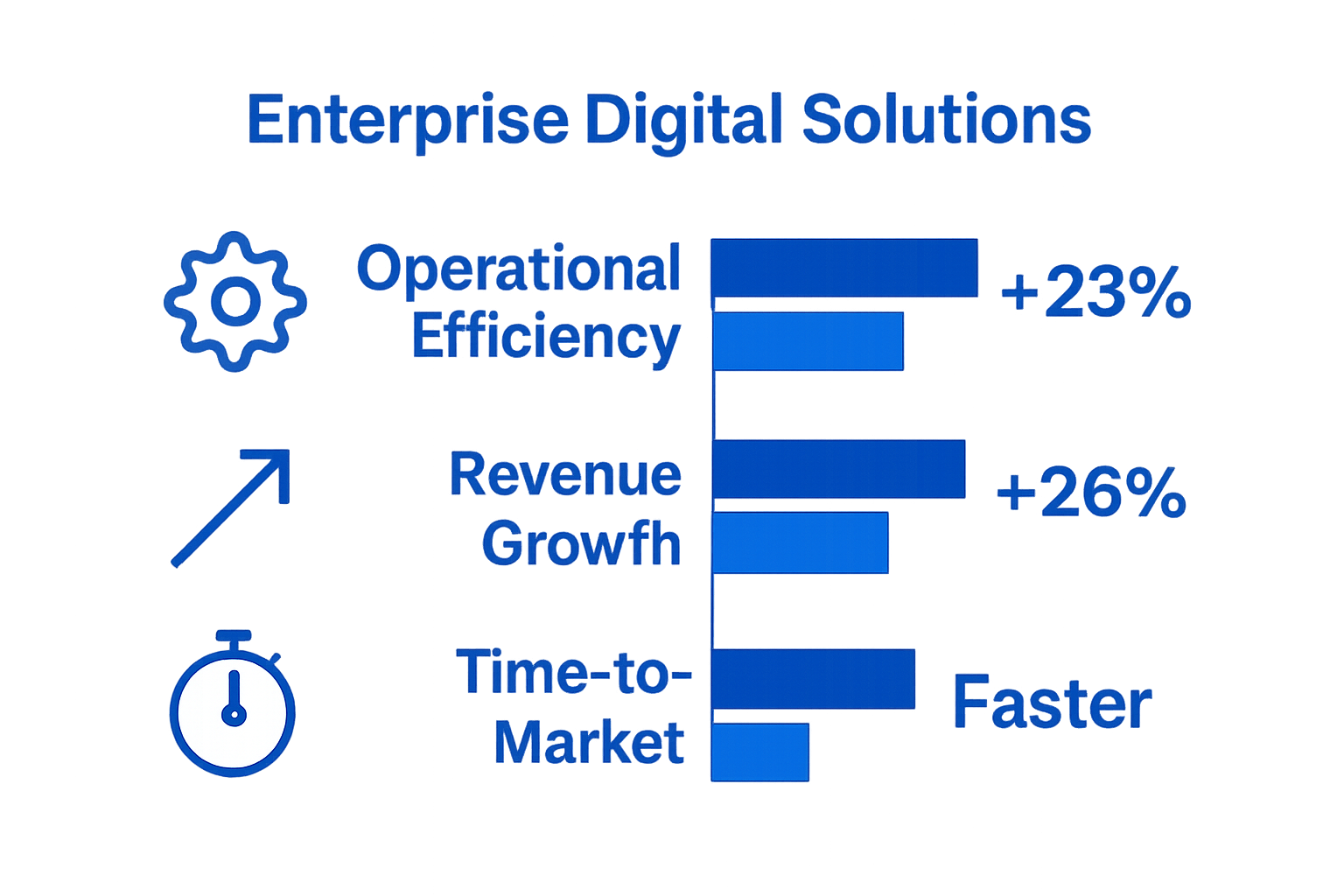
Successful enterprise digital solutions go beyond mere technological implementation. According to Gartner Research, organizations that effectively integrate digital solutions can experience up to 23% improvement in operational efficiency and a significant increase in competitive positioning.
These solutions are not one-size-fits-all but are carefully customized to match an organization’s unique operational landscape, industry requirements, and strategic goals. By leveraging advanced technologies, businesses can create adaptive, intelligent systems that respond dynamically to market changes, customer needs, and emerging technological trends.
See exactly where your profile stands right now.
Our GBP audit shows your current rank position across your market, how your profile completeness scores against competitors, and the specific gaps holding you back from the Map Pack.
Ultimately, enterprise digital solutions represent a holistic approach to digital transformation, enabling businesses to reimagine their operational models, enhance customer experiences, and drive sustainable growth in an increasingly complex digital ecosystem.
The Importance of Enterprise Digital Solutions in Today’s Market
In an increasingly competitive global marketplace, enterprise digital solutions have transformed from optional technological upgrades to critical strategic imperatives for businesses seeking sustainable growth and resilience. These comprehensive technological frameworks enable organizations to navigate complex market dynamics, respond rapidly to changing consumer expectations, and maintain a competitive edge.
Driving Business Competitiveness and Adaptability
The modern business landscape demands unprecedented levels of agility and responsiveness. Digital transformation for SMBs represents a fundamental shift in how companies approach technological integration and strategic planning. Enterprises that effectively leverage digital solutions can achieve significant competitive advantages through:
- Faster decision making enabled by real-time data insights
- Enhanced operational efficiency across multiple business units
- Improved customer engagement and personalization strategies
- Reduced operational costs through automation
- Greater capacity for innovation and rapid market adaptation
According to Deloitte Research, companies investing strategically in digital solutions can experience up to 26% higher revenue growth compared to their less digitally mature competitors.

Economic and Organizational Transformation
Enterprise digital solutions are not merely technological tools but comprehensive organizational transformation mechanisms. They enable businesses to reimagine traditional operational models, create more flexible and responsive organizational structures, and develop new revenue streams through innovative digital capabilities.
Moreover, these solutions provide robust frameworks for managing emerging challenges such as remote work environments, global supply chain complexities, and rapidly evolving cybersecurity threats. By integrating advanced technologies like artificial intelligence, machine learning, and cloud computing, businesses can build resilient, intelligent systems capable of anticipating and responding to market disruptions.
This table organizes key data points and research findings mentioned in the article to provide a quick reference for the measurable impacts of enterprise digital solutions on businesses.
| Source | Metric/Benefit | Percentage Increase |
|---|---|---|
| Gartner Research | Operational efficiency improvement | Up to 23% |
| Deloitte Research | Revenue growth over competitors | Up to 26% |
| McKinsey Research | Industry-specific operational improvement | Up to 50% |
The strategic implementation of enterprise digital solutions represents a fundamental paradigm shift in how organizations conceptualize technological investment, positioning digital capabilities as core drivers of business strategy rather than supplementary support functions.
How Enterprise Digital Solutions Function
Enterprise digital solutions operate as sophisticated technological ecosystems designed to integrate, optimize, and streamline complex business processes through advanced interconnected technologies. These comprehensive platforms function by creating intelligent, adaptive networks that transform raw data into actionable strategic insights across organizational structures.
Integration and Data Management
At their core, enterprise digital solutions function through intricate data integration mechanisms that consolidate information from multiple sources into centralized, intelligent systems. Enterprise SEO strategies exemplify how these solutions can synchronize diverse data streams to create comprehensive operational visibility.
The fundamental operational framework includes several critical components:
- Centralized data repositories that aggregate information from disparate systems
- Advanced analytics engines that process and interpret complex datasets
- Machine learning algorithms that enable predictive and prescriptive insights
- Secure cloud infrastructure supporting real-time data transmission
- Customizable dashboards for strategic decision making
According to Gartner Research, successful enterprise digital solutions leverage a modular approach that allows seamless scalability and continuous technological adaptation.
Technological Architecture and Adaptive Mechanisms
The technological architecture of enterprise digital solutions represents a dynamic, multilayered system designed to provide continuous operational optimization. These solutions employ advanced technologies such as artificial intelligence, machine learning, and cloud computing to create intelligent, self-adjusting platforms that can anticipate organizational needs and proactively recommend strategic interventions.
Unlike traditional technological infrastructures, modern enterprise digital solutions function as living, evolving systems. They continuously analyze performance metrics, identify potential inefficiencies, and suggest optimization strategies across various business domains. This adaptive approach enables organizations to maintain technological relevance, respond rapidly to market changes, and drive sustainable competitive advantages through intelligent, data-driven decision making.
Key Concepts and Technologies Behind Digital Solutions
Enterprise digital solutions are underpinned by a complex network of advanced technologies that work synergistically to transform traditional business operations. These technological foundations represent a sophisticated ecosystem of interconnected tools, platforms, and methodological approaches designed to drive organizational innovation and strategic capabilities.
Core Technological Frameworks
Digital transformation strategies serve as the architectural blueprint for integrating cutting-edge technologies into comprehensive enterprise solutions. The fundamental technological frameworks that power these solutions include:
- Cloud computing infrastructure enabling scalable and flexible resource management
- Advanced artificial intelligence and machine learning algorithms
- Robust cybersecurity and data protection mechanisms
- Distributed computing and edge computing technologies
- Blockchain and distributed ledger systems for secure, transparent transactions
According to IBM Research, cloud computing has become a critical enabler of digital transformation, providing businesses with unprecedented computational flexibility and global accessibility.
Emerging Technologies and Integration Strategies
The most advanced enterprise digital solutions leverage emerging technologies that go beyond traditional computational models. These technologies function through intricate interconnection, creating intelligent systems capable of adaptive learning, predictive analysis, and autonomous decision making.
Artificial intelligence and machine learning represent the most transformative technological components, enabling systems to analyze complex datasets, identify patterns, and generate actionable insights with minimal human intervention. By combining predictive analytics, real-time data processing, and adaptive algorithms, these technologies create self-optimizing platforms that can anticipate organizational needs and proactively recommend strategic interventions.
Ultimately, the power of enterprise digital solutions lies not in individual technologies but in their sophisticated integration, creating holistic technological ecosystems that transcend traditional computational boundaries and enable unprecedented levels of organizational intelligence and strategic responsiveness.
Real-World Applications of Enterprise Digital Solutions
Enterprise digital solutions translate sophisticated technological frameworks into practical, industry-specific interventions that solve complex business challenges across multiple sectors. These solutions demonstrate remarkable versatility in addressing unique operational requirements while driving organizational performance and innovation.
Industry-Specific Digital Transformation
Digital transformation for the automotive industry exemplifies how enterprise digital solutions can revolutionize traditional business models. Different industries leverage these technologies to address sector-specific challenges through targeted technological interventions:
- Healthcare: Patient management systems and telemedicine platforms
- Manufacturing: Predictive maintenance and supply chain optimization
- Financial Services: Risk management and fraud detection algorithms
- Retail: Personalized customer experience and inventory management
- Logistics: Real-time tracking and automated routing systems
According to McKinsey Research, organizations that successfully implement industry-specific digital solutions can achieve up to 50% improvement in operational efficiency.
This is the work we do for you. Every week, without exception.
Managing GBP at this level takes 6–8 hours a week when done right. Nova handles the entire system — posts, photos, reviews, Q&A, citations, heatmap tracking — so you can focus on running your business.
The following table compares the ways different industries apply enterprise digital solutions, highlighting practical use-cases to show their broad applicability across sectors.
| Industry | Example Digital Solution Application |
|---|---|
| Healthcare | Patient management systems, telemedicine platforms |
| Manufacturing | Predictive maintenance, supply chain optimization |
| Financial Services | Risk management, fraud detection algorithms |
| Retail | Personalized customer experience, inventory management |
| Logistics | Real-time tracking, automated routing systems |
Strategic Performance Enhancement
Enterprise digital solutions function beyond mere technological implementation by creating intelligent, adaptive systems that generate actionable insights. These solutions enable businesses to transform raw data into strategic advantages through advanced analytics, machine learning algorithms, and comprehensive integration platforms.
By providing real-time performance monitoring, predictive analytics, and automated decision-making capabilities, digital solutions empower organizations to move from reactive management to proactive strategic planning. The ability to anticipate market shifts, optimize resource allocation, and personalize customer interactions represents a fundamental shift in how businesses conceptualize technological investment and competitive strategy.
Ready to Break Down Silos and Accelerate Growth?
Many businesses struggle with outdated systems that block collaboration and slow down progress. As highlighted in the article, unlocking growth with enterprise digital solutions means unifying your data, automating workflows, and making smarter decisions faster. If your company feels stuck with manual processes, disconnected data, or missed opportunities for innovation, this is your chance to change that.

See what’s possible with a team that thrives on enterprise digital marketing strategies and custom AI-driven tools. From advanced digital transformation techniques to tailored campaigns, discover how your business can increase productivity and stand out. Book a free consultation at 12AM Agency right now and start building your digital edge today.
Frequently Asked Questions
What are enterprise digital solutions?
Enterprise digital solutions are comprehensive technological strategies that transform how businesses operate and deliver value. They encompass integrated software, hardware, and service platforms to enhance productivity and streamline operations.
How can enterprise digital solutions improve operational efficiency?
Enterprise digital solutions can lead to significant improvements in operational efficiency by breaking down traditional silos, enabling real-time data insights, automating workflows, and optimizing processes across various business functions.
What core technologies are involved in enterprise digital solutions?
Core technologies include cloud computing, advanced data analytics, artificial intelligence, machine learning, automation tools, and cybersecurity frameworks, which work together to create an integrated and responsive operational environment.
How do enterprise digital solutions drive business innovation?
By leveraging advanced technologies and data-driven insights, enterprise digital solutions enable organizations to adapt to market changes, enhance customer experiences, and develop new revenue streams, thereby driving innovation and growth.

