




Businesses keep pouring billions into new customer experience tools every year. By 2025, over 50 percent of organizations are already using national surveys and publishing detailed performance reports on customer feedback. That sounds incredibly advanced, right? Yet the real surprise is that the best customer experiences are not coming from technology itself. It turns out the secret is how companies use empathy and adaptability to shape every single customer interaction.
Table of Contents
- Understanding Customer Experience Strategies
- Building A Customer-Centric Culture
- Leveraging Digital Tools For Better Service
- Measuring Success And Continuous Improvement
Quick Summary
| Takeaway | Explanation |
|---|---|
| Hyperpersonalization is Key | Businesses must focus on creating tailored, unique experiences for each customer, leveraging advanced data analytics and predictive AI technologies. |
| Seamless Omnichannel Integration | Successful strategies require consistent high-quality interactions across all communication channels, ensuring customers feel valued and heard. |
| Transformative Customer-Centric Culture | Organizations need to fundamentally shift towards a customer-centric mindset, where every employee understands their role in enhancing customer experiences. |
| Advanced Measurement Techniques | Employ comprehensive metrics that go beyond traditional satisfaction scores to gain nuanced insights into customer interactions and emotional engagement. |
| Adaptive Improvement Frameworks | Businesses should establish dynamic, agile methodologies that allow quick responses to customer feedback, fostering a culture of continuous learning and improvement. |
Understanding Customer Experience Strategies
Customer experience strategies represent the comprehensive approach businesses use to manage and enhance interactions between their organization and customers across multiple touchpoints. In 2025, these strategies are becoming increasingly sophisticated, driven by technological advancements and changing consumer expectations.
The Evolution of Customer Experience Design
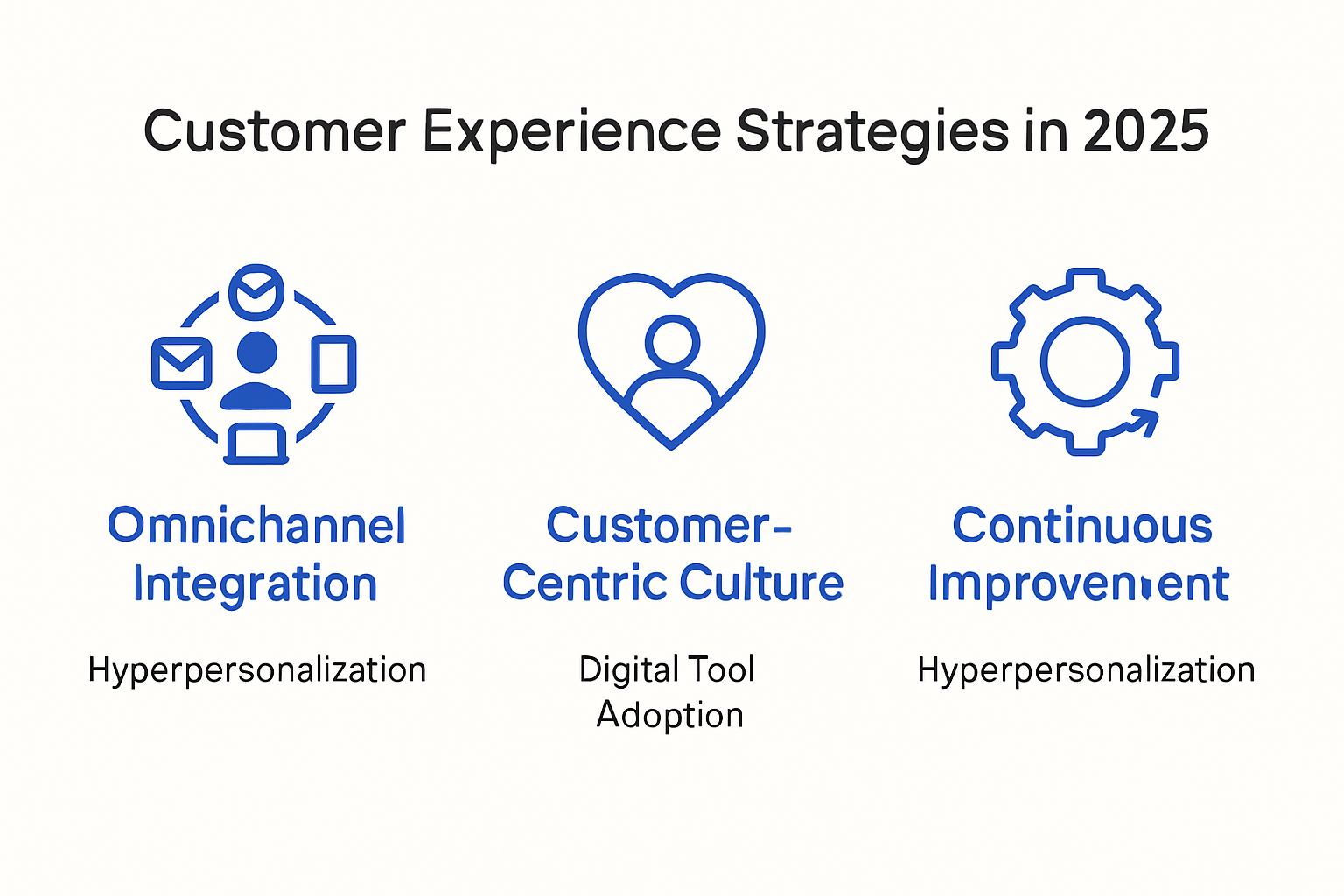
Customer experience is no longer just about resolving issues. According to Forbes, businesses must now focus on hyperpersonalizing experiences at scale. This means creating tailored interactions that feel uniquely crafted for each individual customer, leveraging advanced data analytics and AI technologies.
The core of modern customer experience strategies involves understanding and anticipating customer needs before they even articulate them. Predictive AI tools now enable businesses to analyze customer behavior patterns, preferences, and potential future requirements. Tech Target highlights that proactive outreach using predictive technologies will become a standard practice, transforming reactive customer service models into anticipatory engagement frameworks.
Integrated Omnichannel Experience Strategies
Successful customer experience strategies in 2025 demand seamless integration across multiple communication channels. This means creating consistent, high-quality interactions whether a customer connects through social media, mobile apps, websites, phone support, or in-person experiences. The goal is to provide a unified brand experience where transitions between platforms feel smooth and intuitive.
Businesses are recognizing that customers expect instant, personalized communication. Social media platforms are no longer just marketing channels but critical real-time support mechanisms. Companies must develop robust strategies that enable rapid, meaningful engagement across these platforms, ensuring customers feel heard and valued.
Moreover, our guide on strategic customer insights can help businesses understand how to effectively deploy marketing resources and optimize their customer experience approach. By analyzing customer data and interaction patterns, organizations can continuously refine their engagement strategies.
The most advanced customer experience strategies will incorporate artificial intelligence, predictive analytics, and human-centered design principles. They will prioritize empathy, personalization, and proactive problem-solving. Businesses that master these elements will not just meet customer expectations but consistently exceed them, creating lasting competitive advantages in an increasingly complex digital marketplace.
Building a Customer-Centric Culture
To provide a clearer view, here’s a table summarizing key practices and their impact for building a customer-centric culture as discussed in this section:
| Practice/Element | Key Description | Impact on Organization |
|---|---|---|
| Immersive Training Programs | Employees interact with real customers across roles | Builds empathy and deepens understanding |
| Leadership Direct Customer Engagement | Leaders directly connect with customers to grasp needs | Sets example and guides organizational mindset |
| Employee-Engaging Transformation (EET) | Includes Vision Translation, Persistent Leadership, etc. | Sustains change through structural transformation |
| Middle Management Activation | Managers empowered for customer-focused decisions | Bridges strategic vision and frontline execution |
| Redesigned Metrics & Rewards | Customer satisfaction prioritized over productivity | Encourages and rewards customer-centric behaviors |
| Continuous Feedback Loops | Regularly gather and apply customer feedback | Enables rapid adaptation and improvement |
Building a customer-centric culture requires more than superficial training programs or motivational posters. It demands a profound organizational transformation where every employee understands their role in delivering exceptional customer experiences. In 2025, businesses recognize that customer-centricity is not a department but a comprehensive mindset that permeates every organizational level.
Embedding Customer Empathy Throughout the Organization
To create a truly customer-centric culture, organizations must fundamentally reshape their approach to employee engagement and training. According to University of Arkansas research, developing a culture of empathy starts with leaders directly engaging with customers to understand their needs. This means moving beyond abstract metrics and connecting employees with real customer experiences.
Successful companies are implementing immersive training programs where employees from all departments spend time interacting with customers. Engineers observe product usage, finance teams understand billing challenges, and administrative staff experience service interactions. By creating these direct connections, organizations transform abstract customer data into tangible, emotional understanding.

Structural Transformation for Customer-Centricity
Transforming organizational structure is critical for embedding customer-centricity. The XM Institute outlines the Employee-Engaging Transformation (EET) approach, which includes five pivotal practices: Vision Translation, Persistent Leadership, Middle Management Activation, Grassroots Mobilization, and Captivating Communications.
Middle management plays a crucial role in this transformation. They act as critical bridges between strategic vision and frontline execution. By empowering managers to make customer-focused decisions and rewarding customer-centric behaviors, organizations can create sustainable cultural change. This might involve redesigning performance metrics, compensation structures, and recognition programs to prioritize customer satisfaction over traditional productivity measures.
Additionally, our strategic insights on resource deployment can help businesses understand how to align their internal resources with customer experience goals. By analyzing customer interaction data, companies can make more informed decisions about training, technology investments, and organizational design.
The most successful customer-centric cultures will be those that view customer experience as a continuous learning journey. They will create feedback loops that allow rapid adaptation, encourage cross-functional collaboration, and maintain a relentless focus on understanding and anticipating customer needs. By treating customer-centricity as a dynamic, evolving strategy rather than a static set of rules, businesses can create resilient, adaptive organizations that consistently deliver exceptional experiences.
Leveraging Digital Tools for Better Service
To help readers quickly compare advanced digital tools and their customer experience benefits for 2025, the following table summarizes key features and strengths mentioned in this section:
| Digital Tool/Approach | Key Features | Customer Experience Benefit |
|---|---|---|
| Predictive AI & Machine Learning | Data analysis, future behavior prediction | Hyper-personalized recommendations |
| Modern Recommendation Engines | Use of demographic, real-time, and history | Suggests tailored solutions/offers |
| Omnichannel Integration | Unified channels (social, mobile, website) | Seamless and consistent experience |
| Digital Experience Ecosystems | Multiple integrated digital touchpoints | Intuitive, engaging customer journey |
| Maturity Model Assessment | Structured evaluation of digital capabilities | Systematic improvement over time |
Digital tools have transformed from optional enhancements to essential components of customer service strategies. In 2025, businesses are integrating sophisticated technologies to create more responsive, personalized, and efficient customer experiences that meet increasingly complex consumer expectations.
Advanced AI and Machine Learning Integration
Artificial intelligence and machine learning are revolutionizing customer service approaches. Research from ArXiv reveals that machine learning algorithms are dramatically improving recommendation systems, enabling businesses to provide hyper-personalized interactions that anticipate customer needs before they are explicitly expressed.
Modern recommendation engines use complex predictive models that analyze multiple data points including past purchase history, browsing behavior, demographic information, and real-time interaction patterns. These systems can generate incredibly nuanced suggestions, transforming generic customer interactions into tailored experiences that feel individually crafted.
Digital Experience Design and Optimization
Companies are moving beyond simple digital interfaces to create comprehensive digital experience ecosystems. According to research from Wiley, organizations are developing intricate frameworks that integrate multiple digital touchpoints to create seamless, intuitive customer journeys.
This approach requires sophisticated design thinking that considers every potential customer interaction. Digital tools are no longer just transactional platforms but strategic engagement mechanisms that build deeper, more meaningful relationships between businesses and their customers.
Our comprehensive guide to digital transformation can help businesses understand how to strategically implement these advanced digital tools. By analyzing current technological capabilities and identifying potential improvements, companies can create more responsive and intelligent customer service systems.
The most advanced digital tools in 2025 will feature predictive AI, real-time personalization, omnichannel integration, and adaptive learning capabilities. Academic research from ArXiv suggests organizations can use a maturity model to systematically assess and enhance their digital customer experience capabilities.
Successful digital service strategies will prioritize seamless integration, intelligent personalization, and continuous adaptation. By treating digital tools as dynamic, evolving platforms rather than static solutions, businesses can create customer service experiences that are not just efficient, but genuinely engaging and memorable.
Measuring Success and Continuous Improvement
For reference, the table below summarizes measurement techniques and key statistics mentioned, helping clarify how modern organizations assess customer experience success:
| Metric/Technique | Description | Statistic/Insight |
|---|---|---|
| National Surveys | Broadly assess user experiences | 52% of organizations use them (OECD) |
| Detailed Performance Reports | Published analyses of service outcomes | 57% of organizations publish reports |
| Multidimensional Metrics | Combines feedback, analytics, sentiment, predictive models | Reveals satisfaction and engagement |
| Real-Time Feedback Integration | Immediate capture and use of customer insights | Enables rapid adaptation |
| Predictive Performance Modeling | Anticipate and shape future customer needs | Drives proactive improvement |
| Cross-Functional Dashboards | Unified views for data-driven decision making | Supports continuous strategic action |
Measuring customer experience success requires sophisticated, holistic approaches that go beyond traditional metrics. In 2025, businesses will leverage advanced analytics, comprehensive feedback mechanisms, and adaptive performance frameworks to drive continuous improvement and strategic decision-making.
Advanced Performance Metrics and Analytics
Traditional customer satisfaction scores are no longer sufficient for understanding the depth and quality of customer experiences. According to the OECD’s ‘Government at a Glance 2025’ report, organizations are increasingly adopting comprehensive measurement strategies. This approach involves systematic feedback collection, with 52% of surveyed organizations using national surveys to assess user experiences and 57% publishing detailed performance reports.
Modern performance measurement integrates multiple data sources: customer feedback, behavioral analytics, sentiment analysis, and predictive modeling. These multidimensional metrics provide a more nuanced understanding of customer interactions, revealing not just satisfaction levels but also emotional engagement, perceived value, and potential future behaviors.
Developing Adaptive Improvement Frameworks
Continuous improvement is no longer a periodic exercise but a dynamic, ongoing process. Research from the Teachers College Record emphasizes the critical importance of aligning performance measures with organizational goals and using data-driven approaches to inform strategic decisions.
Successful organizations will create adaptive frameworks that allow rapid iteration and response to customer feedback. This means developing agile methodologies that can quickly translate insights into actionable improvements. Key performance indicators will be continuously refined, ensuring they remain relevant and meaningful in a rapidly changing business environment.
Our strategic insights on digital transformation can provide businesses with a comprehensive roadmap for implementing these advanced measurement and improvement strategies. By understanding how to effectively collect, analyze, and act on customer experience data, companies can create more responsive and customer-centric organizations.
The most advanced measurement approaches will feature real-time feedback integration, predictive performance modeling, and cross-functional performance dashboards. These tools will enable businesses to not just react to customer experiences but anticipate and proactively shape them.
Ultimately, measuring success in customer experience is about creating a culture of continuous learning and adaptation. By treating customer feedback as a strategic asset and developing sophisticated measurement frameworks, businesses can transform customer experience from a reactive function into a powerful driver of innovation and competitive advantage.
Frequently Asked Questions
What are the key customer experience strategies for businesses in 2025?
The key customer experience strategies for businesses in 2025 include hyperpersonalization, seamless omnichannel integration, building a customer-centric culture, and utilizing advanced measurement techniques for continuous improvement.
How can businesses improve customer empathy in their services?
Businesses can improve customer empathy through immersive training programs, where employees interact directly with customers, and by involving leaders in direct customer engagement to understand their needs and challenges.
What role does technology play in customer experience strategies by 2025?
Technology plays a critical role by enabling hyperpersonalization through advanced AI and machine learning, facilitating seamless omnichannel integration, and providing sophisticated measurement tools for assessing customer satisfaction and engagement.
How can companies measure the success of their customer experience strategies?
Companies can measure success through advanced performance metrics that combine customer feedback, analytics, sentiment analysis, and predictive modeling, allowing for a nuanced understanding of customer interactions and continuous improvement.
Ready to Transform Your 2025 Customer Experience Strategy?
Staying ahead in customer experience is a serious challenge. As the article highlighted, modern businesses need hyperpersonalization, seamless omnichannel integration, and a deeply customer-centric culture to thrive. Yet reaching these goals often feels out of reach when your digital presence or tools are not fully aligned with evolving customer expectations. If you are struggling to create unified customer experiences or want to harness technology like AI for tailored interactions, it is time to take decisive action. A scattered approach can result in missed opportunities and dissatisfied customers—something no business can afford in 2025.
Discover how your business can gain a real edge with support from our team at 12AM Agency. Tap into strategies that use predictive AI, digital transformation, and smart measurement frameworks—all designed to boost visibility, engagement, and loyalty. Explore our digital transformation services or see how we turn insights into action across industries. Do not let your competitors outpace you. Visit 12AM Agency now for a personalized consultation and start building a future-proof customer experience foundation.
Recommended
- Content Marketing Strategies for Business Growth in 2025 | 12AM Agency
- Top Local Business Marketing Ideas for 2025 Growth | 12AM Agency
- The Ultimate Guide to Small Business Automation: A 2025 Playbook for The Chief Everything Officer | 12AM Agency
- Social Media for Businesses: Growth Strategies for 2025 | 12AM Agency
- How to Improve Customer Service: Proven Strategies for 2025 – Peuneo
- Customer Journey Mapping for CRO Marketers in 2025