





Most small businesses want to show up on Google and reach the right customers. It surprises a lot of owners when they hear that organic search is responsible for about 53 percent of all website traffic. Paid ads get the buzz but the real growth engine for small business is SEO because it delivers steady, long-term results without draining your wallet.
Table of Contents
- What Is Seo And Why It Matters For Small Businesses
- The Importance Of Local Seo For Community Engagement
- Understanding Keywords And Their Role In Seo Strategy
- How Content Quality Influences Search Engine Rankings
- The Impact Of User Experience On Seo Success
Quick Summary
| Takeaway | Explanation |
|---|---|
| Invest in SEO for visibility | SEO significantly enhances online visibility, helping small businesses connect with potential customers organically. |
| Focus on local SEO strategies | Local SEO helps target specific geographic areas, improving community engagement and attracting nearby customers. |
| Emphasize high-quality content | Quality content boosts search rankings by providing value, relevance, and engagement for users. |
| Understand keyword dynamics | Selecting relevant keywords is crucial; they connect your content with audience search intent and drive targeted traffic. |
| Enhance user experience (UX) | A positive user experience contributes to better SEO rankings, as search engines prioritize engaging and easy-to-navigate websites. |
What is SEO and Why It Matters for Small Businesses
Search engine optimization (SEO) represents a critical digital strategy that enables small businesses to enhance their online visibility and attract potential customers through organic search results. Unlike paid advertising, SEO focuses on improving a website’s natural ranking on search platforms like Google, creating sustainable growth opportunities for businesses with limited marketing budgets.
Understanding the SEO Landscape
SEO is fundamentally about helping search engines understand and rank your website’s content effectively. When businesses optimize their digital presence, they increase the likelihood of appearing in front of potential customers searching for relevant products or services. Learn more about our local SEO services for businesses to understand how targeted optimization can transform your online strategy.
The core components of effective SEO include:
- Keyword Research: Identifying terms potential customers use when searching online
- Content Optimization: Creating high-quality, relevant content that answers user queries
- Technical Website Performance: Ensuring fast loading speeds and mobile responsiveness
Why SEO Matters for Small Business Growth
According to research from Search Engine Journal, organic search drives approximately 53% of website traffic, making it a powerful channel for small businesses. By investing in SEO, companies can:
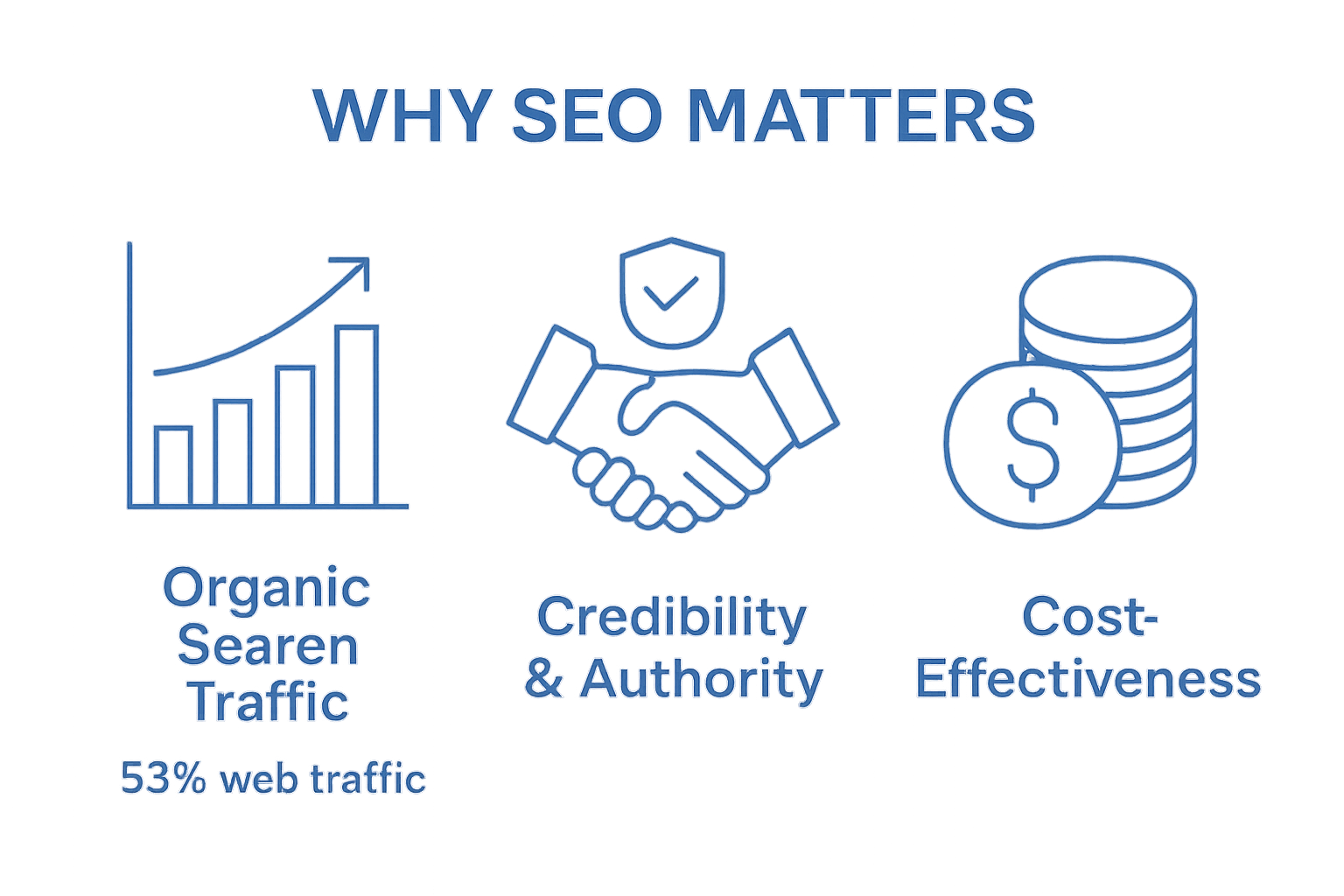
- Compete with larger businesses without massive advertising budgets
- Build long-term credibility and online authority
- Generate consistent, high-quality website traffic
Small businesses that strategically implement SEO can transform their digital presence, turning online searches into valuable customer connections. The key is understanding that SEO is not a one-time task but an ongoing process of refinement and adaptation to changing digital landscapes.
The Importance of Local SEO for Community Engagement
Local SEO represents a targeted digital marketing strategy that helps small businesses connect directly with their immediate geographical community, transforming online visibility into tangible local customer interactions. Unlike broad national marketing approaches, local SEO focuses on capturing the attention of potential customers within a specific geographic radius.
Understanding Local Search Dynamics
Learn more about SEO localization strategies that can help businesses optimize their digital presence for local audiences. Local search enables businesses to appear in geographically relevant search results, Google Maps listings, and location-based queries. When potential customers search for services “near me” or within their community, businesses with strong local SEO have a significant competitive advantage.
Key elements of effective local SEO include:
- Google Business Profile Optimization: Ensuring accurate business information and location details
- Local Keyword Targeting: Incorporating location-specific search terms
- Customer Review Management: Encouraging and responding to local customer feedback
Community Connection through Digital Presence
According to BrightLocal’s Local Consumer Review Survey, 87% of consumers read online reviews for local businesses in 2022, demonstrating the critical role of digital reputation in community engagement. Local SEO goes beyond mere visibility it builds trust, credibility, and meaningful connections with nearby customers.
Small businesses that strategically implement local SEO can transform their digital footprint from an anonymous online entity to a recognized and trusted community resource. The goal is not just to be found but to be chosen as the preferred local solution for customers seeking specific products or services.
Understanding Keywords and Their Role in SEO Strategy
Keywords represent the foundational language that connects businesses with potential customers through online search platforms. They are specific words and phrases that users type into search engines when seeking information, products, or services, serving as critical communication bridges between website content and audience search intent.
The Strategic Importance of Keyword Selection
Learn more about keyword optimization techniques that can elevate your digital marketing strategy. Keywords are not just random terms but strategic tools that help search engines understand and categorize website content. By carefully selecting and implementing relevant keywords, small businesses can significantly improve their online visibility and attract more targeted traffic.
Key considerations for effective keyword strategy include:
- Relevance: Choosing terms directly related to your business offerings
- Search Volume: Identifying keywords with meaningful user search frequency
- Competition Level: Understanding the difficulty of ranking for specific terms
Decoding Keyword Types and Their Impact
According to research from the Louisiana State University Digital Commons, keywords can be categorized into three primary types: broad keywords, long-tail keywords, and local keywords. Each type serves a unique purpose in connecting businesses with their target audience.
Broad keywords represent general search terms with high competition, while long-tail keywords offer more specific, niche opportunities for targeted audience engagement. Local keywords further refine search specificity by incorporating geographical elements, making them particularly powerful for small businesses seeking community-based customers.
Successful keyword strategy is not about quantity but strategic precision.
To clarify the different types of keywords and their unique impact on SEO strategy, the table below summarizes each category, its definition, and its specific role for small businesses.
| Keyword Type | Definition | Impact for Small Business |
|---|---|---|
| Broad Keywords | General terms with high search volume and competition | Increases visibility but harder to rank; less targeted |
| Long-tail Keywords | More specific, longer phrases with lower search volume | Easier to rank; attracts users with specific intent |
| Local Keywords | Phrases that include a specific location or geographic area | Targets local customers; boosts local search results |
 Small businesses must focus on understanding their unique audience, anticipating their search behaviors, and crafting content that authentically addresses their needs and questions.
How Content Quality Influences Search Engine Rankings
Content quality represents the cornerstone of effective search engine optimization, serving as a critical determinant in how search platforms evaluate and rank websites. High-quality content goes beyond mere text it provides genuine value, answers user questions comprehensively, and demonstrates expertise in a specific domain.
Understanding Search Engine Content Evaluation
Explore our comprehensive guide on ranking factors to gain deeper insights into content performance. Search engines like Google employ sophisticated algorithms that assess content through multiple dimensions, evaluating factors such as relevance, depth, originality, and user engagement to determine a webpage’s ranking potential.
Key characteristics of high-quality content include:
- Relevance: Direct alignment with user search intent
- Comprehensiveness: Thorough exploration of the topic
- Originality: Unique perspectives and insights
- Readability: Clear, structured, and accessible information
The Impact of Content Quality on Digital Visibility
According to Google’s Search Central documentation, search algorithms prioritize content that demonstrates expertise, authoritativeness, and trustworthiness (E-A-T). This means small businesses must focus on creating content that not only includes relevant keywords but also provides genuine value to their target audience.
Content quality influences search rankings through multiple interconnected mechanisms. Highly informative and engaging content attracts longer user interactions, reduces bounce rates, and encourages natural link building all of which are positive signals to search engine algorithms. By consistently producing valuable content that addresses user needs, small businesses can improve their digital visibility and establish themselves as credible resources in their respective industries.
The following table outlines the essential factors search engines use to evaluate web content, helping clarify what contributes to higher search rankings for small business websites.
| Content Quality Factor | Description |
|---|---|
| Relevance | How well the content aligns with user search intent and queries |
| Comprehensiveness | Depth and thoroughness in covering the topic or subject matter |
| Originality | Presence of unique insights, perspectives, and avoidance of duplicate content |
| Readability | Clarity, organization, and ease of understanding for all users |
| Expertise/Authority | Demonstrated subject expertise and authority; signals trustworthiness (E-A-T) |
The Impact of User Experience on SEO Success
User experience (UX) has emerged as a critical factor in determining search engine rankings, transforming how small businesses approach their digital presence. Beyond traditional SEO tactics, UX represents the holistic interaction between website visitors and digital platforms, directly influencing how search engines evaluate and rank online content.
Decoding UX Elements in Search Performance
Discover how user experience drives SEO rankings and learn strategies for digital optimization. Search engines like Google have sophisticated algorithms that measure user engagement metrics, interpreting these signals as indicators of content quality and relevance. Websites that provide smooth, intuitive, and valuable experiences are rewarded with higher search rankings.
Critical UX factors that impact SEO include:
- Website Navigation: Clear, intuitive site structure
- Mobile Responsiveness: Seamless performance across devices
- Page Loading Speed: Quick and efficient content delivery
- Interactive Elements: Engaging and user-friendly design
The Interconnection Between User Satisfaction and Search Rankings
According to the World Wide Web Consortium (W3C), accessibility and user experience fundamentally overlap with best practices in digital design. Search engines now interpret user behaviors like time spent on page, bounce rates, and interaction patterns as direct indicators of content quality.
Small businesses must recognize that SEO is no longer just about keywords and backlinks. It is about creating comprehensive digital experiences that genuinely serve user needs. By focusing on intuitive design, fast performance, and meaningful content, businesses can simultaneously improve user satisfaction and search engine visibility.
Take Your Small Business SEO Strategy from Insight to Impact
Are you struggling to turn your SEO knowledge into real growth for your small business? The tips in this article highlight how challenging it can be to compete online without the right keyword research, content quality, and local optimization strategies. Even when you know what needs to change, it is hard to get results without expert guidance and tailored execution.

Let 12AM Agency transform your understanding into action. Our experienced team specializes in local SEO services for businesses, custom strategies, and the latest AI-driven tactics to help you rank higher, attract local customers, and drive leads. Now is the time to bridge the gap between SEO advice and measurable success. Start by requesting a personalized consultation through our contact page. Your path to visible, lasting growth starts here.
Frequently Asked Questions
What is SEO and why is it important for small businesses?
SEO (Search Engine Optimization) is a digital strategy that helps small businesses improve their online visibility in search results. It allows them to attract potential customers organically, competing with larger businesses without hefty advertising budgets.
How can small businesses benefit from local SEO?
Local SEO helps small businesses connect with their immediate community by optimizing their online presence for location-specific searches. It increases visibility in local search results and builds trust among local customers looking for specific services.
What role do keywords play in SEO strategy for small businesses?
Keywords are essential for SEO as they bridge the gap between what users search for and the content businesses provide. By selecting relevant keywords, small businesses can improve their online visibility and attract targeted traffic.
How does content quality influence SEO rankings?
High-quality content is vital for SEO success as it demonstrates expertise, authority, and trustworthiness. Search engines favor relevant, comprehensive, and original content, which positively impacts a website’s ranking and visibility.