




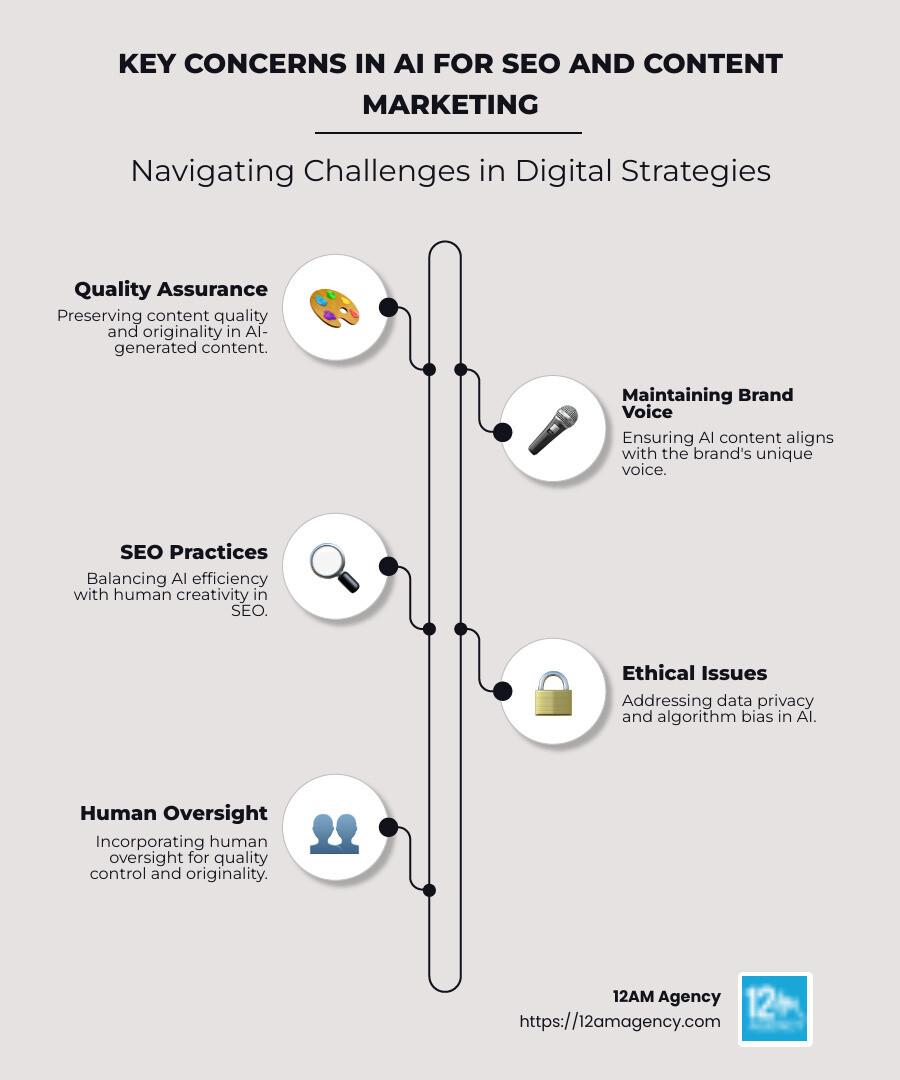
Concerns about ai in seo and content marketing are driving a lot of discussions today. As AI revolutionizes content creation, balance efficiency with quality. Here’s a quick look at the key points:
- Quality and Originality: AI can generate vast amounts of content quickly, but maintaining quality and original brand voice can be challenging.
- SEO Practices: While AI facilitates faster keyword research and content optimization, it may not match human creativity and nuance.
- Ethical Concerns: Issues like data privacy and algorithm bias demand attention as AI becomes more prevalent.
The concerns about ai in seo and content marketing are not just technical. Real change is happening in how we approach and execute digital strategies.
As an information writer with expertise in digital marketing, I’m Robert Portillo. With 18 years of engineering experience and a deep dive into SEO, I’ve seen the concerns about ai in seo and content marketing transform how businesses grow online. In the next sections, we’ll explore this transformative journey.
Concerns about ai in seo and content marketing terms to know:
– generative ai and seo
– use chat gpt for seo
– ai quantative analysis seo and marketing services
Benefits of AI in SEO
AI is reshaping SEO, and it’s bringing some serious benefits to the table. Let’s explore how AI improves efficiency, scalability, and personalization in SEO strategies.
Efficiency
AI tools are game-changers for efficiency. They automate repetitive tasks like keyword research and data analysis, freeing up valuable time for marketers. Instead of sifting through endless data, AI can quickly identify trends and patterns. This means more time to focus on crafting engaging content and developing strategic plans.
For example, AI-powered platforms can analyze vast amounts of search data to provide insights into user behavior. This allows marketers to optimize their strategies without getting bogged down in manual analysis.
Scalability
Scalability is another significant benefit of AI in SEO. AI allows businesses to produce content at a scale that was previously unimaginable. Need hundreds of product descriptions? AI can handle that. Want to optimize thousands of web pages for SEO? AI can do it efficiently.
This scalability is especially useful for large enterprises or e-commerce platforms with extensive product catalogs. AI tools can generate and update content quickly, ensuring that SEO strategies keep pace with business growth.
Personalization
AI excels in personalization, tailoring content to meet individual user needs. By analyzing user data, AI can predict what content will be most relevant to each visitor. This leads to more personalized user experiences and can improve engagement and conversion rates.
See exactly where your profile stands right now.
Our GBP audit shows your current rank position across your market, how your profile completeness scores against competitors, and the specific gaps holding you back from the Map Pack.
For instance, AI can help create personalized email campaigns by analyzing customer preferences and behavior. This targeted approach makes marketing efforts more effective and helps build stronger customer relationships.
AI in SEO offers tangible benefits that can transform how businesses approach digital marketing. As we continue to explore this topic, it’s clear that AI’s role in SEO is only growing.
Concerns about AI in SEO and Content Marketing
While AI brings many benefits to SEO, it also raises some concerns. Let’s explore these issues around quality, originality, and brand voice.
Quality Issues
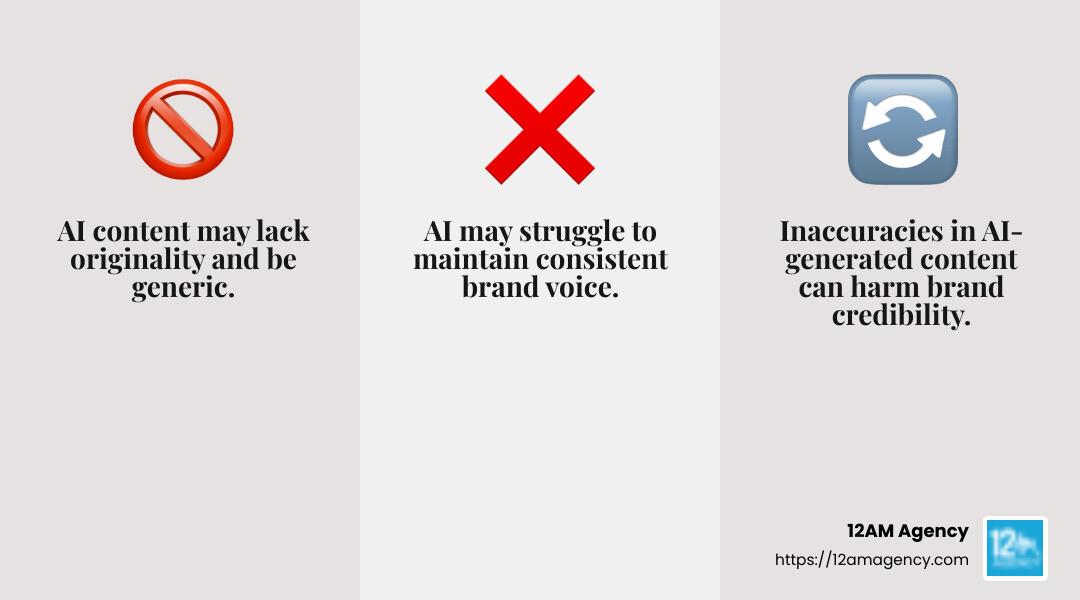
AI-generated content often struggles with maintaining high quality. Because AI tools predict words based on patterns in existing data, the content can be generic and sometimes inaccurate. This can lead to quality issues that affect user trust and engagement.
For example, there have been instances where AI tools generated factually incorrect statements, like the Gemini demo’s misleading claim about the James Webb Space Telescope. These inaccuracies can harm your brand’s credibility.
Originality
Originality is a significant concern with AI-generated content. Since AI systems rely on existing data to produce output, the content often lacks uniqueness. This can lead to repetitive or rehashed material that doesn’t stand out in the crowded digital landscape.
Search engines, like Google, prioritize fresh and unique content. Over-reliance on AI-generated material can decrease your site’s chances of ranking well on search engine result pages (SERPs). Brands must ensure their content is not just a regurgitation of what’s already online.
Brand Voice
Maintaining a consistent brand voice is crucial for effective content marketing. AI tools can struggle to capture the nuances of a brand’s personality and tone. This can result in content that feels disconnected from the brand’s identity.
Every brand has a unique style and tone that resonates with its audience. AI might produce content that sounds robotic or lacks the emotional connection that human writers can achieve. This can weaken the brand’s relationship with its audience.
In summary, while AI can improve SEO strategies, address these concerns. Balancing AI’s capabilities with human creativity ensures that content remains high-quality, original, and true to the brand voice.
Next, we’ll dig into the ethical concerns surrounding AI content creation, including privacy and data usage.
Ethical Concerns in AI Content Creation
As AI becomes more involved in content creation, several ethical concerns come into play. These include issues related to privacy, data usage, and algorithm bias.
Privacy
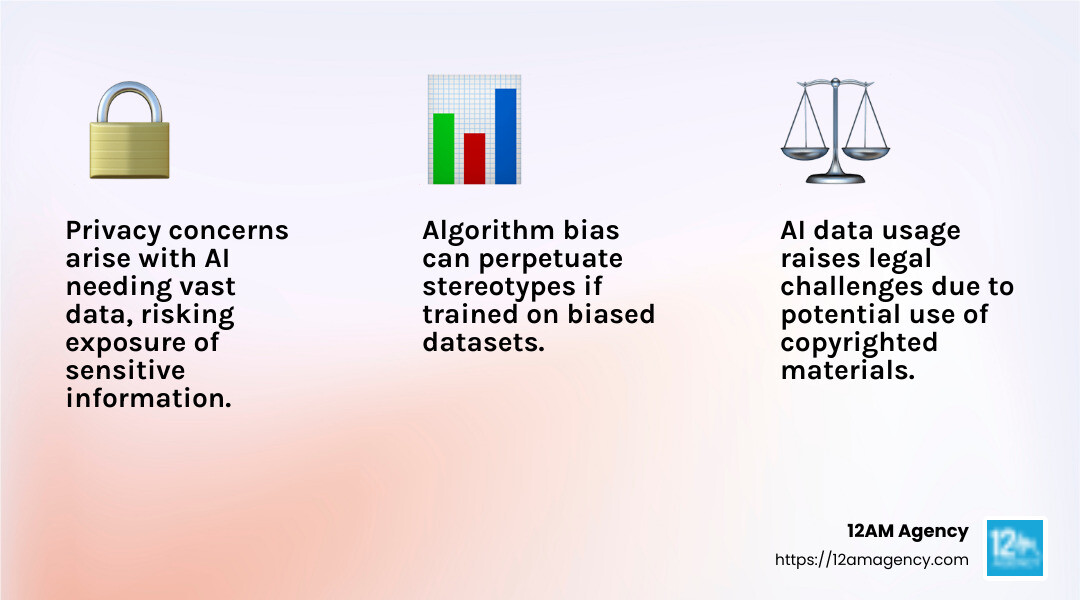
Privacy is a significant concern when it comes to AI content creation. AI systems often require vast amounts of data to function effectively. This data can include personal information, which raises questions about how it’s collected, stored, and used.
For instance, when AI tools analyze user data to personalize content, there’s a risk that sensitive information could be mishandled or exposed. Companies must ensure they have robust data protection measures in place to prevent breaches and maintain user trust.
Data Usage
The way AI systems use data also poses ethical concerns. AI relies on large datasets to learn and generate content. However, these datasets can sometimes include copyrighted material or information that wasn’t intended for public use.
A recent lawsuit against OpenAI highlighted this issue, as the company faced allegations of using copyrighted content to train its algorithms. Businesses using AI for content creation must steer these legal complexities to avoid potential lawsuits and maintain ethical standards.
Algorithm Bias
Algorithm bias is another critical concern. AI systems learn from existing data, which can include biases present in the source material. This can lead to biased content that perpetuates stereotypes or misrepresents certain groups.
For example, if an AI tool is trained on biased datasets, it might produce content that lacks diversity or fairness. Brands must carefully evaluate AI-generated content to ensure it aligns with their values and does not unintentionally harm or mislead their audience.
In summary, while AI offers exciting possibilities for content creation, address these ethical concerns. By prioritizing privacy, responsible data usage, and fairness, businesses can leverage AI’s capabilities while maintaining trust and integrity in their content marketing efforts.
Next, we’ll explore best practices for using AI in SEO, focusing on human oversight and quality control.
Best Practices for Using AI in SEO
When it comes to using AI in SEO, it’s crucial to balance technology with human expertise. Here are some best practices to ensure your AI-generated content meets quality standards and maintains originality.
Human Oversight
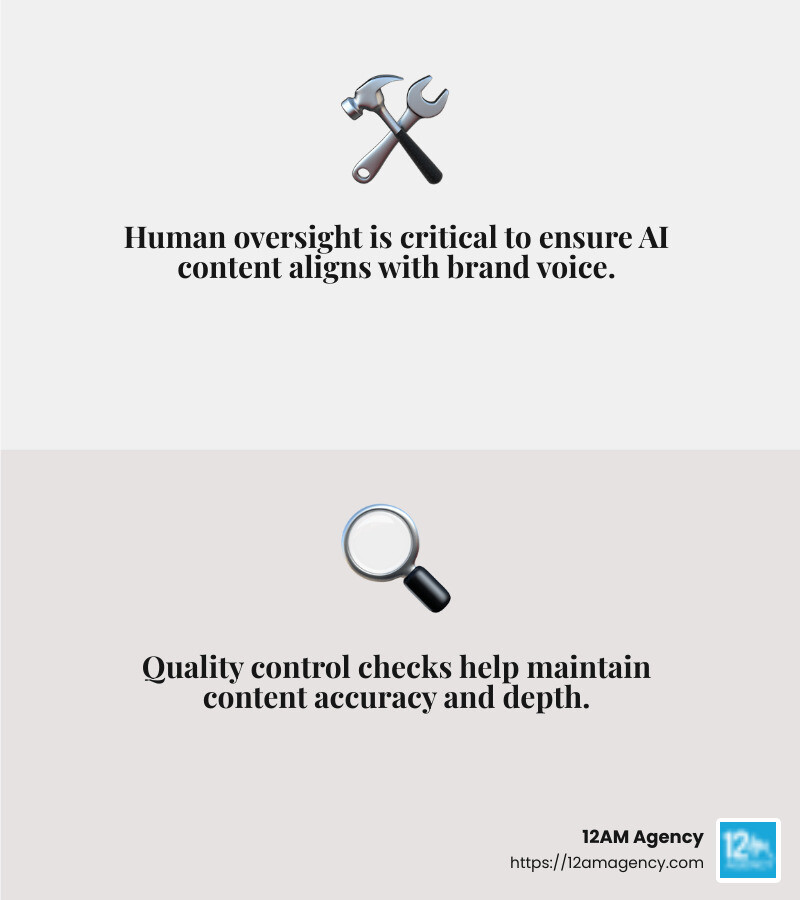
AI can generate content quickly, but it lacks the human touch needed for emotional resonance and contextual understanding. Human oversight is vital to ensure the content aligns with your brand’s voice and values.
- Editing and Review: Always have a human editor review AI-generated content. They can catch nuances and ensure the material is engaging and accurate.
- Cultural Sensitivity: Humans understand cultural nuances better than machines. Ensure content is culturally appropriate by having it reviewed by someone familiar with the target audience.
Quality Control
AI tools can sometimes produce content that lacks depth or accuracy. Implementing robust quality control measures is essential to maintain high standards.
- Consistency Checks: Ensure the writing style remains consistent throughout the content.
- Fact Verification: Double-check facts and data presented in AI-generated content to avoid spreading misinformation.
Originality
One of the primary concerns about AI in SEO and content marketing is the potential for generating generic or repetitive content. Ensuring originality is key to standing out and ranking well on search engines.
- Unique Insights: Incorporate unique insights or expert opinions to add value and originality to AI-generated content.
- Avoid Over-Reliance: Use AI as a tool to assist, not replace, human creativity. Balance AI-generated content with original human-created pieces to keep your content fresh and engaging.
By combining AI’s efficiency with human creativity and oversight, you can create content that not only ranks well but also resonates with your audience. This approach helps mitigate the risks associated with AI in SEO and ensures your content remains authentic and impactful.
Next, we’ll address some frequently asked questions about AI in SEO, including how AI affects search rankings and user experience.
Frequently Asked Questions about AI in SEO
How is AI affecting SEO?
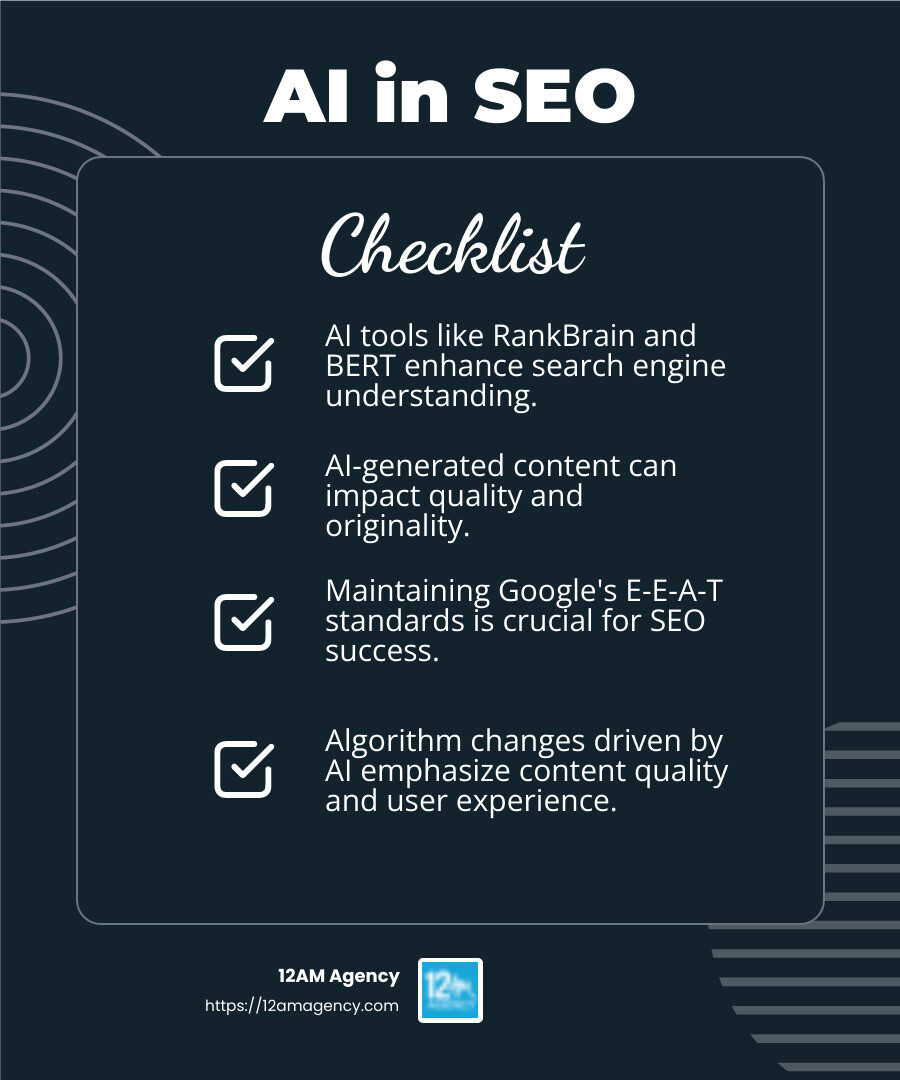
AI is changing SEO by automating tasks, analyzing vast datasets, and providing insights that were previously unattainable. AI tools like RankBrain and BERT are used by search engines to understand user intent and improve search results. These tools analyze how users interact with search results, helping to refine algorithms to better meet user needs.
AI-generated content, while efficient, raises concerns about quality and originality. Machines can produce text quickly, but they often lack the creativity and depth that human writers bring. This can affect the overall user experience and the perceived value of the content.
Does AI content hurt SEO?
This is the work we do for you. Every week, without exception.
Managing GBP at this level takes 6–8 hours a week when done right. Nova handles the entire system — posts, photos, reviews, Q&A, citations, heatmap tracking — so you can focus on running your business.
AI-generated content can be a double-edged sword. On one hand, it can improve efficiency and scalability. On the other, if not carefully managed, it can lead to a drop in user experience and fail to meet Google’s E-E-A-T (Experience, Expertise, Authoritativeness, and Trustworthiness) standards. Google’s focus is on providing helpful, people-first content, and AI-generated text may fall short if it lacks the human touch.
Poorly executed AI content can lead to lower engagement, reduced dwell time, and increased bounce rates, all of which can negatively impact search rankings. Therefore, it’s crucial to ensure AI content is reviewed and edited by humans to maintain quality and relevance.
How will AI affect search engines?
AI is reshaping how search engines rank and index content. With advancements in natural language processing and machine learning, search engines can better understand and interpret user queries. This means that content creators need to focus on creating high-quality, engaging content that meets user intent rather than merely optimizing for keywords.
Algorithm changes driven by AI will continue to evolve. As AI tools become more sophisticated, search engines will likely place even greater emphasis on content quality and user experience. This shift means that content indexing will prioritize originality and relevance, making it essential for marketers to integrate AI thoughtfully into their SEO strategies.
As AI continues to influence SEO, marketers must adapt by embracing these technologies while ensuring that human oversight and creativity remain central to their strategies.
Conclusion
As we steer the evolving landscape of AI in SEO, it’s clear that a balanced approach is essential. At 12AM Agency, we understand the importance of integrating AI with human expertise to craft personalized, results-driven strategies. Our team is dedicated to ensuring that your digital marketing efforts are not only efficient but also maintain the unique voice and authenticity of your brand.
AI offers incredible opportunities for efficiency and scalability in digital marketing. However, it’s crucial to remember that quality and originality are irreplaceable elements. Our approach at 12AM Agency combines the power of AI with the creativity and insight of human experts to deliver content that truly resonates with your audience.
We pride ourselves on offering custom solutions that improve your online presence while keeping your brand’s identity intact. Whether it’s SEO, PPC, website design, or mobile app development, our strategies are designed to maximize your digital footprint and drive measurable results.
For businesses looking to stay ahead in the digital field, embracing AI thoughtfully is key. By partnering with us, you can open up the full potential of your online presence and propel your business to new heights.
To learn more about how we can help you achieve your digital marketing goals, visit our SEO services page. Let’s work together to create a strategy that fits your unique needs and drives success in this AI-driven era.

