



How To Prepare For the 2021 Google Page Experience Update
The Update Will Lead To Changes in Positions From Mid-June To Late August
Preparing for this update means improving page experience. So how does one improve page experience? In this post, I will explain Google’s updated page experience criteria and more.
Google’s Updated Page Experience Criteria
As far as the updated page experience criteria go, Google has listed metrics that help them to understand how a user will view, or perceive, their experience on a specific web page.
Below are page experience factors and considerations:
- Page Speed
- Presence of ads
- Does content “jump around” as the page loads
- Mobile-friendliness
- Does the website have HTTPS
Below is a screenshot from Google’s PageSpeed Insights. PageSpeed Insights scans the content of a page, and lists suggestions to improve page speed.
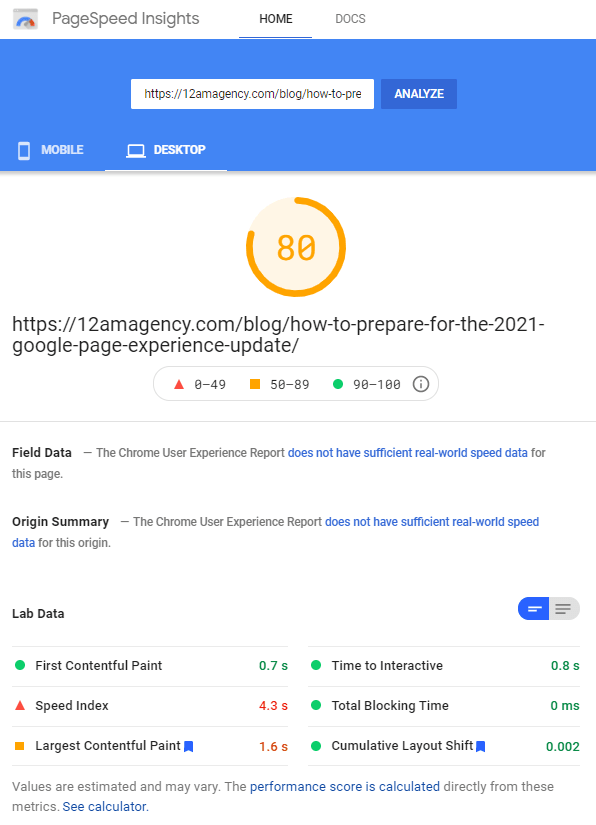
Google has refined their metrics on usability and speed and they are called Core Web Vitals.
Core Web Vitals include user-centered and real-world metrics that lead to various scores on different parts of your pages. These include interactivity, page load time, and the total stability of content (images, text, and more) as a page loads.
See exactly where your profile stands right now.
Our GBP audit shows your current rank position across your market, how your profile completeness scores against competitors, and the specific gaps holding you back from the Map Pack.
Below is how Google records each of the many factors that play into page experience:
- First Input Delay (FID): FID measures interactivity and to provide a decent user experience, websites should have an FID of less than 100 milliseconds. In other words, it measures the total time from when a person first interacts with a page (when they click a link, for example) to the time when the browser begins processing event handlers in response to that first interaction.
- Largest Contentful Paint (LCP): LCP measures loading performance and to provide a decent user experience, websites should have an LCP occur within 2.5 seconds. In other words, it reports the total render time of the biggest image or text block (that is visible within the viewport) relative to when the page first began to load.
- Cumulative Layout Shift (CLS): CLS measures visual stability and to provide a decent user experience, websites should have a CLS score of less than 0.1. In other words, it measures the total of all individual layout shift scores for every unexpected layout shift that happens during the entire page session. A layout shift happens when a visible element on a page changes size or position which affects the position of the other content around it.
It is important to note that Google announced that page experience specifically is not a ranking score. It is instead the case that each factor has its own rankings in the overall ranking algorithm that Google has created.
List of Changes For the Page Experience Update
So what is rolling out in mid-June with the page experience update? Read our list below.
- The Top Stories carousel feature on the search engine results page (SERP) will include all news content. the content must meet the Google News content policies & guidelines.
- AMP is no longer required to rank in particular top stories. Google also made it clear that this is “irrespective of its Core Web Vitals score or page experience status.”
- AMP will not be required for the Google News app as well as news.google.com.
- AMP badge will slowly start to go away
- Potential page experience badges will proceed to be tested. However, Google has not completed plans for this badge.
Google announced that it will finish the complete rollout of the page experience update position changes by the end of August. It will take into account all of the core web vital metrics, such as FID, LCP, and CLS. Plus, Chrome’s recent fix to CLS will be taken into account.
Why You Should Not Expect To See a Significant Change in Rankings
The public has learned a lot from Google about Google updates from the past. For example, we learned that Panda’s release affected 11.8% of all queries. Also, we learned that BERT (Bidirectional Encoder Representations from Transformers) affected 10% of queries.
We have been told many different things about particular ranking factors too. For example, Search Engine Land was told that HTTPS is a small factor. They talked with Rudy Galfi, the product lead on the Google Search ecosystem team, and he told them that they are not talking about how much every factor is weighted.
Rudy did say that top-notch content will still be a much more important factor. He even commented that great content with a poor page experience would still rank well on the search engine results pages (SERP).
“While all of the components of page experience are important, we will rank pages with the best information overall, even if some aspects of page experience are subpar. A good page experience doesn’t override having great, relevant content. However, in cases where there are multiple pages that have similar content, page experience becomes much more important for visibility in Search,” Google announced to the world.
However, Google also announced that: “While this update is designed to highlight pages that offer great user experiences, page experience remains one of many factors our systems take into account… Given this, sites generally should not expect drastic changes”.
I would bet on this update not having a significant impact on rankings given what Rudy told Search Engine Land.
More on How the Update Effects Websites That Have AMP
As previously stated, AMP (accelerated mobile pages) will not be a requirement for Google’s Top Stories section for both desktop and mobile. What will eventually matter is the page experience scores which partly determine what content appears in Google’s Top Stories section for both desktop and mobile.
The good news is that if you have AMP, then the majority of AMP pages will do very well when it comes to page experience metrics according to Rudy Galfi. It does not mean that every single AMP page will have top-notch page experience metrics.
However, AMP is built in a way to help with this. Mobile page rankings will use the page experience metrics that come from your AMP blog, or page, content too.
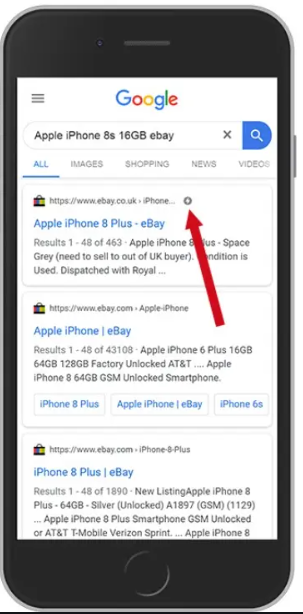
Look at the arrow in the image below to see what the AMP symbol looks like on the mobile version of the search engine results page. The image was created by Learn Digital Academy.
The 2021 Page Experience Update Will Gradually Rollout in Mid-June
The update will not fully be live until the end of August. I expect most website owners that cared about making the necessary changes for the new page experience update by the end of this month.
This is the work we do for you. Every week, without exception.
Managing GBP at this level takes 6–8 hours a week when done right. Nova handles the entire system — posts, photos, reviews, Q&A, citations, heatmap tracking — so you can focus on running your business.
The page experience update ranking change will not be live as of today. However, Google is releasing a couple of updates including the following:
- Availability for signed exchanges for all indexed webpages
- The Page Experience Report in GSC (Google Search Console)
The actual position changes for this page experience update will commence in mid-June and are said to be a slow, or gradual, rollout.
It will end several weeks later in late August. Google will be able to closely monitor any unintended or unexpected issues due to the delay. With this rollout, you should not expect drastic changes according to Google.
Final Words on the Page Experience Update
Google’s grand vision for page experience is to create a web ecosystem that Google users love. Google is investing heavily to ensure that you have the right resources and tools before the page experience update rolls out in mid-June 2021.
12AM Agency hopes that the updates that we shared with you will make you feel better about the update and help you prepare for it properly. We will help you solve your SEO-related problems similar to how a man figures out how to solve a Rubik’s cube.

Let’s Work Together
Get Your FREE SEO Audit
Talk to an expert:
1-800-863-7958


