


Every single month, thousands of small business owners and professional service firms check their Google Analytics dashboards only to face a frustrating paradox. Traffic is trending upward, yet the phone isn’t ringing, contact forms remain empty, and revenue growth stays completely flat.
For years, the standard playbook said to hire an SEO agency to drive traffic, and then hire a conversion rate optimization (CRO) consultant to fix the pages. In the modern search ecosystem, this siloed approach is completely dead.
To turn casual clicks into loyal clients, scaling brands must deploy conversion rate optimization sxo (Search Experience Optimization). SXO bridges the massive gap between what a user looks for on a search engine and the immediate experience they have once they click through to your website. If you are ready to stop wasting valuable organic traffic and transform your digital footprint into a pipeline of signed qualified leads, this comprehensive playbook outlines the exact strategic framework required to dominate your vertical.
Key Takeaways
| Problem | Action | Outcome |
| High organic traffic but low conversion rates due to misaligned user expectations. | Transition from isolated SEO/CRO strategies to a unified conversion rate optimization sxo framework. | Increased engagement, lower bounce rates, and a surge in qualified pipeline leads. |
| Traditional A/B split tests fail or produce flat results over long cycles. | Map page layouts explicitly to transactional search intent and targeted buyer modifiers. | Faster statistical validation and predictable conversion lift across organic funnels. |
| Landing pages lose prospects due to friction-heavy, long-form educational copy. | Deploy a modern performance landing page utilizing micro-conversions and clear direct answers. | Higher micro-conversion rates that systematically nurture buyers down the sales funnel. |
How does Search Experience Optimization (SXO) systematically improve website conversion rates?
Search Experience Optimization represents the evolution of traditional search engine optimization. Where SEO traditionally stops at the click, SXO looks at the entire user journey from the initial search query all the way to the final macro-conversion.
[Search Query] ➔ [Intent-Matched Landing Page] ➔ [Frictionless UX] ➔ [Signed Lead]
When you systematically integrate search signals with on-page user experience design, your website starts converting at a significantly higher level for three core reasons:
- Intent Synchronization: SXO ensures that the content a visitor sees above the fold perfectly matches the psychological state of their search query. If a user searches for a specific operational solution, they land on a page that addresses that problem instantly, rather than a generic homepage.
- Reduction of Bounce Rates: Google closely monitors how users interact with your site post-click. If a visitor lands on your site and hits the back button immediately (pogosticking), it signals to the algorithm that your page failed to deliver value. By optimizing the page experience layout, you keep users engaged, protecting both your organic visibility and your conversion funnel.
- Technical Performance Optimization: SXO naturally prioritizes core web vitals, mobile responsiveness, and clean accessibility paths. A faster, highly responsive site naturally experiences less friction, paving a seamless pathway for visitors to fill out forms, request consultations, or complete purchases.
By treating search intent and conversion mechanics as a single, unified marketing discipline, businesses can maximize the financial return on every single organic visitor they earn.
Why do traditional CRO split tests fail without explicit intent alignment?
It is incredibly common for digital marketing teams to run a traditional CRO split test—such as changing a call-to-action button from blue to green—only to find that it has absolutely zero statistically significant impact on revenue.
See exactly where your profile stands right now.
Our GBP audit shows your current rank position across your market, how your profile completeness scores against competitors, and the specific gaps holding you back from the Map Pack.
The primary reason these tests fail is a total lack of user intent optimization. Traditional CRO often treats all website traffic as a homogenous block of users. In reality, a visitor arriving from an educational informational blog post behaves completely differently than a visitor landing on a commercial service page via a targeted paid campaign.
Crucial Insight: An unaligned split test is merely putting lipstick on a pig. If the core content of the page does not directly resolve the specific problem the user typed into Google, tweaking your button color, font size, or hero image layout will never save the conversion.
When search intent is completely decoupled from your optimization experiments, you run into the “local maxima” problem. You might find a slight variation that improves micro-clicks, but it fails to translate into long-term signed qualified leads because the wrong audience is viewing the offer. True conversion acceleration requires analyzing the exact search phrases driving traffic to that page and modifying the layout to serve that precise cohort.
How do you optimize a performance landing page for maximum micro-conversions?
Building a high-converting performance landing page requires balancing immediate utility with subtle, low-friction conversion steps known as micro-conversions. Micro-conversions include actions like downloading a specialized checklist, interacting with a cost calculator, watching a case study video, or scrolling through a detailed process breakdown.
To construct a landing page that captures these actions flawlessly, follow this foundational framework:
1. The Above-the-Fold Intent Match
Your headline must explicitly mirror the primary keyword intent that brought the visitor to the page. If they searched for comprehensive seo services, the main headline should immediately confirm that you offer high-performance search solutions. Eliminate massive, vague branding statements and replace them with direct value propositions.
2. Visual Hierarchy and Scannability
Modern web users do not read every word on a page; they skim. Use a bold, logical hierarchy with clear subheadings, short paragraphs (2 to 4 sentences max), and intuitive bullet points.
[Hero Headline: Clear Value Match]
│
▼
[Sub-headline: Core Benefit Statement]
│
▼
[Bullet Points: Strategic Proof Metrics]
│
▼
[Primary Action: Ultra-Low Friction Form]
3. Strategic Micro-Conversion Placements
Instead of demanding a full 10-field consultation request right away, offer lower-barrier opportunities for engagement. A simple interactive quiz or an open text field asking, “What is your biggest marketing bottleneck?” allows users to begin interacting with your brand without feeling overwhelmed by an immediate sales pitch.
What are high-intent buyer modifiers and how do they impact signed qualified leads?
Not all search traffic is created equal. A user searching for “what is digital marketing” is likely months away from hiring an external agency. Conversely, a user searching for “best digital asset management firm for professional services” is practically holding their credit card in their hand.
These highly descriptive qualifiers are known as high-intent buyer modifiers. Common examples include:
- Action-Oriented: Buy, hire, request quote, pricing, contract.
- Value-Oriented: Best, top-rated, certified, professional, enterprise.
- Geographic: Near me, local, city-specific terms.
When your content strategy targets keywords loaded with these specific modifiers, the traffic arriving at your site is already pre-qualified. Consequently, your conversion rate optimization sxo efforts become significantly easier because you are no longer attempting to convince a skeptic to buy; you are simply proving that you are the most logical, frictionless choice to fulfill their existing demand.
For professional service companies looking to scale, focusing purely on these high-intent phrases yields a dramatically higher volume of actual sales pipeline conversions compared to chasing massive, top-of-funnel keyword volumes. For instance, analyzing options like whether a comprehensive boutique digital strategy or corporate platforms like Law Firm Digital Marketing match your immediate growth requirements can save thousands in misallocated budget. Exploring deep reviews of prominent market options, such as wondering Is Scorpion Worth It for Law Firms? The 2026 Honest Review, highlights how critical intent matching is before making large-scale infrastructure investments.
How does structuring direct answers improve both AI engine visibility and visitor trust?
The rise of generative search experiences and conversational AI platforms has fundamentally shifted how users consume online information. Today, users expect clear, direct, and unambiguous answers to their questions without having to hunt through paragraphs of fluff.
Structuring clean, direct answers early in your content achieves two critical strategic marketing goals simultaneously:
- Generative Engine Optimization (GEO): AI search engines look for concise, structured definitions, bulleted processes, and structured data tables to pull directly into their conversational summaries. By formatting your content with direct answer blocks, you maximize the probability that your brand is cited as the primary source in AI-generated answers.
- Instantaneous Visitor Trust: When a human visitor clicks your link and immediately finds a clear, authoritative, and direct answer to their complex query right at the top of the page, cognitive friction vanishes. They instantly perceive your brand as an expert authority, making them significantly more receptive to your primary call to action later in the journey.
To execute this effectively, use tight H2 or H3 question headers followed immediately by a bolded 2 to 3-sentence summary definition before diving into the deeper, nuanced context.
Why are unverified superlatives harmful to modern consumer conversion layouts?
For decades, standard business copywriting was filled with hyperbolic phrases like “The Best Agency in the World,” “Unmatched Quality,” and “The Most Trusted Source for Professional Services.” In the modern consumer era, these are known as unverified superlatives, and they act as absolute poison to your conversion rates.
Modern B2B decision-makers and savvy B2C consumers possess incredibly high levels of skepticism. When they encounter empty, unverified bragging on a performance landing page, their subconscious danger signals fire immediately. It signals that the business lacks concrete, quantifiable data to back up its marketing claims.
| Instead of Using This Empty Copy… | Deploy This Quantifiable Performance Data… |
| “We are the best digital transformation agency in the industry.” | “We have successfully executed over 140 enterprise migrations, reducing operating costs by 22% on average.” |
| “Our customer support team provides unmatched service quality.” | “Our dedicated technical support desk maintains a verified 14-minute average response time, 24/7/365.” |
| “We offer the most affordable marketing packages available.” | “Our transparent tiered pricing model scales directly with your generated lead volume, ensuring a clear ROI path.” |
By systematically scrubbing your website copy of unverified marketing hype and replacing it with verifiable, concrete data points, you build a foundation of absolute transparency that drives conversions.
How do transparent customer reviews provide social proof for incoming organic traffic?
Organic search traffic frequently consists of cold prospects who have had zero historical interactions with your brand. Because they do not know, like, or trust you yet, they look for external validation from their peers to de-risk their decisions. This is where transparent customer reviews and dynamic social proof become absolutely non-negotiable within your conversion rate optimization sxo workflow.
This is the work we do for you. Every week, without exception.
Managing GBP at this level takes 6–8 hours a week when done right. Nova handles the entire system — posts, photos, reviews, Q&A, citations, heatmap tracking — so you can focus on running your business.
To maximize the conversion velocity of organic traffic, reviews must be integrated strategically across the site rather than hidden away on a solitary “Testimonials” tab:
- Contextual Placement: Place specific case reviews immediately adjacent to relevant service sections. If you are highlighting a complex optimization service, embed a review from a client who specifically praises your optimization capabilities.
- Unedited Integrity: Include direct links back to verifiable third-party platforms such as Google Business Profile, Clutch, or Trustpilot. Showing both the raw text and the source platform proves to the user that the review is real and unedited.
- Highlighting the Transformation: The most effective reviews do not just say, “They were nice people.” The best social proof highlights the exact before-and-after state of the client’s business, outlining the tangible problem, the direct action taken, and the profitable business outcome achieved.
Frequently Asked Questions
What is the operational relationship between search engine traffic quality and user conversions?
The operational relationship is directly proportional. Driving millions of low-intent impressions to a transactional page will inevitably tank your conversion rates and waste computing resources. High-performing growth strategies focus on capturing high-intent keyword phrases loaded with buyer modifiers. This ensures that every user landing on your site is already psychologically predisposed to take action, causing conversion efficiency to soar even if total traffic volumes remain modest.
How does initial page experience layout influence a visitor’s willingness to stay?
First impressions online are formed within milliseconds. If a visitor lands on a site that has massive, slow-loading images, intrusive promotional pop-ups, or a chaotic layout that obscures the primary answer to their query, they will immediately exit the page. A clean, optimized page experience layout instantly reassures the visitor that they are in the right place, radically lowering bounce rates and buying you the precious time needed to present your main value proposition.
Should transactional legal landing pages use long-form educational copy or minimal forms?
The ideal format is a hybrid structure built around strategic layout choices. High-ticket, high-friction professional service pages (like legal or financial consulting) require deep, authoritative informational copy to build necessary trust and satisfy E-E-A-T principles. However, this deep content should sit underneath an above-the-fold interface that features an incredibly clear, minimal micro-conversion path. This lets highly motivated buyers take immediate action while allowing more analytical researchers to scroll down to consume the comprehensive educational copy.
Can strategic optimization for conversational AI engines improve user conversion flows?
Absolutely. When you format your website content using precise question headings, concise definition syntax, and structured data tables, conversational AI engines can easily digest and extract your key insights. When these engines present your business as the definitive answer to a user’s prompt, the traffic that clicks through to your site arrives with a built-in level of pre-established trust, creating a highly accelerated, seamless conversion flow.
Driving Measurable Business Outcomes
Achieving sustainable digital growth is no longer a matter of simply ranking number one on a search results page. True enterprise acceleration requires building a frictionless digital bridge between the user’s initial search query and the final conversion point on your performance landing page.
By executing a unified conversion rate optimization sxo strategy, you eliminate the operational inefficiencies of traditional, siloed marketing approaches. You stop paying for empty traffic that doesn’t convert, and you start extracting maximal revenue from the visibility you already possess.
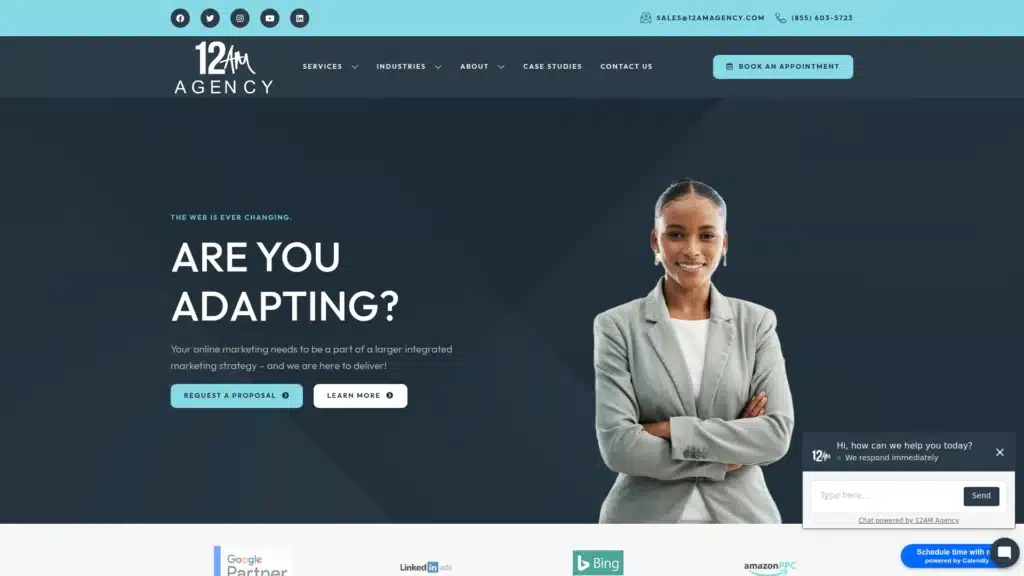
If you are ready to stop guessing, eliminate unverified superlatives, and systematically transform your organic search footprint into a predictable pipeline of high-value clients, it is time to upgrade your brand’s digital infrastructure. Let the elite digital engineering team at 12AM Agency map out your high-intent growth strategy today. Partner with us to activate an end-to-end digital transformation tailored explicitly to generate predictable, high-value growth for your firm.

