




As a healthcare practitioner or practice manager, you’re the ultimate “Chief Everything Officer.” You’re not just a provider; you’re managing a complex, high-stakes small business. And you’re likely facing a perfect storm of pressures: rising patient expectations, increasing administrative burdens (and the burnout that comes with it), and razor-thin margins.
You constantly hear the buzzword “digital transformation.” It sounds massive, impossibly expensive, and something reserved for giant hospital systems with billion-dollar IT budgets.
But what if it’s not?
What if digital transformation in healthcare is simply a plan to…
- Stop using paper forms?
- Automate the soul-crushing admin work your staff hates?
- Give patients the “Amazon-like” convenience they now demand?
- And use data to make better clinical decisions, faster?
For the modern practitioner, digital transformation isn’t a “nice to have” tech project. It’s the core strategy for survival and growth. This guide will cut through the jargon and show you what it really means for your practice.
Key Takeaways
|
Problem (The “Practitioner’s” Pain Point) |
The “Analog” Way |
The “Digital Transformation” Solution |
| Administrative Burnout | Your staff spends hours per day on manual data entry, paper forms, and phone-tag for appointments. | Automation and a Cloud-Based EHR handle 80% of admin, from patient intake to billing, freeing up your team. |
| “Clunky” Patient Experience | Patients wait on hold to book, fill out the same paper clipboard every visit, and can’t access their own records. | Telehealth & Patient Portals allow 24/7 online booking, digital-first intake, and instant access to lab results and care summaries. |
| Reactive, Siloed Care | You only have the data from your clinic. You don’t know if a patient is following up with a specialist or adhering to their care plan. | Interoperable EHRs & Data Analytics create a unified patient view, enabling proactive, coordinated care between providers. |
| Making “Gut Feel” Decisions | You think you know which treatments are most effective or where your practice is inefficient, but you lack hard data. | AI & Data Analytics analyze thousands of patient outcomes to reveal patterns, predict risks, and pinpoint operational bottlenecks. |
| Post-Visit Patient Drop-Off | Once a patient leaves your office, you have no visibility into their health until their next (or-if-they-return) visit. | IoT & Remote Patient Monitoring (RPM) tools (like smart glucose monitors) send real-time data to your team, enabling proactive care. |
What are the Key Components of Digital Transformation in Healthcare?
At its core, a digital transformation is not just “buying software.” It’s a fundamental change in your practice’s culture and processes to be more efficient, intelligent, and patient-centric.
It’s not one “thing”; it’s an ecosystem of four key components working together:
- A Cloud-Based Foundation: This is the “new normal.” Your old, server-in-the-closet system is replaced by a secure, cloud-based platform (like a modern EHR). This is the foundation that makes everything else—like telehealth and remote data access—possible.
- Process Automation: This is the “burnout buster.” It’s the use of technology to automate the repetitive, manual tasks that drain your team’s time and morale—from patient scheduling and billing to insurance verification.
- Data Integration & Analytics: This is the “brain.” It’s the strategy of breaking down “data silos” (where your patient data, billing data, and scheduling data are all trapped in separate, non-communicating programs) and bringing them into one place to get a single, 360-degree view of your practice and your patients.
- A “Digital-First” Patient Experience: This is the “front door.” It’s a shift from “call us 9-to-5” to a modern, user-friendly web design that includes online booking, patient portals, and telehealth options.
What are the Main Benefits of Digital Transformation for Patients and Providers?
This isn’t about “tech for tech’s sake.” The benefits are real, measurable, and solve your biggest daily frustrations.
Benefits for You (The Provider)
- Drastically Reduced Burnout: By automating administrative tasks, you free your highly-skilled team to focus on high-value, top-of-license work: patient care.
- Improved Operational Efficiency: Instead of “flying blind,” you get real-time dashboards on your practice’s health: What’s your patient wait time? Your no-show rate? Your revenue cycle?
- Better Clinical Decisions: With AI and analytics, you can spot patterns. You can get an alert that a patient is at high risk for readmission before it happens.
- A More Profitable Practice: Faster, more accurate billing, fewer no-shows, and higher staff productivity all drop directly to your bottom line.
Benefits for Your Patients
- Convenience & Access: They can book an appointment at 10 PM from their phone. They can have a follow-up visit via telehealth without taking a half-day off work.
- Empowerment & Transparency: Patient portals give them direct access to their own lab results, care plans, and medical history. An empowered patient is a more engaged and adherent patient.
- Better, Safer Care: When your systems are integrated, you reduce the risk of human error (like a prescription mistake). Data-driven, proactive care means you’re catching problems before they become emergencies.
What Specific Technologies are Driving Healthcare Transformation?
These components are powered by a few key technologies. You’re already using some, but the “transformation” happens when they work together.
1. Artificial Intelligence (AI) and Machine Learning
This is the “brain” that analyzes data.
- For Admin: AI can “read” faxes from other clinics and automatically file the data in the right patient’s chart.
- For Clinicians: AI can analyze a medical image (like an X-ray or MRI) to “double-check” a diagnosis by highlighting areas of potential concern that the human eye might miss.
- For Operations: AI can analyze your schedule and patient data to predict no-shows, allowing your team to proactively double-book or send targeted reminders.
2. Telehealth and Virtual Care
This is the “new front door.” It’s not just a “video call” anymore. A true telehealth platform is integrated with your EHR. You can conduct the visit, pull up the patient’s chart, send a prescription to their pharmacy, and log the billing code, all from a single screen.
3. Internet of Things (IoT) & Remote Patient Monitoring (RPM)
This is “proactive care.” IoT refers to “smart” medical devices.
- Smart glucose monitors
- Digital blood pressure cuffs
- Wearable heart monitors (like an Apple Watch)
Instead of relying on a patient’s self-reported, error-prone logbook, these devices send real-time data directly to your EHR. You can get an alert that a patient’s blood pressure is dangerously high, allowing you to intervene before they land in the ER.
How Does Digital Transformation Improve Patient Care and Outcomes?
This is the “why” that matters most.
It shifts the entire model of care from reactive to proactive and predictive.
- Reactive (The Old Way): A patient feels sick. They call your office. They wait three days for an appointment. You see them for 15 minutes, relying only on the info you can get in that short window. You send them home and hope they get better.
- Proactive (The New Way): A high-risk diabetic patient wears a smart glucose monitor. Your system gets an alert that their levels have been trending upward for 48 hours. A nurse is automatically prompted to call them, and you discover they’re confused about their new medication. You solve the problem before it requires an emergency visit.
You are no longer just treating sickness; you are managing wellness. You have a continuous, data-driven relationship with your patient, not just a 15-minute, episodic one.
What is the Role of Data Analytics and Electronic Health Records (EHRs)?
The Electronic Health Record (EHR) is the heart of your digital practice. But for years, it’s been a “dumb” digital filing cabinet. It was a place to store data, not use it.
The transformation is in making the EHR an intelligent, analytical platform.
When your EHR is connected to your other tools (billing, scheduling, labs, telehealth), it becomes a “single source of truth.” This is where data analytics comes in.
Your EHR can now answer complex questions that were impossible before:
- “Show me all my diabetic patients over 60 who haven’t had their A1c checked in the last 6 months.”
- “Which of our care plans has the highest patient adherence and best outcomes?”
- “What was our average wait time last Tuesday, and why was it so high?”
Your EHR transforms from a “data graveyard” into your practice’s most powerful strategic tool.
This kind of backend automation is critical. As this video from Automation Anywhere explains, automating the “unseen” processes is what allows your patient-facing team to succeed.
What are the Biggest Challenges and Barriers to Implementing Digital Health?
If this is so great, why isn’t everyone doing it? As a practitioner, you already know the answers. The barriers are significant, but they are not insurmountable.
Cost & Complexity: This is the #1 hurdle.
- The Barrier: “This sounds expensive, and I don’t have an IT department.”
- The Solution: Start small. You don’t need to “boil the ocean.” Start with a “pilot project” that solves your single biggest pain point (like “patient scheduling” or “paper intake forms”). A small win builds momentum and self-funds the next step.
Lack of Interoperability:
- The Barrier: “My EHR doesn’t talk to the hospital’s EHR, which doesn’t talk to the lab’s system.”
- The Solution: This is improving with new standards (like FHIR). When choosing new tech, make “interoperability” and “open APIs” your #1 technical requirement. Don’t buy “closed boxes.”
Team Resistance & Culture:
- The Barrier: “My staff is already burned out. They don’t have time to learn a new system.”
- The Solution: This is a change management problem. You must frame the transformation around “What’s In It For Them?” (WIIFT). Don’t say, “You all have to learn this new software.” Say, “We’re buying a tool that will eliminate 5 hours of your worst admin work every week.”
Conclusion: The Transformation is Already Here
The world has changed. Your patients now live “digital-first,” and they expect their healthcare to do the same.
A digital transformation is not an “if” proposition; it’s a “when and how” reality. For the “Chief Everything Officer” of a medical practice, it is the single best path to reducing staff burnout, improving operational efficiency, and—most importantly—delivering the high-quality, proactive patient care you’ve always strived for.
You don’t need a billion-dollar budget. You just need a plan. You need a roadmap that starts with your biggest pain point and delivers a quick, measurable win.
If you’re ready to build that roadmap, our team at 12AM Agency has the expertise to help. We don’t just talk about tech; we build real-world case studies by solving business problems.
Frequently Asked Questions
Why is digital transformation important in healthcare?
It’s important because it’s the primary solution to the three biggest crises in healthcare:
- Patient Experience: It meets the modern patient’s demand for convenience, transparency, and access.
- Provider Burnout: It automates low-value administrative work, freeing clinicians and staff to focus on patient care.
- Cost & Outcomes: It shifts the model from expensive, reactive “sick care” to affordable, proactive “wellness care” driven by data.
What is an example of digital transformation in a hospital?
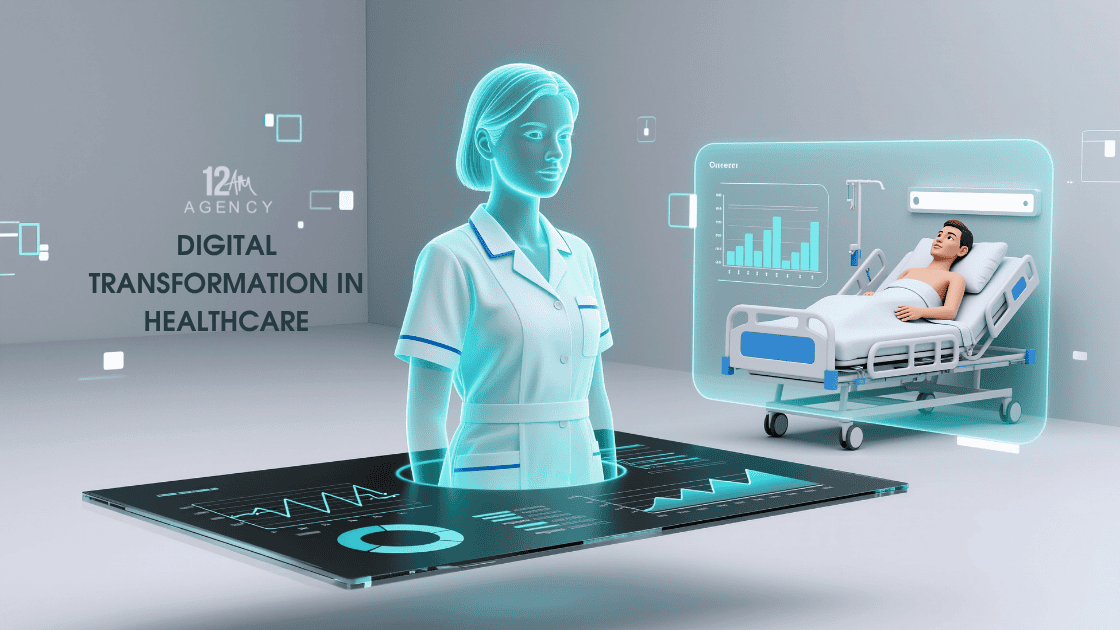
A great example is a “smart” hospital room.
- Before: A nurse manually checks vitals, writes them on a chart, then walks to a computer to type them into the EHR.
- After: The patient’s vitals are monitored by IoT sensors. The data flows directly to the EHR in real-time. A central AI monitors all patient data, and if a patient’s vitals trend downward, it sends an alert directly to the charge nurse’s mobile device before a code blue is called.
How does digital transformation reduce healthcare costs?
It reduces costs in three main ways:
- Automation: It slashes the high cost of manual, administrative labor (billing, scheduling, data entry).
- Proactive Care: It helps catch problems early with remote monitoring and AI, preventing a $1,000 clinic visit from becoming a $100,000 hospital stay.
- Efficiency: It reduces errors (like incorrect billing codes or duplicate tests) and optimizes resources (like scheduling and room usage).
What is the difference between digitization and digital transformation in healthcare?
This is a critical distinction:
- Digitization: This is “analog-to-digital.” You’ve replaced your paper charts with an EHR. You’ve “digitized” the file, but your process is the same. It’s a “dumb” digital filing cabinet.
- Digital Transformation: This is a process and model change. Your new “smart” EHR is now integrated with your telehealth platform, your billing system, and patient-worn IoT devices. It’s no longer a filing cabinet; it’s an intelligent, proactive system.