





Businesses pour millions into digital marketing every year, hoping for big wins and bigger profits. Turns out, only 22 percent of companies believe they can accurately measure their marketing ROI. That sounds shocking, but it gets even more interesting. The smartest brands are now using a handful of powerful digital marketing ROI metrics to finally crack the code on what actually works and what flops.
Table of Contents
- What Are Digital Marketing Roi Metrics?
- Why Digital Marketing Roi Metrics Matter For Businesses
- How Digital Marketing Roi Metrics Work In Practice
- Key Concepts Behind Digital Marketing Roi Metrics
- Real-World Applications Of Digital Marketing Roi Metrics
Quick Summary
| Takeaway | Explanation |
|---|---|
| Track Key ROI Metrics | Focus on conversion rate, customer acquisition cost, and lifetime value. These help measure the effectiveness of your marketing efforts. |
| Justify Marketing Expenses | Use ROI metrics to provide evidence of marketing performance to stakeholders, increasing accountability and support for budgets. |
| Optimize Future Strategies | Identify which marketing channels work best and adjust your strategies and budgets accordingly for improved results. |
| Leverage Data for Growth | Transform raw marketing data into actionable insights that guide strategic decision-making and foster sustainable business growth. |
| Implement Continuous Monitoring | Regularly assess marketing metrics and adapt strategies to ensure they remain aligned with business goals and market conditions. |
What Are Digital Marketing ROI Metrics?
Digital marketing ROI metrics are quantitative measurements that help businesses evaluate the financial effectiveness and performance of their online marketing efforts. These metrics transform raw marketing data into meaningful insights that demonstrate the direct relationship between marketing investments and business outcomes.
Defining ROI in Digital Marketing
Return on Investment (ROI) in digital marketing represents the percentage of profit or loss generated from marketing campaigns relative to their total cost. Research from Bowling Green State University highlights that effective ROI tracking provides executives with critical proof of marketing performance.
Key components of digital marketing ROI metrics include:
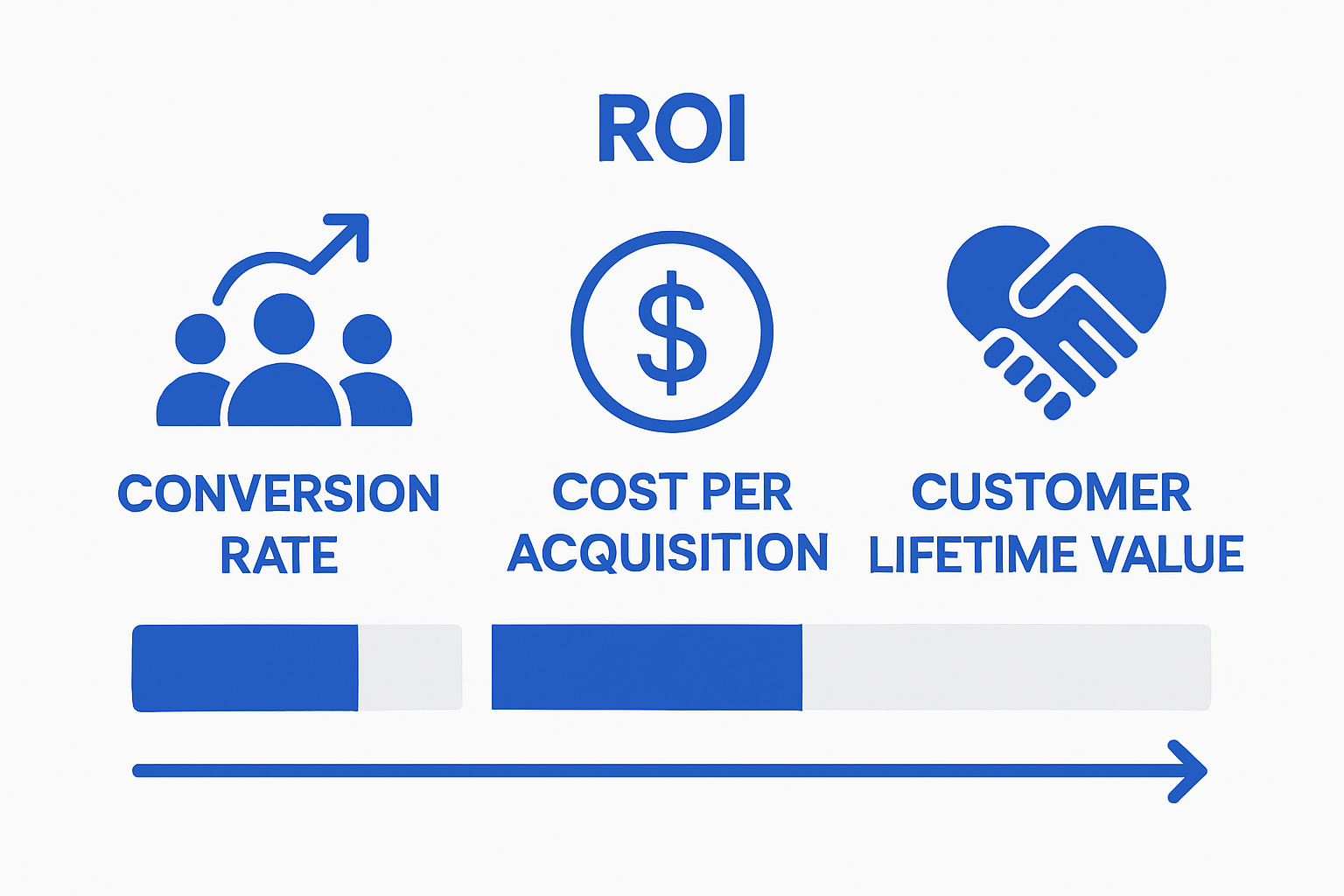
- Conversion Rate: Percentage of website visitors who complete a desired action
- Cost Per Acquisition: Total marketing expenses divided by number of new customers gained
- Customer Lifetime Value: Predicted net profit from entire future relationship with a customer
Why Digital Marketing ROI Metrics Matter
Understanding these metrics is crucial because they enable businesses to:
- Justify marketing expenditures to stakeholders
- Identify which marketing channels deliver the best results
- Optimize future marketing strategies and budget allocation
By tracking digital marketing ROI metrics, companies can make data-driven decisions that directly impact business growth strategies. These metrics transform marketing from a cost center into a measurable, strategic business function that demonstrates tangible financial impact.
To help clarify the essential components of digital marketing ROI metrics, the table below defines each key term and summarizes its significance for marketing measurement.
| Metric | Definition | Why It Matters |
|---|---|---|
| Conversion Rate | Percentage of website visitors who complete a desired action | Shows effectiveness of encouraging users to take valuable action |
| Cost Per Acquisition (CPA) | Total marketing expenses divided by the number of new customers gained | Helps measure how much it costs to gain each customer |
| Customer Lifetime Value | Predicted net profit from the entire future relationship with a customer | Guides long-term strategy and spend allocation |
| Cost Per Click (CPC) | Financial investment required to generate individual website visitor interactions | Allows channel and campaign performance comparison |
| Customer Acquisition Cost | Total expense of acquiring a new customer | Informs efficiency and budget optimization |
Why Digital Marketing ROI Metrics Matter for Businesses
Digital marketing ROI metrics have become essential for businesses seeking sustainable growth and competitive advantage in an increasingly data-driven marketplace. By translating marketing activities into measurable financial outcomes, these metrics provide critical insights that guide strategic decision making.
Financial Accountability and Strategic Planning
Businesses invest significant resources in digital marketing, making ROI metrics crucial for demonstrating tangible value. According to research on digital marketing profitability, these metrics enable organizations to:
- Quantify the precise financial impact of marketing campaigns
- Validate marketing expenditures to stakeholders
- Identify high-performing and underperforming channels
- Reallocate budgets more effectively
Performance Optimization and Competitive Intelligence
ROI metrics offer more than financial tracking. They provide a comprehensive view of marketing performance by revealing:
- Customer acquisition costs
- Campaign effectiveness across different platforms
- Long-term customer value
- Potential areas for strategic improvement
By leveraging these insights, businesses can develop more targeted marketing strategies that minimize waste and maximize return.
This data-driven approach transforms marketing from a cost center into a strategic growth engine, enabling companies to make informed decisions that directly impact their bottom line.
How Digital Marketing ROI Metrics Work in Practice
Digital marketing ROI metrics transform abstract marketing efforts into concrete, measurable financial outcomes through systematic tracking and analysis. By implementing a strategic approach, businesses can uncover meaningful insights that drive data-driven decision making and optimize marketing performance.
Tracking and Measurement Methodology
Research from scholarly publications reveals specific metrics that help businesses evaluate digital marketing investments. The process involves collecting and analyzing key performance indicators that provide a comprehensive view of marketing effectiveness:
- Cost Per Click (CPC): Measures the financial investment required to generate individual website visitor interactions
- Conversion Rate: Calculates the percentage of visitors completing desired actions
- Customer Acquisition Cost (CAC): Determines total expense of acquiring a new customer
Practical Implementation and Analysis
Successful implementation of ROI metrics requires a structured approach that goes beyond simple number crunching. Businesses must:
- Establish clear marketing objectives
- Select relevant tracking technologies
- Create baseline performance measurements
- Continuously monitor and adjust strategies
By integrating advanced analytics and understanding comprehensive marketing strategies, companies can transform raw data into actionable intelligence. This approach enables marketing teams to demonstrate tangible value, optimize resource allocation, and drive sustainable business growth through precise, quantifiable insights.

Key Concepts Behind Digital Marketing ROI Metrics
Digital marketing ROI metrics are grounded in complex frameworks that transform raw marketing data into strategic business intelligence. Understanding these foundational concepts enables organizations to move beyond surface-level analytics and develop nuanced, data-driven marketing strategies.
Fundamental Mathematical Principles
Research from the American Marketing Association reveals that effective ROI calculations rely on precise mathematical models that translate marketing activities into financial outcomes. The core mathematical formula involves:
- Net Profit Calculation: Total revenue minus total marketing expenses
- Percentage ROI: (Net Profit / Total Marketing Investment) x 100
- Comparative Analysis: Benchmarking performance across different marketing channels
Strategic Performance Dimensions
Beyond numerical calculations, digital marketing ROI metrics encompass multidimensional performance evaluation. Successful organizations recognize that true ROI extends beyond immediate financial returns and includes:
- Brand perception and reputation enhancement
- Long-term customer relationship development
- Competitive market positioning
- Potential for future revenue generation
By integrating comprehensive data-driven ranking strategies, businesses can transform raw metrics into actionable strategic intelligence. This holistic approach ensures that marketing investments are viewed not just as expenses, but as critical drivers of sustainable business growth and competitive advantage.
Real-World Applications of Digital Marketing ROI Metrics
Digital marketing ROI metrics transcend theoretical calculations, offering tangible strategic insights that drive business performance across diverse industries. By transforming complex data into actionable intelligence, organizations can make informed decisions that directly impact bottom-line results.
Industry-Specific Performance Measurement
Research from comprehensive marketing studies demonstrates how different sectors leverage ROI metrics to optimize marketing strategies. Key industry applications include: In the retail sector, businesses often analyze sales data alongside customer engagement metrics to determine effective promotional strategies. Similarly, in the tech industry, companies explore how to measure marketing ROI by assessing user acquisition costs against lifetime value. These insights enable organizations to refine their campaigns and allocate resources efficiently, ensuring maximum impact and profitability.
- E-commerce: Tracking customer acquisition costs and lifetime value
- B2B Services: Measuring lead generation efficiency and conversion rates
- Retail: Analyzing multichannel marketing performance and customer engagement
Practical Strategic Implementation
Successful businesses integrate ROI metrics into their strategic planning through sophisticated approaches that go beyond simple number tracking. Effective implementation involves:
- Creating comprehensive data dashboards
- Establishing cross-departmental communication channels
- Developing predictive modeling capabilities
- Continuously refining measurement methodologies
By selecting the right performance marketing partners, companies can transform raw marketing data into strategic advantages. This approach enables organizations to move beyond traditional reporting, using data-driven insights to anticipate market trends, optimize resource allocation, and create more targeted, effective marketing strategies that deliver measurable business growth.
The following table compares how different industries utilize digital marketing ROI metrics, providing a clearer understanding of industry-specific measurement approaches discussed in the article.
| Industry | Key ROI Metrics Used | Main Objectives |
|---|---|---|
| E-commerce | Customer acquisition costs, lifetime value | Maximize long-term value and optimize acquisition spending |
| B2B Services | Lead generation efficiency, conversion rates | Improve lead quality and increase sales conversions |
| Retail | Multichannel performance, customer engagement | Enhance customer relationships and increase store/online sales |
Turn Your Marketing Data Into Real Growth
Are you struggling to prove the value of your digital marketing investments? The article highlighted how confusing it can be to track conversion rates, customer acquisition costs, or campaign effectiveness—and how these numbers make a real difference for your business goals. If you find it hard to connect the dots between marketing spend and true business growth, you’re not alone. Many businesses face this challenge and risk missing out on smarter strategies, wasted budgets, and untapped potential.

Now’s your opportunity to move forward with clarity. At 12AM Agency, we bring your ROI metrics to life with actionable insights and purpose-built solutions. Our team does more than just analyze data—we create customized campaigns that turn numbers into measurable results across SEO, PPC, reputation management, and more. Ready to see real change? Connect with us now for a personalized growth consultation. Let’s unlock the next level of business performance together.
Frequently Asked Questions
What are digital marketing ROI metrics?
Digital marketing ROI metrics are quantitative measurements that help businesses evaluate the financial effectiveness and performance of their online marketing efforts, demonstrating the relationship between marketing investments and business outcomes.
How is ROI calculated in digital marketing?
ROI in digital marketing is calculated by subtracting total marketing expenses from total revenue, then dividing by the total marketing investment and multiplying by 100 to get a percentage.
Why are digital marketing ROI metrics important for businesses?
These metrics are vital because they help justify marketing expenditures, identify high-performing channels, and optimize future marketing strategies and budget allocation, ultimately driving sustainable growth.
What are some key components of digital marketing ROI metrics?
Key components include conversion rate (percentage of visitors completing desired actions), cost per acquisition (total expenses divided by new customers gained), and customer lifetime value (predicted net profit from future customer relationships).
Recommended
- Top Digital Marketing Trends 2025 for Business Growth | 12AM Agency
- Unlock Growth: Essential Digital Marketing Strategies for Small Business Owners in 2025 | 12AM Agency
- What Is Digital Marketing? Essential Guide for Business Growth 2025 | 12AM Agency
- How to Choose a PPC Company That Delivers Real ROI (Not Just Reports) | 12AM Agency
- Top Digital Marketing KPIs to Track in 2025 for Success