





B2B lead nurturing is changing the way companies connect with potential clients. Most sales teams throw everything at prospects hoping for a quick win but end up spinning their wheels. The real upside? Effective lead nurturing can deliver 50 percent more sales-ready leads at a much lower cost than old-school marketing tactics. This flips the script and shows that patience and precision can outplay any hard sell—hinting at bigger gains just by rethinking your approach.
Table of Contents
- What Is B2B Lead Nurturing And Its Purpose?
- Why B2B Lead Nurturing Matters For Businesses
- How B2B Lead Nurturing Works In Practice
- Key Concepts And Strategies In B2B Lead Nurturing
Quick Summary
| Takeaway | Explanation |
|---|---|
| B2B lead nurturing builds relationships. | This approach focuses on developing meaningful connections with potential clients throughout their buying journey. |
| Segment clients for targeted messaging. | By categorizing prospects based on their specific needs, businesses can provide tailored content that resonates effectively. |
| Leverage multiple channels for engagement. | Use integrated communication strategies, like email and webinars, to maintain consistent and valuable interactions with prospects. |
| Implement lead scoring for prioritization. | Determine the most promising leads using behavioral and demographic data to allocate marketing resources efficiently. |
| Content mapping enhances buyer experience. | Align content with different stages of the buyer’s journey to address evolving needs and facilitate decision-making. |
What is B2B Lead Nurturing and Its Purpose?
B2B lead nurturing represents a strategic approach to building meaningful relationships with potential business customers throughout their purchasing journey. Unlike traditional sales tactics that focus on immediate conversion, this process prioritizes understanding and addressing the specific needs, challenges, and interests of potential clients over time.
The Core Purpose of Lead Nurturing
The fundamental goal of B2B lead nurturing is to guide potential customers through the sales funnel by providing targeted, valuable information that gradually builds trust and demonstrates your understanding of their business challenges. Research from Marketo indicates that effective lead nurturing can produce 50% more sales-ready leads at a significantly lower cost compared to traditional marketing strategies.
Key objectives of B2B lead nurturing include:
- Establishing credibility and trust with potential clients
- Educating prospects about your solutions and industry expertise
- Maintaining consistent communication during the decision-making process
- Reducing the sales cycle by proactively addressing potential concerns
How B2B Lead Nurturing Works
Successful B2B lead nurturing operates through a systematic approach of personalized communication and targeted content delivery. This involves segmenting potential clients based on their industry, company size, specific challenges, and stage in the buying process. By creating tailored content and touchpoints, businesses can demonstrate their understanding of unique client needs.
The process typically involves multiple interaction channels such as:
- Personalized email sequences
- Targeted content marketing
- Webinars and educational resources
- Strategic follow-up communications
Learn more about how SEO companies can generate more leads to complement your nurturing strategies and enhance your overall marketing approach.
Why B2B Lead Nurturing Matters for Businesses
In the competitive landscape of modern business, B2B lead nurturing has transformed from a strategic advantage to an essential survival mechanism for companies seeking sustainable growth. By creating meaningful connections with potential clients, businesses can significantly enhance their conversion rates and long-term revenue potential.
To clarify the primary advantages and economic impact of strategic B2B lead nurturing discussed in the text, the table below summarizes the key economic benefits and how each impacts business growth.
| Economic Benefit | Description |
|---|---|
| Reduced Customer Acquisition Cost | Streamlines marketing spend by targeting high-potential leads, lowering overall customer costs. |
| Increased Sales Pipeline Efficiency | Focuses resources on qualified prospects, boosting productivity and pipeline throughput. |
| Higher Conversion Rates | Offers relevant content and engagement, resulting in more prospects becoming customers. |
| Improved Return on Marketing Investment | Allocates spend for maximum results, driving better outcomes from existing budgets. |
The Economic Impact of Strategic Lead Nurturing
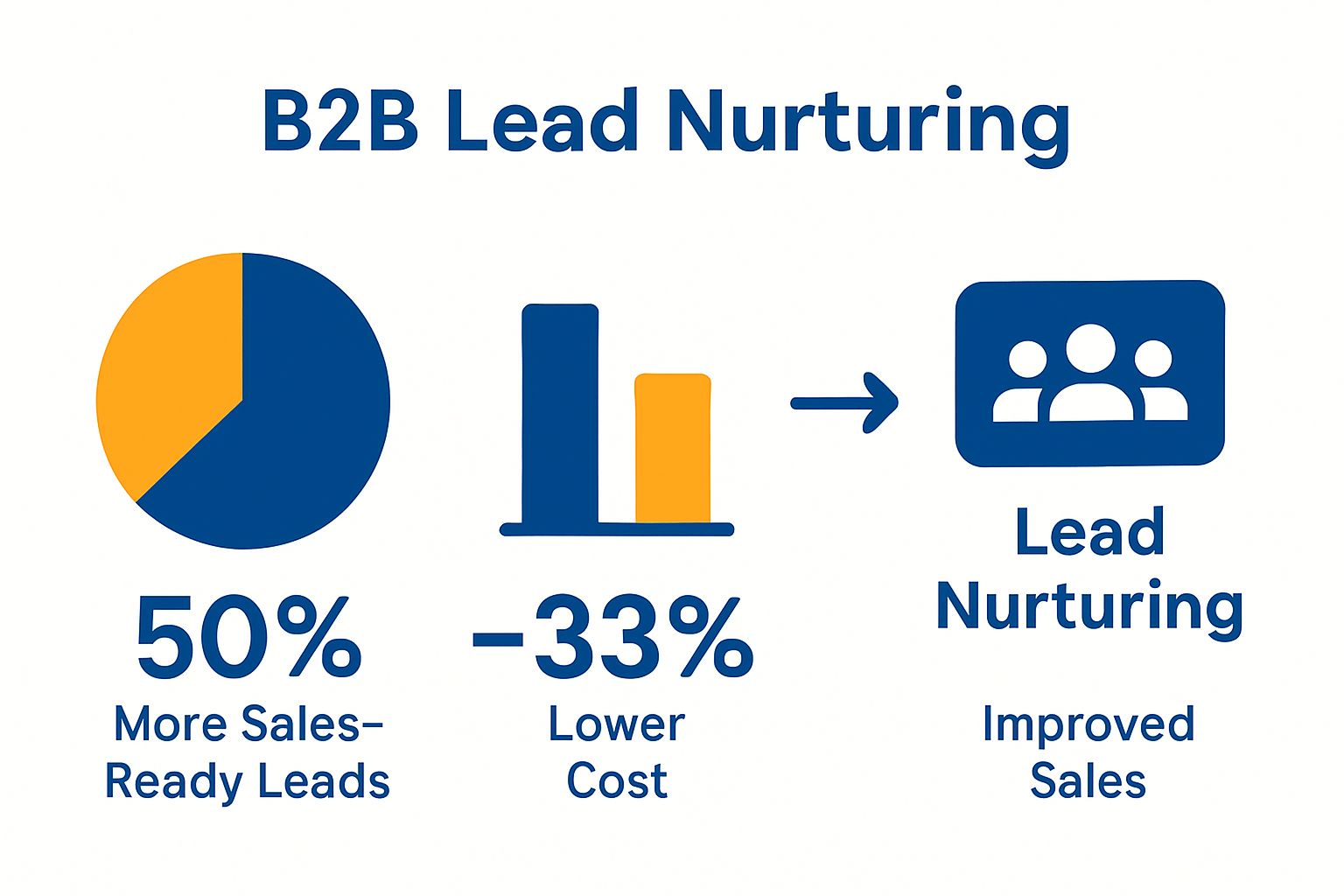
Research from Forrester reveals that companies implementing systematic lead nurturing generate 50% more sales-ready leads at 33% lower cost. This economic advantage stems from a targeted approach that reduces wasted marketing resources and focuses on high-potential prospects.
Key economic benefits include:
- Reduced customer acquisition costs
- Increased sales pipeline efficiency
- Higher conversion rates from prospect to customer
- Improved return on marketing investments
Building Long-Term Business Relationships
B2B lead nurturing goes beyond immediate sales transactions. It represents a sophisticated method of relationship building that positions your business as a trusted advisor rather than a mere vendor. By consistently demonstrating industry expertise and understanding client challenges, companies can establish deeper, more meaningful connections that transcend traditional transactional interactions.
The strategic advantages of this approach encompass:
- Enhanced brand reputation
- Increased customer loyalty
- Stronger competitive differentiation
- More predictable revenue streams
Learn more about lead generation strategies for business growth to complement your nurturing efforts and maximize your marketing potential.
How B2B Lead Nurturing Works in Practice
B2B lead nurturing transforms theoretical marketing strategies into practical, measurable engagement processes that systematically guide potential customers through their purchasing journey. By implementing sophisticated, data-driven approaches, businesses can create personalized experiences that resonate with their target audience’s specific needs and challenges.
Segmentation and Personalization Strategies
Research from Digital Commons demonstrates that effective lead nurturing relies on granular audience segmentation and highly tailored communication strategies. Successful implementation involves categorizing potential clients based on multiple sophisticated parameters:
- Organizational size and industry vertical
- Current technological infrastructure
- Specific pain points and business challenges
- Historical interaction data with marketing materials
- Stage within the purchasing decision cycle
This strategic segmentation enables businesses to craft hyper-targeted content that speaks directly to each prospect’s unique context, dramatically increasing engagement and conversion potential.

Multichannel Engagement Approaches
Modern B2B lead nurturing transcends traditional single-channel communication models. Companies now leverage an integrated approach that synchronizes multiple touchpoints to maintain consistent, meaningful interactions. These engagement channels typically include:
- Personalized email marketing sequences
- Targeted social media interactions
- Remarketing advertising campaigns
- Customized webinar and content experiences
- Strategic direct outreach from sales representatives
The goal is to create a seamless, omnichannel experience that provides value at every interaction point, gradually building trust and demonstrating genuine understanding of the prospect’s business ecosystem.
Discover more insights about B2B content syndication strategies to enhance your lead nurturing approach and drive digital growth.
Key Concepts and Strategies in B2B Lead Nurturing
B2B lead nurturing demands a sophisticated, multifaceted approach that combines strategic thinking, data analysis, and precise communication tactics. Successful implementation requires understanding complex psychological and technological frameworks that transform potential leads into committed customers.
This table summarizes key strategies and elements of advanced B2B lead nurturing, highlighting the main mechanisms and strategic practices used to effectively engage and convert leads.
| Key Strategy | Main Elements |
|---|---|
| Lead Scoring & Qualification | Behavioral metrics, demographic data, real-time tracking, predictive analytics, weighted scores |
| Content Mapping & Communication | Persona-based content, info hierarchies, sequenced touchpoints, adaptive delivery, analytics |
| Segmentation & Personalization | Industry, company size, technology, pain points, buying stage |
| Multichannel Engagement | Email, social media, remarketing, webinars, direct sales outreach |
Lead Scoring and Qualification Mechanisms
Research from Content Marketing Institute reveals that advanced lead nurturing strategies leverage systematic scoring mechanisms to prioritize and segment potential clients. These sophisticated evaluation frameworks help businesses allocate resources more effectively by identifying the most promising prospects.
Key components of effective lead scoring include:
- Behavioral engagement metrics
- Demographic and firmographic data points
- Real-time interaction tracking
- Predictive analytics capabilities
- Weighted probability calculations
By developing a nuanced understanding of each prospect’s potential value, companies can create targeted, high-conversion engagement strategies that maximize marketing efficiency.
Content Mapping and Strategic Communication
Successful B2B lead nurturing transcends generic communication by implementing precise content mapping strategies that align messaging with specific buyer journey stages. This approach requires creating tailored content experiences that address evolving prospect needs and pain points.
Essential content mapping strategies include:
- Developing persona-specific content architectures
- Creating progressive information hierarchies
- Designing multi-touchpoint communication sequences
- Implementing adaptive content delivery mechanisms
- Tracking and analyzing engagement metrics
Learn more about small business automation strategies to complement your lead nurturing approach and enhance overall marketing effectiveness.
Ready to Transform B2B Lead Nurturing Into Real Revenue?
You know how overwhelming it can feel guiding prospects through complex buying cycles. The article highlighted the struggle to maintain personalized, consistent communication and the challenge of building credibility in a crowded market. Your company cannot afford to miss out on more sales-ready leads while competitors invest in smarter strategies. Imagine what is possible when every touchpoint is strategic, every follow-up is intentional, and your sales funnel is finally optimized.
Now is the time to turn nurturing into lasting business growth. At 12AM Agency, we combine tailored SEO management, cutting-edge AI-driven strategies, and deep experience in B2B lead nurturing to help you achieve measured results. Let us show you exactly how our solutions can address your toughest sales challenges. Take the first step today with a free marketing evaluation at our contact page. Take action now and create the sales momentum your business needs.
Frequently Asked Questions
What is B2B lead nurturing?
B2B lead nurturing is a strategic approach that focuses on building meaningful relationships with potential business customers throughout their purchasing journey, prioritizing understanding their needs over immediate sales.
Why is lead nurturing important for B2B businesses?
Lead nurturing is essential for B2B businesses as it helps establish credibility, educate prospects, reduce sales cycles, and significantly increase conversion rates by maintaining consistent communication.
How does effective B2B lead nurturing work?
Effective B2B lead nurturing operates through personalized communication and targeted content delivery, involving segmentation of potential clients based on their unique challenges and stage in the buying process.
What are some key strategies in B2B lead nurturing?
Key strategies in B2B lead nurturing include lead scoring and qualification, content mapping, and employing multichannel engagement approaches to create seamless interactions that resonate with prospects.
Recommended
- How SEO Companies Can Generate More Leads: A Step-by-Step Guide | 12AM Agency
- Top Lead Generation Strategies for Business Growth in 2025 | 12AM Agency
- SEO and Digital Marketing: A Powerful Duo for Lead Generation | 12AM Agency
- SEO for HVAC: Proven Lead Generation Techniques | 12AM Agency
- What is Content Marketing? Understanding Its Importance
- 15 Proven B2B Demand Generation Best Practices for Sustainable Growth – Kadima