



Did you know that Google now processes over 100 billion searches a month? Yet, its share of the total daily search pie is only 27%. The game has changed. For years, you’ve been told to focus all your energy on ranking on Google. But the rise of AI-powered search on platforms from TikTok to ChatGPT has shattered that old playbook. If you’re a DIY business owner trying to get real results from your marketing, you’re likely feeling the ground shift beneath your feet. The big question on everyone’s mind is: is AI killing SEO? The short answer is no. But it is fundamentally transforming it. This guide will provide you with a data-backed, actionable framework to navigate the new world of SEO in 2025 and come out on top.
The New Commandment: Search Everywhere Optimization (SEO)
The first mindset shift you must make, as emphasized by marketing guru Neil Patel, is to stop thinking about SEO as just “Search Engine Optimization” and start thinking of it as “Search Everywhere Optimization.” The reality is that your customers are looking for solutions on a multitude of platforms:
- Instagram: 6.5 billion searches/day
- Snapchat: 4 billion searches/day
- Amazon: 3.5 billion searches/day
- ChatGPT: 1 billion searches/day
Focusing only on Google means you are invisible to nearly 73% of daily searches. To win in 2025, your brand needs to be present and optimized wherever your audience is asking questions.
The H-AI Content Strategy: Your Shield Against Irrelevance
With 4.6 billion pieces of content created daily, “good enough” is dead. AI can write an article, but it often lacks what Google calls E-E-A-T (Experience, Expertise, Authority, and Trust). Neil Patel’s own experiments showed that pure AI-written content received 5.44 times less organic traffic than content created with a human touch.
The future is H-AI: Human + AI.
- You (The Human): Provide the strategy, experience, unique insights, and brand voice. You are the expert.
- AI (The Tool): Use AI for research, outlines, data analysis, and first drafts. It’s your tireless assistant.
This hybrid approach ensures your content is not only efficient to produce but also deeply valuable, fresh, and trustworthy—qualities that both users and search algorithms reward.
Your 6-Step Blueprint to Rank in AI Overviews
The most immediate change from AI is the “AI Overview” (formerly Google’s Search Generative Experience or SGE). Getting your business featured here is the new frontier of SEO. Based on detailed analysis from Ahrefs, here is a proven 6-step process to make it happen.
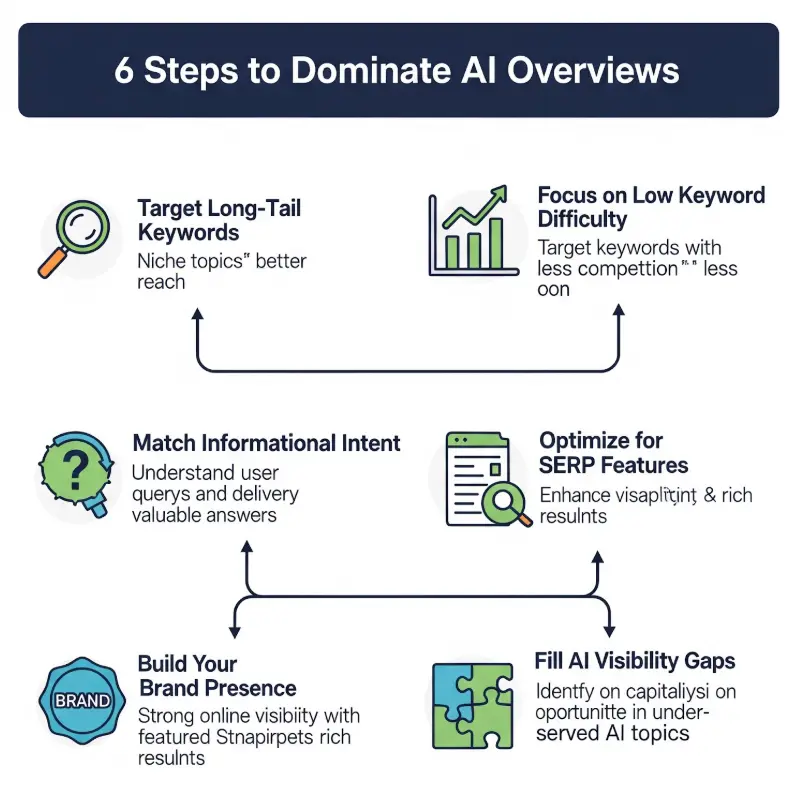
Step 1: Target Long-Tail Keywords
AI Overviews are designed to answer questions. This means they are triggered more often by longer, more conversational queries. The data shows AI Overview keywords contain four words on average, compared to just two for standard searches.
- Action Step: Shift your keyword research from short, broad terms to longer, question-based phrases that your ideal customer would ask.
Step 2: Target Keywords with Low Difficulty
You don’t need a massive backlink profile to win here. A staggering 71% of AI Overview keywords have a Keyword Difficulty score below 30. This is a massive opportunity for small businesses to compete with established giants.
- Action Step: Use a tool like Ahrefs to find relevant keywords with a difficulty score of 30 or less.
Step 3: Match Informational Search Intent
Nearly all (99.2%) of AI Overview keywords are informational. Users are looking for answers, explanations, and guides, not to make a purchase at that exact moment.
- Action Step: Create high-quality, comprehensive content that genuinely helps and informs your audience. Think “how-to” guides, ultimate guides, and detailed explanations.
Step 4: Optimize for Featured Snippets & “People Also Ask”
AI Overviews pull information from pages that are already ranking for other SERP features. The most common are “People Also Ask” boxes and Featured Snippets.
- Action Step: Structure your content with clear headings and concise answers to common questions in your niche. Answer the questions from the “People Also Ask” section directly in your content.
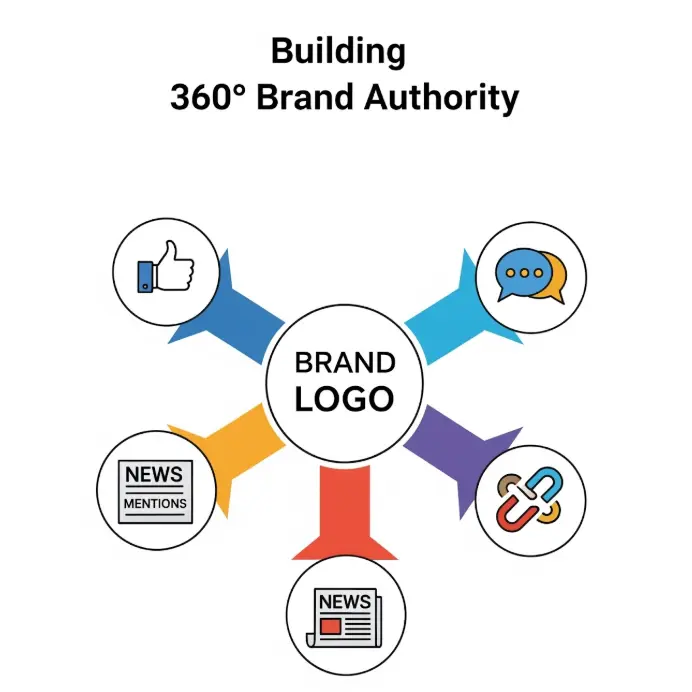
Step 5: Improve Your Brand’s Presence Everywhere
The AI doesn’t just look at your website. It scans the entire web to determine who is an authority. It’s looking at reviews, brand mentions on other sites, awards, and backlinks.
Action Step: Actively seek out mentions, collaborations, and guest posting opportunities. Encourage customer reviews on relevant platforms.
Step 6: Find and Fill AI Visibility Gaps
An “AI visibility gap” is when a competitor is cited in an AI Overview, but you are not.
- Action Step: Search for your target keywords and analyze the AI Overviews. See which competitors are being cited. Can you create better content? Can you reach out to the sources citing them and get your brand included?
Conclusion: Be Cautious, But Be Prepared
As SEO expert Brian Dean advises, it’s wise to adopt a “wait and see” approach rather than panicking. The ultimate success of AI search will depend on whether users find it genuinely more useful than the traditional “10 blue links.”
However, waiting doesn’t mean doing nothing. The steps outlined above—expanding to “Search Everywhere Optimization,” creating high-value H-AI content, and strategically targeting AI Overviews—are not just defensive moves against a changing landscape. They are powerful, proactive strategies that will build a more resilient, authoritative, and successful brand for the long term. The future of search is here, and now you have the blueprint to master it.