




For over two decades, the primary goal of structured data (Schema markup) was to earn “rich snippets”—those eye-catching stars, prices, and FAQ accordions on Google’s search results page. But as we move deeper into 2026, the objective of technical SEO has shifted. We are no longer just optimizing for visual flair on a search results page; we are optimizing for machine comprehension.
Large Language Models (LLMs) and their associated crawlers, such as OpenAI’s GPTBot, Perplexity’s crawler, and Google’s Vertex AI bots, do not “read” a website the same way a human does. They are looking for high-fidelity, structured, and disambiguated data that they can ingest into their Retrieval-Augmented Generation (RAG) pipelines. In this environment, Structured Data for AI is the primary language of authority.
This comprehensive guide explores the technical architecture of LLM-friendly schema, the specific types that move the needle for AI citations, and how to avoid the technical pitfalls that leave your site’s data in the “dark.”
The Paradigm Shift: From Rich Snippets to Data Ingestion
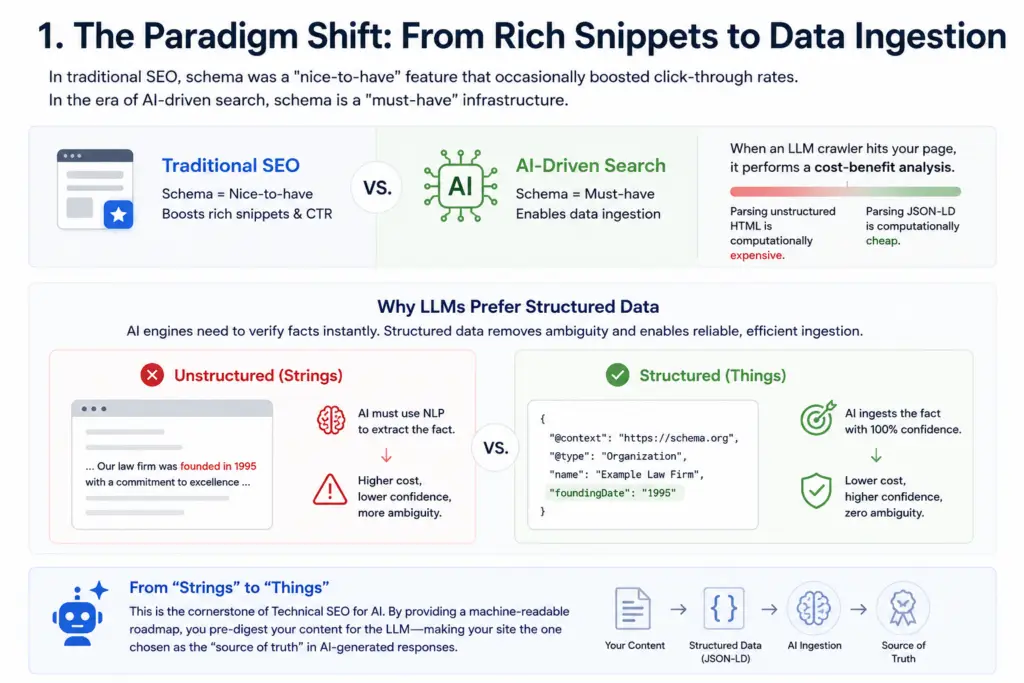
In traditional SEO, schema was a “nice-to-have” feature that occasionally boosted click-through rates. In the era of AI-driven search, schema is a “must-have” infrastructure. When an LLM crawler hits your page, it is performing a cost-benefit analysis. Crawling and parsing unstructured HTML is computationally expensive. Parsing a JSON-LD script is computationally cheap.
Why LLMs Prefer Structured Data
When an AI engine like SearchGPT or Perplexity synthesizes an answer, it needs to verify facts instantly. If a law firm’s website says they were “founded in 1995” in a paragraph of text, the AI has to use natural language processing to extract that fact. However, if that same fact is nested within an Organization schema under the foundingDate property, the AI can ingest it with 100% confidence and zero ambiguity.
This move from “strings” to “things” is the cornerstone of Technical SEO for AI. By providing a machine-readable roadmap, you are essentially pre-digesting your content for the LLM, making it much more likely that your site will be the one chosen as the “source of truth” in an AI-generated response.
How LLM Crawlers Ingest and Weight Schema
Not all schema is created equal. While there are thousands of types available in the Schema.org vocabulary, AI models prioritize types that help them build a Knowledge Graph of entities.
The Parsing Process
- Discovery: The LLM crawler identifies the <script type=”application/ld+json”> tag.
- Entity Identification: The crawler looks for the @type (e.g., ProfessionalService or TechArticle) and the @id. The @id is crucial because it acts as a unique URI for your brand in the AI’s memory.
- Relationship Mapping: The crawler analyzes properties like knowsAbout, memberOf, or parentOrganization to see how you fit into the broader industry landscape.
- Verification: The crawler cross-references the data found in your schema with other authoritative sources (Wikidata, LinkedIn, official registries) to assign a “Trust Score” to the entity.
Semantic Weighting
LLMs weight schema based on its ability to provide Information Gain. If your schema provides data that isn’t easily found in the body text, such as specific ISO certifications, professional licenses, or detailed technical specifications, the AI assigns it a higher weight during the “Reranking” phase of the RAG process.
The “Big Four” Schema Types for AI Visibility
If you want to rank in AI search, your technical strategy must prioritize these four specific schema types. These are the building blocks that LLMs use to construct their answers.
A. Organization and LocalBusiness Schema
This is the “Identity” layer. For AI models, the Organization schema is the primary source of truth for who you are.
- Key Properties for AI: * sameAs: This is perhaps the most important property. It should link to your Wikipedia page, Wikidata entry, and official social profiles. It tells the AI: “I am the same entity as this verified profile.”
- knowsAbout: This property allows you to explicitly list your areas of expertise. For a law firm, this might include “Personal Injury Law” or “Intellectual Property.”
- award: List every industry recognition here to build the “Authority” part of E-E-A-T.
B. Product Schema
For e-commerce and SaaS brands, Product schema is the bridge to “Agentic” commerce—where an AI recommends a specific product to a user.
- Key Properties for AI:
- aggregateRating: AI models prioritize products with high social proof.
- offers: Include real-time availability and price.
- material or isRelatedTo: Detailed specifications help the AI answer “niche” prompts like “What is the best waterproof hiking boot for wide feet under $200?”
C. FAQPage Schema
The FAQPage schema is a citation magnet. Because AI search engines are inherently question-and-answer machines, they look for schema that provides a direct mapping between a question and an answer.
- Why LLMs Love It: It reduces the “hallucination” risk. If the AI uses your structured FAQ answer, it doesn’t have to “invent” a response; it just summarizes your verified data.
- Pro Tip: Ensure the questions in your schema match the “Long-Tail Prompts” your audience is actually asking in ChatGPT.
D. HowTo Schema
As users increasingly ask AI “How do I…” questions, the HowTo schema has become essential for instructional content.
- Step-by-Step Logic: This schema breaks a process down into discrete step objects. LLMs can easily parse these steps and present them as a numbered list in the AI sidebar or voice response.
- Actionability: Including supply, tool, and totalTime properties helps the AI provide a comprehensive overview of the task’s difficulty and requirements.
Advanced Entity Disambiguation Strategy
One of the greatest challenges in 2026 SEO is Entity Disambiguation. There may be thousands of businesses with similar names. How does an LLM know that your company is the one to cite?
See exactly where your profile stands right now.
Our GBP audit shows your current rank position across your market, how your profile completeness scores against competitors, and the specific gaps holding you back from the Map Pack.
Using the @id Property
The @id property (or “URI”) is a unique identifier. Instead of just listing your name, you should use a canonical URL (often your homepage URL with an appended #organization) to identify your brand. This allows the LLM to create a specific “node” in its knowledge graph for your brand.
The Role of mainEntityOfPage
When you write a technical article, use the mainEntityOfPage property to tell the crawler exactly what the core focus of the page is. This prevents the AI from getting “distracted” by sidebar content, related posts, or navigation links. It focuses the AI’s attention on the specific information you want it to ingest.
Defining “KnowsAbout” and “Expertise”
Modern LLMs are highly sensitive to “Contextual Relevance.” By using the knowsAbout property within your Person or Organization schema, you can link to external URLs (like a Wikipedia page for “Artificial Intelligence”) to define your niche. This provides a “Semantic Link” that helps the AI understand your area of authority.
Technical Validation: The “Broken Schema” Crisis
At our agency, we’ve performed thousands of technical audits. One of the most shocking trends we’ve discovered in 2026 is the sheer volume of “broken” or “hallucinated” schema. On our own site’s legacy audits, we once identified 8,987 broken schema instances—errors that were invisible to a human eye but completely blocked AI crawlers from understanding our content.
Why Simple Validation Isn’t Enough
Most SEOs use the Google Rich Results Test. However, that tool only checks if your schema is valid for Google’s visual features. It does not check if your schema is optimized for an LLM’s knowledge graph.
Common “Silent” Errors that Block AI:
- Missing @id links: If your Article schema isn’t properly linked to your Organization schema via a #id reference, the AI won’t know that you are the author of that expert content.
- Context Mismatch: Using LocalBusiness on a page that is actually a broad Service description. This confuses the AI’s geographic relevance engine.
- Circular References: Schema that links back to itself in an infinite loop, causing crawlers to timeout.
- Stale Data: Schema that says a product is “In Stock” when the page text says “Sold Out.” AI models are trained to spot these inconsistencies and will penalize your “Trust Score” as a result.
Real-World JSON-LD Examples for AI Optimization
To help you visualize what “AI-First” schema looks like, here are two high-impact examples.
Example 1: The “Expert Author” Organization Schema
This script doesn’t just name the company; it defines its expertise and its “Entity” connections.
JSON
{
“@context”: “https://schema.org”,
“@type”: “ProfessionalService”,
“@id”: “https://12amagency.com/#organization”,
“name”: “12AM Agency”,
“url”: “https://12amagency.com”,
“logo”: “https://12amagency.com/logo.png”,
“sameAs”: [
“https://www.linkedin.com/company/12am-agency/”,
“https://twitter.com/12amagency”,
“https://www.wikidata.org/wiki/Q12345678”
],
“knowsAbout”: [
“https://en.wikipedia.org/wiki/Search_engine_optimization”,
“https://en.wikipedia.org/wiki/Artificial_intelligence”,
“https://en.wikipedia.org/wiki/Generative_artificial_intelligence”
],
“description”: “A strategy-led, full-service creative agency specializing in AI-powered digital transformation and SEO.”
}
Example 2: The “Answer-Ready” FAQ Schema
This is designed to be scraped directly by ChatGPT or Perplexity for a specific query.
JSON
{
“@context”: “https://schema.org”,
“@type”: “FAQPage”,
“mainEntity”: [{
“@type”: “Question”,
“name”: “How does structured data improve AI search ranking?”,
“acceptedAnswer”: {
“@type”: “Answer”,
“text”: “Structured data provides a machine-readable roadmap that LLMs use to verify facts, disambiguate entities, and ingest content into RAG pipelines for more accurate citations.”
This is the work we do for you. Every week, without exception.
Managing GBP at this level takes 6–8 hours a week when done right. Nova handles the entire system — posts, photos, reviews, Q&A, citations, heatmap tracking — so you can focus on running your business.
}
}]
}
The AI-Ready Technical SEO Checklist
Before you move on to your next sprint, use this checklist to ensure your technical infrastructure is ready for the next generation of LLM crawlers.
- Check robots.txt for AI Bots: Ensure you are not blocking GPTBot, PerplexityBot, anthropic-ai, or Google-CloudVertex.
- Establish a Canonical @id: Ensure every page has a unique identifier for the main entity.
- Implement ‘SameAs’ Everywhere: Connect your website to every high-authority third-party profile you own.
- Audit for Data Consistency: Does your JSON-LD match the visible text on the page? Discrepancies lead to “Trust Score” penalties.
- Use TechArticle for Deep Dives: If you are writing research-based content, use the TechArticle schema instead of a generic Article to signal higher informational gain.
- Review for Nesting Errors: Ensure your Author is properly nested within the Article, and your Article is properly nested within the Organization.
Conclusion: Your Data is Your Reputation
In the AI era, your website is no longer just a digital brochure for humans; it is a database for machines. The quality of your structured data directly determines your brand’s reputation in the eyes of an LLM. If your data is messy, incomplete, or broken, the AI will perceive your brand as an unreliable source and will look elsewhere for its answers.
By mastering Structured Data for LLM Crawlers, you are doing more than just “optimizing for search.” You are ensuring that your brand’s expertise is preserved, understood, and cited in the conversational future of the web.
Is your schema holding you back?
With the complexity of modern LLM requirements, “standard” SEO tools often miss the technical nuances that lead to AI citations. At 12AM Agency, we specialize in deep technical schema audits and AI-first optimization. We’ve seen the thousands of broken schemas that hide in legacy sites, and we know exactly how to fix them to get you cited.
Contact 12AM Agency for a Technical Schema Audit Today
Frequently Asked Questions (FAQ)
1. Does structured data still help with traditional Google search? Absolutely. While we are focusing on LLMs, Google still uses schema for rich results. The benefit of AI-optimized schema is that it fulfills both requirementsimproving visibility for humans on Google and authority for machines in Gemini and ChatGPT.
2. Can I use a plugin like Yoast or RankMath for AI SEO? Plugins are a great starting point, but they often produce generic schema that lacks the “Entity Disambiguation” properties (like @id and sameAs) required for high-level AI ranking. For technical showcases, custom JSON-LD is often necessary.
3. What is the difference between Article and TechArticle schema? Article is a general type for news or blog posts. TechArticle is a specific subtype that signals to AI models that the content contains technical details, instructions, or research, often leading to higher “Information Gain” weighting.
4. How often should I audit my site’s structured data? Because LLM requirements and Schema.org vocabularies evolve rapidly, we recommend a technical audit every quarter. As you add new services or win new awards, your “Identity” schema must be updated to reflect your growing authority.
5. Why did 12AM Agency have so many broken schemas? Great question! Like many firms that have existed through various eras of the web, legacy content often contains outdated markup. Our discovery of those 8,987 errors was a turning point that led us to develop our current “AI-First” technical framework, ensuring our clients never face the same “dark data” issues.

