




Most businesses know they need a marketing budget but the process often feels like a guessing game. Think you need a huge budget to see real results? Actually, smart planning matters more than big spending since companies that set specific, measurable marketing goals are 376% more likely to achieve success. The secret is not in how much you spend but in how clearly you define your goals and adapt your strategy along the way.
Table of Contents
- Understanding Your Marketing Goals And Needs
- Key Factors To Consider In Budget Planning
- Step-By-Step Process For Creating A Marketing Budget
- Tips To Manage And Optimize Your Marketing Spend
Quick Summary
| Takeaway | Explanation |
| Define clear marketing goals. | Establish specific, measurable goals to guide your budget allocations effectively. |
| Assess current marketing performance. | Evaluate existing channels and metrics to inform future budget decisions and improvements. |
| Allocate budget strategically across channels. | Distribute funds based on performance data, focusing more on high-yield marketing initiatives. |
| Maintain flexibility in budget planning. | Reserve 10-15% of your budget for unexpected opportunities and adjustments as needed. |
| Implement advanced tracking and analytics. | Use detailed performance tracking to optimize spending and measure ROI accurately. |
Understanding Your Marketing Goals and Needs
Successful marketing budget planning starts with crystal clear goal setting. Your marketing objectives are the strategic compass that will guide every dollar you spend, ensuring maximum return on investment. Without well defined goals, your marketing budget becomes a random allocation of resources rather than a purposeful investment in business growth.
Defining Your Core Marketing Objectives
Every business has unique marketing needs, but most fall into several fundamental categories. Learn how to align your marketing strategy with your specific business objectives. Typical marketing goals include:
- Brand Awareness: Increasing visibility and recognition in your target market
- Lead Generation: Creating a consistent pipeline of potential customers
- Customer Acquisition: Converting interested prospects into paying clients
- Revenue Growth: Directly driving sales and expanding market share
According to Harvard Business Review, companies that set specific, measurable marketing goals are 376% more likely to report successful marketing outcomes. This statistic underscores the critical importance of precise goal setting.
Assessing Your Current Marketing Performance
Before allocating your budget, conduct a comprehensive audit of your existing marketing efforts. This involves analyzing:
- Current marketing channels and their performance metrics
- Customer acquisition costs
- Conversion rates across different platforms
- Return on investment for previous marketing campaigns
Gartner Research reveals that top performing companies spend between 6.4% to 12.5% of their total revenue on marketing, with the allocation varying significantly by industry and business maturity.
Your marketing goals should be SMART: Specific, Measurable, Achievable, Relevant, and Time bound. For example, instead of saying “increase social media engagement,” a SMART goal would be “Increase Instagram follower engagement by 25% within the next quarter through targeted content and strategic advertising.”
Remember, your marketing budget is not just an expense but a strategic investment. Each dollar should be carefully considered and aligned with your broader business objectives. The most effective marketing budgets are dynamic, allowing for flexibility and adjustment based on real world performance and emerging opportunities.
See exactly where your profile stands right now.
Our GBP audit shows your current rank position across your market, how your profile completeness scores against competitors, and the specific gaps holding you back from the Map Pack.
Key Factors to Consider in Budget Planning
Planning a marketing budget requires strategic thinking and comprehensive analysis. While every business has unique needs, several critical factors universally impact budget allocation and effectiveness. Understanding these key considerations will help you create a robust and flexible marketing investment strategy. developing a marketing budget framework is essential for aligning your goals with available resources. By analyzing market trends and consumer behavior, businesses can prioritize their spending effectively. This proactive approach not only maximizes return on investment but also prepares companies for future shifts in the marketplace.
Industry Benchmarks and Company Size
Marketing budget allocation varies significantly across different industries and company sizes. Learn more about strategic marketing planning to understand your specific context. According to Harvard Business School Online, small businesses typically allocate 7% to 12% of their total revenue to marketing, while larger enterprises might invest up to 15%. These percentages can fluctuate based on:
- Business Maturity: Startups often require higher marketing investments
- Growth Stage: Companies in rapid expansion mode may need more aggressive marketing spending
- Competitive Landscape: Highly competitive industries demand more substantial marketing budgets
Marketing Channel Diversity and Cost Effectiveness
Modern marketing requires a multi channel approach. University of Florida’s IFAS Extension recommends analyzing each marketing channel’s potential reach, engagement rates, and return on investment. Consider allocating budget across:
- Digital Marketing (SEO, PPC, Social Media)
- Content Marketing
- Email Marketing
- Traditional Advertising
- Public Relations
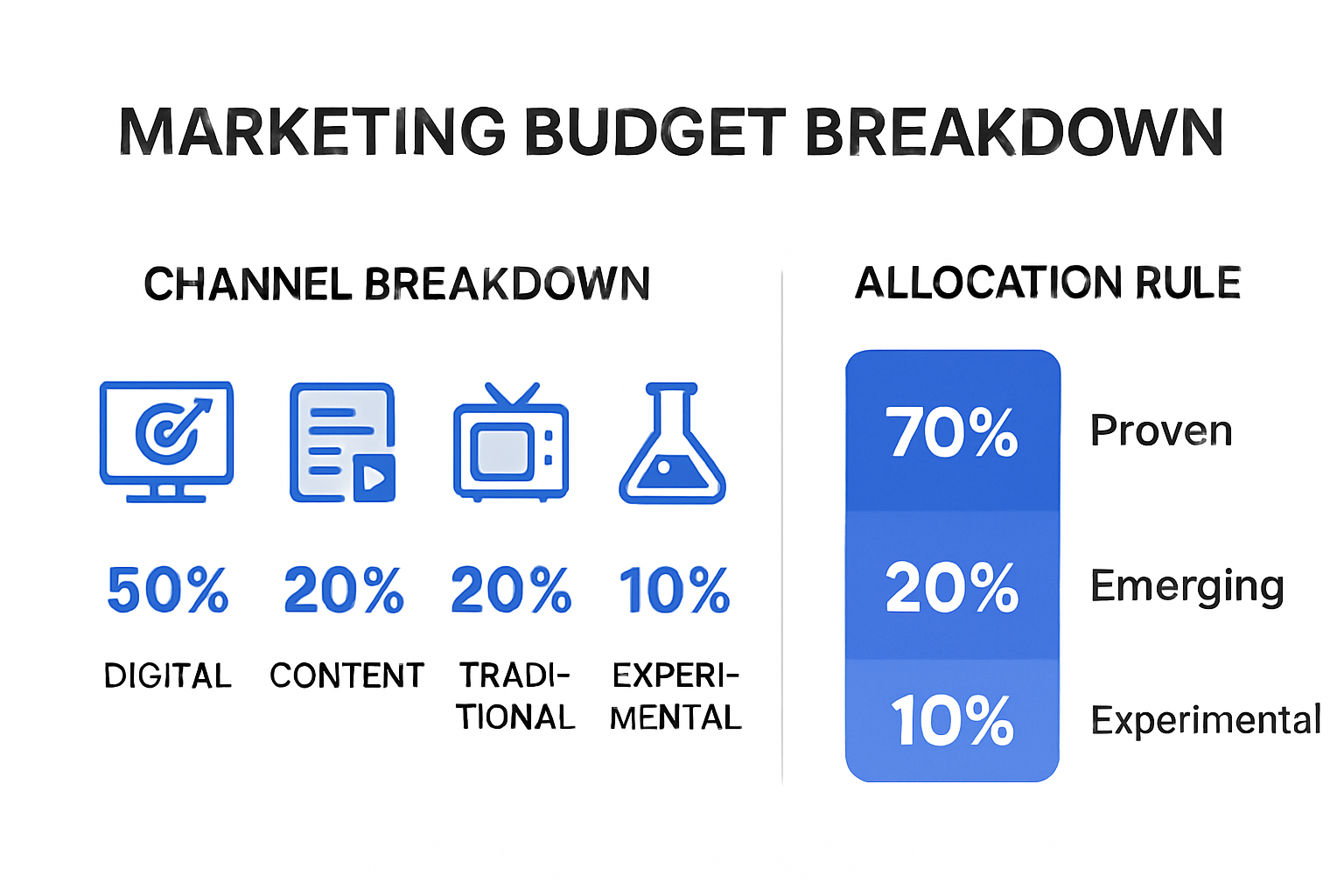
Each channel has different cost structures and performance metrics. Digital platforms often provide more precise tracking and lower entry costs compared to traditional media. Gartner Research suggests that top performing companies allocate approximately 55% of their marketing budget to digital channels.
Risk Management and Flexibility
A well planned marketing budget must include contingency funds and flexibility for unexpected opportunities or market shifts. Professional Services Council recommends maintaining 10% to 15% of your budget as a flexible reserve. This approach allows you to:
- Quickly respond to emerging market trends
- Capitalize on unexpected promotional opportunities
- Mitigate risks associated with underperforming marketing initiatives
- Experiment with innovative marketing strategies
Successful marketing budget planning is not about rigid spending but strategic investment. Continuously monitor your marketing performance, be prepared to reallocate resources, and remain adaptable to changing business environments. Your marketing budget should be a living document that evolves with your business growth and market dynamics.
Step-by-Step Process for Creating a Marketing Budget
Developing a comprehensive marketing budget requires a systematic approach that transforms your strategic vision into a concrete financial plan. Discover strategic budgeting techniques to maximize your marketing investments and drive business growth.
Detailed Financial Assessment and Baseline Calculation
Begin by conducting a thorough financial analysis that provides the foundation for your marketing budget. According to the U.S. Small Business Administration, this process involves several critical steps:
- Revenue Analysis: Review your total annual revenue and determine the appropriate marketing budget percentage
- Historical Performance: Examine past marketing expenditures and their corresponding results
- Profit Margins: Consider your current profit margins and growth objectives
University of Florida’s IFAS Extension recommends allocating between 5% to 15% of total revenue toward marketing efforts, with the specific percentage varying based on industry, business maturity, and competitive landscape.
Strategic Budget Allocation and Channel Selection
Once you’ve established your total marketing budget, the next crucial step is strategic allocation across various marketing channels. This requires a data driven approach that balances potential reach, cost effectiveness, and expected return on investment:
To help you choose the most effective marketing channels for your business, here’s a summary table comparing key options, their typical budget allocation, and main benefits as outlined in the article:
| Marketing Channel | Typical Budget Allocation | Key Benefits |
| Digital Marketing (SEO, PPC, Social Media) | 50-60% | High reach, precise tracking, cost-effective |
| Content Marketing | 15-20% | Engages audience, boosts SEO, builds authority |
| Traditional Advertising | 10-15% | Mass audience, brand awareness, credibility |
| Experimental/Emerging Channels | 5-10% | Innovation, reaching new segments, staying agile |
Prioritize channels that have demonstrated the highest engagement and conversion rates for your specific business model. This might mean investing more heavily in platforms where your target audience is most active and responsive.
Implementation and Continuous Performance Monitoring
Successful marketing budget management is an ongoing process of tracking, analyzing, and adjusting. Implement robust tracking mechanisms to measure the performance of each marketing initiative:
- Set clear, measurable key performance indicators (KPIs)
- Use advanced analytics tools to monitor real time performance
- Schedule quarterly budget reviews to assess effectiveness
- Be prepared to reallocate resources based on performance data
Remember that a marketing budget is not a static document but a dynamic tool that should evolve with your business. Flexibility and data driven decision making are key to maximizing your marketing investments and achieving sustainable growth. Regular assessment and willingness to pivot will help you optimize your marketing spend and drive meaningful business results.
Below is a process table outlining the recommended step-by-step approach for creating an effective marketing budget, as detailed in the article:
| Step | Description |
| Financial Assessment and Baseline | Analyze revenue, review past marketing spend, and evaluate profit margins and growth objectives. |
| Strategic Budget Allocation | Distribute budget across marketing channels based on reach, cost-effectiveness, and ROI. |
| Implementation and Monitoring | Set KPIs, use analytics tools, conduct regular reviews, and reallocate resources as needed. |
Tips to Manage and Optimize Your Marketing Spend
Effective marketing budget management goes beyond initial allocation. It requires continuous monitoring, strategic adjustments, and a data driven approach to maximize your return on investment. Learn advanced strategies for optimizing ad spend to ensure every marketing dollar delivers measurable results.
Implementing Advanced Performance Tracking
To optimize your marketing spend, you must develop a robust performance tracking system. According to the U.S. Government Accountability Office’s Performance Budgeting Guide, successful budget management requires linking spending directly to specific outcomes. This approach involves:
- Granular Metric Tracking: Monitor key performance indicators (KPIs) at the most detailed level possible
- Attribution Modeling: Understand exactly which marketing efforts drive conversions
- Cost Per Acquisition Analysis: Calculate the exact cost of acquiring each customer across different channels
Google Analytics and other advanced analytics platforms provide tools to track these metrics with unprecedented precision. Implement multi channel tracking to gain a comprehensive view of your marketing performance.
Strategic Budget Reallocation and Optimization
Marketing budgets should be fluid, not fixed. Top performing businesses continuously reallocate resources based on real world performance. Key strategies include:
- Identify top performing channels and incrementally increase their funding
- Gradually reduce investment in underperforming marketing initiatives
- Create a flexible budget with 10-15% reserved for experimental marketing approaches
- Conduct monthly or quarterly budget reviews to ensure alignment with business goals
Consider using the 70-20-10 budget allocation rule: 70% on proven marketing strategies, 20% on emerging tactics, and 10% on experimental approaches. This method balances stability with innovation.
Technology and Automation for Budget Efficiency
Leverage cutting edge technologies to maximize marketing budget efficiency. Modern marketing automation tools can help you:
- Automate repetitive marketing tasks
- Reduce manual labor costs
- Provide real time performance insights
- Optimize ad spend through AI driven algorithms
- Implement predictive analytics for more accurate budget planning
Invest in marketing technologies that offer comprehensive reporting and integration capabilities. Look for solutions that provide end to end tracking and actionable insights across multiple marketing channels.
This is the work we do for you. Every week, without exception.
Managing GBP at this level takes 6–8 hours a week when done right. Nova handles the entire system — posts, photos, reviews, Q&A, citations, heatmap tracking — so you can focus on running your business.
Remember that marketing budget optimization is an ongoing process. Stay agile, embrace data driven decision making, and be willing to pivot your strategies based on performance metrics. The most successful marketing budgets are those that can quickly adapt to changing market conditions and emerging opportunities.

Frequently Asked Questions
How should I start planning my marketing budget?
Begin by defining your core marketing objectives and conducting a comprehensive audit of your current marketing performance. Establish specific, measurable goals to guide your budget allocation effectively.
What percentage of revenue should I allocate to my marketing budget?
Typically, small businesses allocate 7% to 12% of their total revenue to marketing, while larger enterprises may invest up to 15%. This percentage can vary based on industry, business maturity, and market competitiveness.
How can I ensure my marketing budget is flexible?
Maintain 10-15% of your budget as a flexible reserve to quickly adapt to emerging trends, capitalize on unexpected opportunities, and mitigate risks associated with underperforming initiatives.
What are the key factors to consider when allocating my marketing budget?
Key factors include industry benchmarks, company size, marketing channel diversity and cost-effectiveness, and the need for risk management to ensure adaptability in your budget allocation.
Transform Your Marketing Budget Into Real Results With Tailored Strategy
Struggling to convert your marketing budget into measurable growth? This article shows you how unclear goals and scattered marketing spend can drain your resources and limit your reach. If you feel overwhelmed by too many choices or unsure about where to invest for maximum ROI, you are not alone. Most businesses need a partner who understands how to turn SMART objectives and performance tracking into a step-by-step action plan that delivers actual results.
Let 12AM Agency help you escape the guesswork. Our full-service digital marketing solutions combine proven methods in SEO management and AI-driven analysis with real-time campaign optimization. We build strategic budgets that stretch every dollar further, using tactics like PPC, web design, and Google My Business optimization tailored for your industry and goals. Stop wondering if your marketing spend is working. Act now by visiting https://12amagency.com and schedule a strategic consultation to secure a smarter, more profitable marketing budget today.
Recommended
- The Ultimate Guide to Creating a Content Calendar That Drives Real Growth | 12AM Agency
- Choose the Right Marketing Agency for Your Business
- Unlock Growth: Essential Digital Marketing Strategies for Small Business Owners in 2025 | 12AM Agency
- How to Choose a PPC Company That Delivers Real ROI (Not Just Reports) | 12AM Agency
- Marketingplan schrijven in 2025: Praktische gids voor mkb’ers – Twizz
- “Non ho budget per il marketing” » strategiavincente.it

