



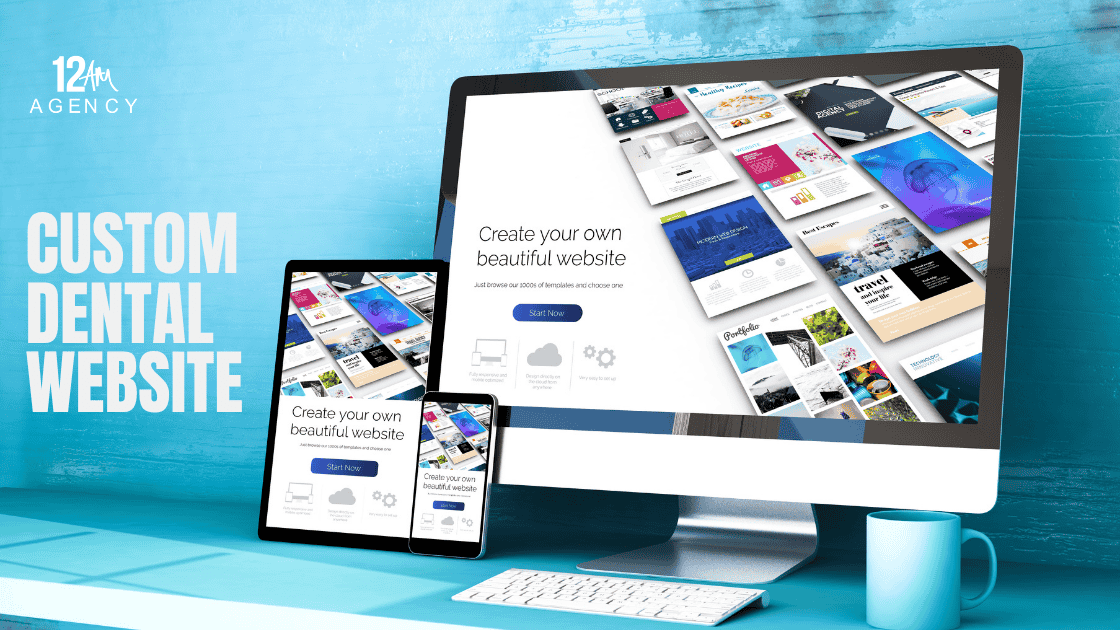
Let’s get right to the $20,000 question.
You’ve seen the quotes. A custom dental website can cost $15,000, $25,000, or even more. Meanwhile, a template site from a generic provider might be $5,000. Is the custom option really worth 3-5x the price?
As a practice owner—a “Chief Everything Officer”—you don’t make investments lightly. You’d analyze the ROI of a new CEREC machine or a 3D cone beam scanner. You need to treat your website the same way.
The hard truth is this: A template website is a cost. A custom website is an asset.
A template is a digital brochure. A custom site is your 24/7 patient acquisition engine, your lead-nurturing front desk, and your single most powerful marketing tool.
This guide isn’t here to “sell” you. It’s here to give you the framework to calculate the ROI for yourself. We’ll break down the real differences, the costs, and the specific, measurable benefits that turn a website from an expense into a high-growth investment.
Key Takeaways
| Problem | Action |
Outcome |
| Your template site isn’t growing your practice. | View a custom website as a business asset, not a cost. | A site built for patient acquisition, not just as a digital brochure. |
| You’re invisible on Google for high-value keywords. | Invest in a custom site built on a clean, fast, SEO-first foundation. | Higher rankings for “dental implants [your city],” driving qualified, high-value leads. |
| Your website visitors don’t convert. | Design a custom user journey that builds trust and funnels users to “Book Now.” | A higher conversion rate, turning more visitors into scheduled appointments. |
| You’re locked into a proprietary, “cheap” platform. | Move to a custom-built, open-source (e.g., WordPress) site that you 100% own. | Full control, flexibility, and freedom to work with any marketing partner. |
| You’re not sure how to justify the high cost. | Calculate the ROI based on the Lifetime Value (LTV) of a single new patient. | A clear business case showing the site can pay for itself in just a few months. |
Custom vs. Template Dental Websites: A Direct Comparison
It’s tempting to think the only difference is a “unique look.” The real differences are under the hood, and they are what separate a stagnant practice from a growing one.
| Feature | Template Website |
Custom Dental Website |
| Design | Cookie-Cutter: Looks like hundreds of other dental sites. | Unique: 100% custom-designed to match your brand, build trust, and reflect your practice’s values. |
| Strategy | One-Size-Fits-All: Built to be “a website.” | Patient-Centric: Built around a specific user journey to convert visitors into patients. |
| SEO | Poor to Fair: Often has bloated code, slow speeds, and a rigid structure that’s terrible for SEO. | Excellent: Built from the ground up with clean code, fast speeds, and a flexible structure designed to rank on Google. |
| Ownership | Often “Leased”: Many vendors lock you into their proprietary system. If you leave, your site is gone. | 100% Owned: You own the code, the design, and the content. You can host it anywhere. |
| Flexibility | Very Low: “Sorry, the template can’t do that.” You’re stuck with its limitations. | Unlimited: Need to add online payments? Integrate with a new PMS? No problem. |
| Cost | $3,000 – $10,000 (Lower Upfront) | $15,000 – $40,000+ (Higher Upfront) |
| Best For | New practices with a very limited budget. | Practices focused on growth, SEO, and long-term ROI. |
What are the Main Benefits of Custom Web Design for Dentists?
This is where the investment starts to make sense. A custom site isn’t just “prettier.” It’s a high-performance machine.
1. It Unlocks Your True SEO Potential (The Growth Engine)
This is the most important difference. Template sites are often a disaster for SEO. They are built on bloated code that makes them slow, and Google hates slow sites.
A custom dental website is built for SEO from day one.
- Clean Code: It’s fast, lightweight, and easy for Google to crawl.
- Site Structure: It’s architected around your high-value “money” pages (e.g., “Dental Implants,” “Invisalign,” “Emergency Dentistry”).
- Local SEO: It’s built to perfectly integrate with your Google Business Profile, check-in software, and review platforms.
You can’t bolt on a high-end SEO services plan to a broken template foundation. You must build on a solid foundation.
2. It’s Built for Conversion (The “Digital Front Desk”)
Your template site has a “Contact Us” page. A custom site is built with a singular goal: turn a visitor into a scheduled patient.
Every element is A/B tested and strategically placed:
- “Book Now” buttons are above the fold and in the sticky navigation.
- Click-to-call phone numbers are prominent on mobile.
- HIPAA-compliant online forms are easy to use, pre-qualifying new patients.
- Trust signals (real team photos, “As Seen On,” patient testimonials) are placed at key decision points.
This is the difference between a 1% conversion rate and a 4% conversion rate. For a site with 3,000 visitors a month, that’s 90 new patient leads.
3. You Get 100% Ownership (No Hostage Situations)
This is a hidden danger. Many “cheap” dental website companies lock you into their proprietary Content Management System (CMS). You pay a low setup fee and a monthly “subscription.”
But what happens when you want to leave? You lose your website. All the content, all the design. It’s gone. You are effectively held hostage.
A custom site built on an open-source platform like WordPress means you own 100% of it. You own the code, the design, the files. You can take it to any developer or hosting company in the world. This is a critical part of a smart digital transformation strategy.
4. It Builds a Unique, Trustworthy Brand
A potential new patient is scared, in pain, or anxious about the cost. When they land on your site, they are making a snap judgment.
If your site looks identical to three other dentists in your area, you’re competing on price. If your site is unique, professional, and features real-life, high-quality photos of your team and your office, you’re competing on trust.
You can’t build a premium, high-trust brand on a $100 template.
How Much Does a Custom Dental Website Cost in 2025?
Let’s be transparent. As HubSpot and WebFX note, prices are a spectrum.
- Template / DIY Sites (Wix, Squarespace): $1,000 – $5,000. Cheap, but you get what you pay for. Not a serious tool for a growing practice.
- High-End Template (Agency “Lite” Version): $5,000 – $12,000. This is a common dental marketing offering. It’s a pre-built template with your colors and logo. It’s better, but still limiting.
- Custom-Designed & Developed Website: $15,000 – $40,000+. This is a 100% unique, agency-built site. It includes a full strategy, user experience (UX) design, copywriting, custom development, and SEO-first build.
The sticker shock is real. But what if you re-framed the question?
What is the Typical ROI of a Custom Dental Website?
Let’s do some simple math.
- What is the Lifetime Value (LTV) of a single new dental patient? Studies show it’s anywhere from $1,200 to $5,000+ over 5 years. Let’s be conservative and say **$2,500**.
- What’s the LTV of a high-value implant or Invisalign case? $8,000 – $15,000+.
- Your custom website investment is $25,000.
To break even on your investment, you need:
- 10 new “average” patients (10 x $2,500)
- …or 2-3 new implant/Invisalign cases.
Can a high-performance website built for conversion and SEO deliver 10 new patients? It should do that in the first 6-12 months, and then every month after that for years.
A template site that gets 1,000 visitors and 10 leads (1% conversion) is a failure.
A custom site that gets 1,000 visitors and 40 leads (4% conversion) is an asset that pays for itself over and over. You can see this in our own case studies—the right design makes a measurable difference.
What Key Features Should Every Growth-Focused Dental Website Include?
When you vet a developer, ask them about these features. This list separates the pros from the amateurs.
- Mobile-First, Responsive Design: Not just “mobile-friendly.” It must be designed for a thumb on a smartphone first.
- Prominent “Click-to-Call” & Online Booking: A user should be one tap away from scheduling.
- HIPAA-Compliant Online Patient Forms: A massive time-saver for your front desk and a convenience for new patients.
- High-Fidelity, Real Team & Office Photos: No stock photos. Ever. This is your #1 trust-builder.
- Optimized Service Pages: Dedicated, in-depth pages for each of your high-value services (Implants, Cosmetic, Sedation, etc.).
- “Meet the Doctor” Page: This is your E-E-A-T (Experience, Expertise, Authoritativeness, Trust) hub. It’s where you build a human connection.
- Video Testimonials & “Smile Gallery”: Social proof is everything.
- A Fast-Loading, Active Blog: Your long-term SEO engine for answering patient questions.
How Long Does It Take to Build a Custom Dental Site?
Be wary of anyone who promises a “custom” site in 4 weeks.
A professional, custom-built website takes 3 to 6 months.
- Month 1: Discovery & Strategy: Researching your market, your goals, and your patient personas.
- Month 2: UX Design & Branding: Creating wireframes (blueprints) and the visual “look and feel.”
- Month 3-4: Development & Content: Writing the code, writing the SEO-optimized content.
- Month 5: Testing & Revisions: Finding and squashing bugs.
- Month 6: Launch & Post-Launch Optimization.
How to Choose the Right Dental Website Developer
You’re not just hiring a designer; you’re hiring a partner. Ask these questions:
- Do you build on a proprietary system or an open-source platform like WordPress? (If they say “proprietary,” run.)
- Will I own 100% of the website, code, and content at the end of the project? (The only right answer is “Yes.”)
- Can you show me 3-5 examples of dental websites you’ve built that are ranking on page 1 of Google? (This proves they can do SEO, not just design.)
- How do you handle HIPAA-compliance for online forms? (They should have a clear, confident answer.)
- What is your process after the site launches? (The best partners have ongoing SEO and support plans.)
The Verdict: When Is a Custom Site Worth It?
So, is a custom dental website worth the investment?
- A template website is right for you if: You are a brand new practice, have a very limited budget, and just need a “digital business card” for now.
- A custom website is right for you if: You are an established practice, you are in a competitive market, you are focused on growth, and you understand that your website is a business asset, not just an IT expense.
Your website is your digital front door. It’s the first impression you’ll ever make on 90% of your new patients.
At 12AM Agency, we don’t just build “pretty” websites. We build patient-acquisition engines. Our web design and development team works hand-in-hand with our SEO strategists to build sites that don’t just sit there—they perform.
Ready to see the ROI on a website built for growth? Contact 12AM Agency for a free, no-obligation consultation today.
Frequently Asked Questions (FAQ)
Is a custom website really worth the investment for a dental practice?
Yes, if your goal is growth. A custom site gives you a competitive advantage in SEO, user experience, and conversion rates. This leads to more high-value patient bookings, providing a clear ROI that a cheap template site cannot.
Why are custom dental websites so expensive?
You are paying for 300-500+ hours of expert, specialized labor. This includes:
- Strategy: Market research, user-journey mapping.
- UX/UI Design: Custom wireframes and unique visual design.
- Copywriting: SEO-optimized, patient-centric, and E-E-A-T compliant content.
- Development: Clean, fast, custom code.
- Project Management: A dedicated point of contact.
You’re not buying a product; you’re commissioning a team of specialists to build a custom-tool for your business.
What makes a “good” dental website?
A “good” dental website is one that converts visitors into patients. It does this by:
- Loading fast (under 2 seconds).
- Being mobile-first and easy to use.
- Building trust with real photos, bios, and testimonials.
- Having clear calls-to-action (e.g., “Book Now”).
- Ranking on Google for the services you offer.
Can I just use a template website for my dental practice?
You can, but it comes with significant trade-offs. A template is a “cost” that will get you a basic online presence. It is not a “growth investment.” You will be limited in your design, flexibility, and, most importantly, your ability to rank on Google (SEO). It’s a fine starting point, but not a long-term solution for a growth-oriented practice.