




Setting marketing goals can feel overwhelming when every expert throws around big promises. But most people miss a crucial detail. A vague goal like grow the business is never enough. Real growth happens only when you sharpen your aim and break everything down into clear targets that you can actually measure. Get ready to see goal setting with fresh eyes.
Table of Contents
- Step 1: Define Your Business Objectives
- Step 2: Analyze Your Target Audience
- Step 3: Set Smart Marketing Goals
- Step 4: Develop Actionable Strategies
- Step 5: Monitor Progress And Adjust As Necessary
Quick Summary
| Key Point | Explanation |
|---|---|
| 1. Define Specific Business Objectives | Clearly outline measurable goals like revenue growth and client acquisition to guide your marketing strategies. |
| 2. Understand Your Target Audience | Gather both demographic and psychographic data to tailor marketing strategies that resonate with potential customers. |
| 3. Set SMART Marketing Goals | Create goals that are Specific, Measurable, Achievable, Relevant, and Time-bound to ensure clarity and focus. |
| 4. Develop Actionable Strategies | Break down marketing goals into specific actions across various channels to drive real business growth. |
| 5. Monitor and Adjust Strategies Regularly | Use key performance indicators to track progress and be prepared to pivot strategies based on data insights. |
Step 1: Define Your Business Objectives
Defining your business objectives is the foundational step in creating marketing goals that drive meaningful results. This critical phase transforms vague aspirations into concrete, actionable strategies that will guide your entire marketing approach. Successful marketing begins with crystal clear understanding of what your business wants to achieve.
Start by examining your current business situation with radical honesty. What are your revenue targets? Where do you want your business to be in the next 12 months? These questions demand precise answers, not general wishful thinking. For instance, instead of saying “I want to grow my business,” specify “I want to increase monthly revenue by 25% and expand our customer base by 500 new clients.”
Your objectives must align with your broader business strategy. This means looking beyond surface level metrics and understanding the deeper strategic implications. According to University of Florida’s Institute of Food and Agricultural Sciences, effective goals should be SMART: Specific, Measurable, Attainable, Relevant, and Time-bound. These criteria transform abstract desires into trackable, actionable targets.
Consider breaking down your objectives into different categories to ensure comprehensive coverage:
- Financial objectives (revenue growth, profit margins)
- Customer acquisition targets
- Brand awareness and market positioning goals
- Operational efficiency improvements
While defining these objectives, remember that they should directly connect to your marketing strategies. Each objective needs a corresponding marketing approach that can realistically help you achieve it. For example, if your objective is increasing revenue by 25%, your marketing goals might include expanding digital advertising reach, optimizing conversion funnels, or developing targeted lead generation campaigns.
Use this checklist table to ensure you’ve adequately defined your business objectives and are ready to align them with marketing strategies.
| Verification Step | Completion Criteria |
|---|---|
| Are your objectives specific and measurable? | Goals use exact numbers, not vague descriptions |
| Do objectives align with broader business strategy? | Each goal connects to overall company mission |
| Are objectives broken into clear categories? | Includes financial, customer, brand, and operational targets |
| Is each objective actionable by marketing? | Marketing can realistically influence each goal |
| Can you answer critical verification questions? | Can state specificity, achievability, and connection to marketing for each objective |
To verify you’ve successfully defined your business objectives, ask yourself these critical questions: Are these goals specific enough to be measured? Do they challenge your team while remaining achievable? Can you articulate exactly how marketing will help you reach these objectives? If you can answer “yes” confidently, you’re on the right track.
For more insights on strategic planning, our comprehensive guide can help you dive deeper into translating these objectives into actionable marketing strategies.
Step 2: Analyze Your Target Audience
Analyzing your target audience is more than a marketing exercise it is a strategic deep dive into understanding who will actually purchase your products or services. This critical step transforms generic marketing approaches into precision-targeted strategies that speak directly to your ideal customers.
Begin by gathering comprehensive data about your potential customers. Demographic information provides the skeleton of your audience profile, but the real magic happens when you understand their deeper motivations, challenges, and aspirations. Start by collecting baseline information such as age, income level, geographic location, and professional background. However, do not stop there. Dig deeper into psychographic details that reveal why someone might be interested in your offering.
See exactly where your profile stands right now.
Our GBP audit shows your current rank position across your market, how your profile completeness scores against competitors, and the specific gaps holding you back from the Map Pack.
According to Harvard Business School, effective audience analysis involves examining customer behavior across multiple dimensions. This means tracking not just who your customers are, but how they interact with similar products, what digital platforms they frequent, and what emotional triggers might prompt a purchase.
Utilize multiple research methods to build a robust audience profile:
- Customer surveys and direct interviews
- Social media audience insights
- Website and digital platform analytics
- Competitor audience research
- Industry reports and market research
One often overlooked aspect of audience analysis is understanding pain points and desired solutions. What problems does your target audience consistently face? How can your product or service provide a unique solution? These questions transform audience research from passive data collection to active strategy development.
Advanced marketers leverage tools like Google Analytics, social media insights, and specialized market research platforms to gather nuanced audience data. Pay special attention to engagement metrics behavior patterns show more about your audience than basic demographic information ever could.
To verify you have successfully analyzed your target audience, ensure you can answer these critical questions: Can you describe your ideal customer in vivid, specific detail? Do you understand their motivations beyond surface level demographics? Have you identified the specific channels where they are most likely to engage with your marketing?
Refer to this table for a quick comparison of essential research tools and methods available for analyzing your target audience, including what each method uncovers.
| Method | What It Reveals | Best For |
|---|---|---|
| Customer Surveys & Interviews | Direct motivations and feedback | Deep insights from actual users |
| Social Media Insights | Engagement patterns, interests | Understanding online behaviors |
| Website & Platform Analytics | Visitor demographics, user flow | Tracking digital interactions |
| Competitor Audience Research | Gaps, shared audience traits | Benchmarking against competitors |
| Industry Reports | Market trends, broad demographics | Validating assumptions with data |
Learn more about converting audience insights into actionable marketing strategies with our comprehensive guide that bridges audience understanding and strategic implementation.
Step 3: Set SMART Marketing Goals
Transforming your broad business objectives into precise marketing goals requires a strategic approach that goes beyond wishful thinking. SMART goals turn abstract aspirations into concrete, actionable strategies that provide clear direction and measurable outcomes for your marketing efforts.
The SMART framework is not just a buzzword it is a powerful methodology for creating goals that are Specific, Measurable, Achievable, Relevant, and Time-bound. Specificity is your first critical consideration. Instead of a vague goal like “increase website traffic,” craft a precise objective such as “increase organic website traffic by 35% within the next six months through targeted SEO and content marketing strategies.”
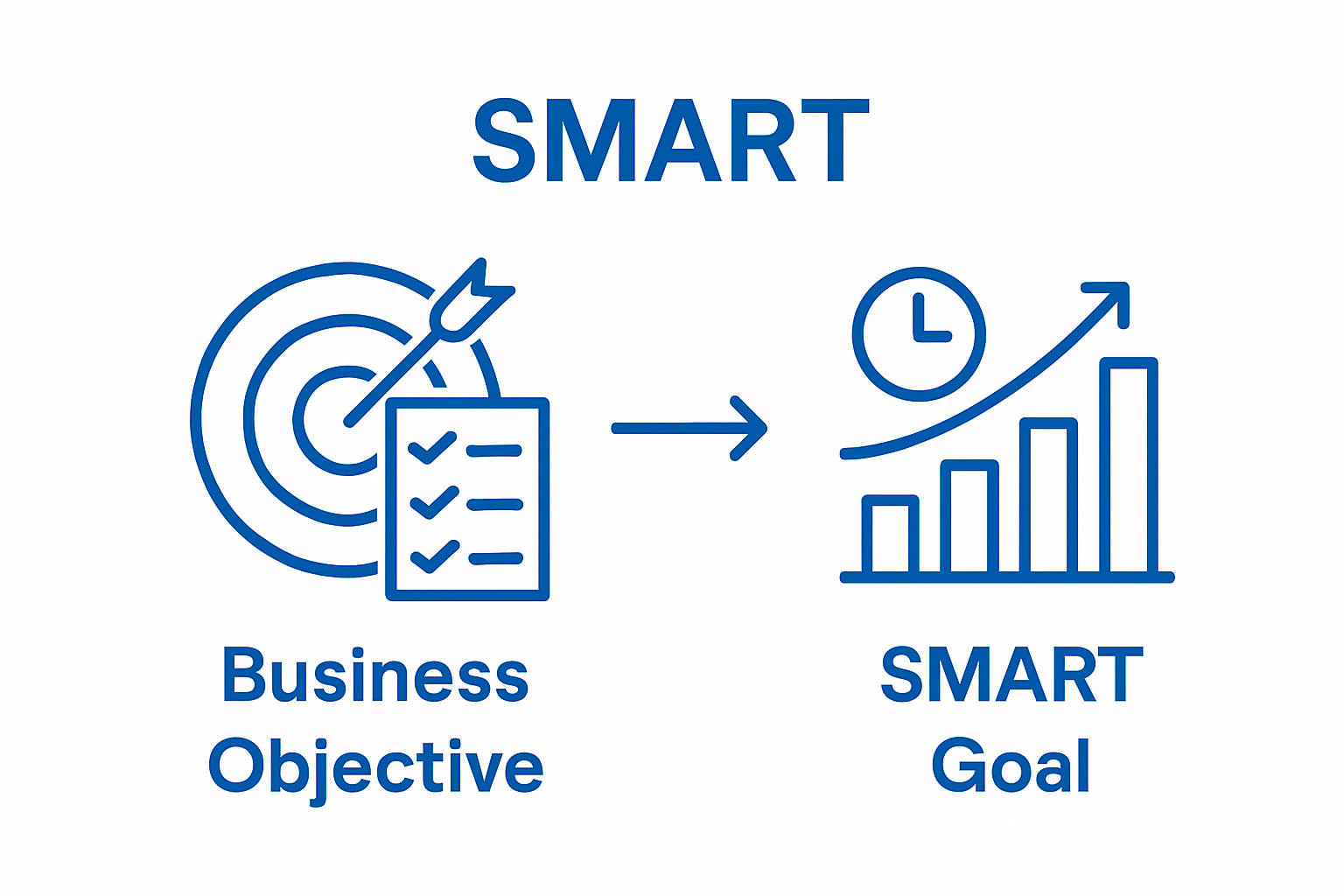
According to University of Colorado Boulder’s goal-setting research, effective goals require breaking down complex objectives into manageable, trackable components. This means each marketing goal must have clear metrics that allow you to measure progress consistently and objectively.
When developing your SMART marketing goals, consider these essential categories:
- Revenue generation targets
- Customer acquisition metrics
- Brand awareness and engagement objectives
- Conversion rate improvements
- Lead generation benchmarks
Measurability transforms goals from abstract concepts to concrete targets. Implement tracking mechanisms like Google Analytics, marketing dashboards, and customer relationship management (CRM) tools to monitor your progress. Quantifiable metrics provide the clarity needed to adjust strategies in real-time.
Achievability is another crucial aspect of SMART goal setting. While ambitious goals drive motivation, unrealistic targets can demoralize your team. Balance stretch goals with historical performance data and industry benchmarks. Consider your current resources, team capabilities, and market conditions when defining what “achievable” means for your specific business context.
Time-bound goals create urgency and focus. Each objective should have a clear deadline that creates a sense of momentum. Quarterly or semi-annual review periods allow you to assess progress, recalibrate strategies, and maintain accountability.
To verify you have successfully set SMART marketing goals, ask yourself these critical questions: Can you articulate each goal in a single, clear sentence? Have you identified specific metrics for measurement? Do these goals directly support your broader business objectives? Are the timelines realistic and challenging?
Explore our comprehensive guide on digital marketing fundamentals to further refine your goal-setting approach and ensure your marketing strategies are built on a solid, strategic foundation.
Step 4: Develop Actionable Strategies
Developing actionable marketing strategies transforms your carefully crafted goals from theoretical concepts into executable plans that drive real business growth. This is where strategic vision meets practical implementation, turning your marketing objectives from abstract ideas into concrete actions that can generate measurable results.
The foundation of effective strategy development lies in understanding the intricate relationship between your business goals, target audience insights, and available resources. Begin by mapping out a comprehensive approach that breaks down each marketing goal into specific, tactical actions. Strategy is not about doing everything, but about doing the right things with precision and focus.
According to research on academic health centers, successful strategic implementation involves intensive promotion, flexible distribution systems, and targeted approaches. Apply this principle by creating a multi-channel strategy that leverages different marketing platforms to maximize your reach and impact.
Consider developing strategies across these critical marketing dimensions:
- Digital marketing channels (social media, email, content marketing)
- Paid advertising approaches
- Content creation and distribution
- Customer engagement and retention tactics
- Performance tracking and optimization methods
Each strategy should directly connect to the SMART goals you established earlier. For instance, if your goal is to increase website traffic by 35%, your strategy might include a combination of search engine optimization (SEO), targeted content marketing, and strategic paid advertising campaigns.
Resource allocation is a critical component of strategy development. Evaluate your budget, team capabilities, and technological tools to ensure your strategies are not just ambitious but achievable. This means being ruthlessly pragmatic about what you can realistically execute with your current resources.
Technology and data analytics play a pivotal role in strategy development. Utilize marketing automation tools, customer relationship management (CRM) systems, and advanced analytics platforms to track performance, gather insights, and continuously refine your approach. The most effective strategies are those that remain flexible and responsive to real-world performance data.
To verify you have successfully developed actionable strategies, ask yourself these critical questions: Can you articulate each strategy in a clear, step-by-step format? Have you identified specific tactics for each marketing channel? Do these strategies directly support your original business and marketing goals? Can you measure the potential impact of each strategic approach?
Explore our comprehensive guide on building a strong online brand to further enhance your strategic marketing approach and ensure your tactics are aligned with your broader business vision.
Step 5: Monitor Progress and Adjust as Necessary
Monitoring and adjusting your marketing strategies is not a passive exercise it is an active, dynamic process that separates successful marketing campaigns from mediocre ones. Think of this step as the mission control center of your marketing efforts, where data becomes your primary navigational tool for continuous improvement and strategic refinement.
The key to effective monitoring is establishing a robust system of key performance indicators (KPIs) that provide clear, objective insights into your marketing performance. These metrics are your early warning system, signaling when strategies are working brilliantly or when immediate course corrections are necessary. Implement comprehensive tracking mechanisms across all your marketing channels to capture a holistic view of your performance.
According to Penn State Extension’s marketing research, tracking specific metrics allows for data-driven adjustments that keep your marketing strategies aligned with business goals. This means going beyond surface level metrics and diving deep into meaningful performance indicators.
Consider monitoring these critical performance dimensions:
- Conversion rates across different marketing channels
- Customer acquisition costs
- Return on marketing investment (ROMI)
- Engagement metrics (click-through rates, time on page)
- Lead quality and progression through sales funnel
Technology is your greatest ally in this monitoring process. Leverage advanced analytics platforms like Google Analytics, marketing automation tools, and customer relationship management (CRM) systems to gather comprehensive data. These tools transform raw numbers into actionable insights, providing visual dashboards that make complex performance data immediately understandable.
This table gives an at-a-glance summary of critical performance indicators to monitor when analyzing your marketing strategy’s effectiveness.
| KPI | What It Measures | Why It Matters |
|---|---|---|
| Conversion Rate | % of visitors taking desired action | Indicates how well marketing converts leads |
| Customer Acquisition Cost | Cost to gain each new customer | Helps optimize marketing spend |
| ROMI (Return on Marketing Investment) | Profit generated per dollar spent | Measures overall strategy profitability |
| Engagement Metrics | Clicks, time on page, interactions | Shows audience interest and activity |
| Lead Quality | Progress through sales funnel | Identifies readiness to convert |
This is the work we do for you. Every week, without exception.
Managing GBP at this level takes 6–8 hours a week when done right. Nova handles the entire system — posts, photos, reviews, Q&A, citations, heatmap tracking — so you can focus on running your business.
The art of adjustment requires a delicate balance between patience and proactivity. Not every slight fluctuation demands an immediate strategy overhaul, but significant deviations from expected performance require swift, strategic intervention. Develop a quarterly review process that allows you to step back and evaluate your marketing strategies with a critical, data-driven perspective.
Remember that market conditions, audience behaviors, and technological landscapes are constantly evolving. Your marketing strategies must be equally dynamic. This means being willing to experiment, test new approaches, and quickly pivot when data suggests a different direction would be more effective.
To verify you have successfully monitored and adjusted your marketing strategies, ask yourself these critical questions: Are you tracking comprehensive, meaningful metrics? Can you articulate specific performance trends? Have you established a consistent review process? Are you prepared to make data-driven adjustments?

Explore our in-depth guide on lead conversion strategies to further refine your approach to monitoring and optimizing marketing performance.
Take Your Marketing Goals From Planning to Real Results
Are you frustrated by marketing goals that never seem to turn into measurable growth? This article lays out clear steps for setting SMART, actionable marketing goals but putting them into practice is a whole new challenge. Many businesses struggle to convert data-driven objectives and complex strategies into real revenue, stronger online presence, and increased customer engagement.
At 12AM Agency, we specialize in transforming your carefully defined goals into tailored, technology-backed campaigns. Whether you need AI-driven SEO, precise PPC advertising, advanced reputation management, or Google My Business optimization, our experts bring the tools and insights needed to help you reach your targets faster and smarter. See how these strategies come to life in real scenarios by visiting our lead conversion strategies guide.
Why let great goals sit on paper? Unlock marketing growth and visibility with a dedicated partner. Contact us now through our digital marketing consultation form and turn your vision for maximum impact into results that matter. Your next step could be your biggest yet.
Frequently Asked Questions
What are SMART marketing goals and how can I set them?
SMART marketing goals are specific, measurable, achievable, relevant, and time-bound objectives that guide your marketing strategies. To set them, clearly articulate each goal in a single sentence, identify specific metrics for measurement, and ensure they support your broader business objectives.
How can I analyze my target audience effectively?
Analyzing your target audience involves gathering demographic and psychographic data to understand their motivations, challenges, and behaviors. Utilize tools like customer surveys, social media insights, and website analytics to build a detailed customer profile.
What are some key performance indicators (KPIs) to track my marketing strategies?
Important KPIs to monitor include conversion rates, customer acquisition costs, return on marketing investment (ROMI), engagement metrics (such as click-through rates), and lead quality throughout the sales funnel. These metrics help assess the effectiveness of your marketing efforts.
How often should I review and adjust my marketing strategies?
You should review and adjust your marketing strategies on a quarterly basis or whenever significant deviations from expected performance occur. Establish a consistent review process to evaluate your strategies based on data-driven insights and adapt to changing market conditions.

