





Managing business growth is more than chasing bigger sales numbers. It is a process where every choice shapes the future of a company. Now check this out. Businesses with structured growth management approaches are 70 percent more likely to achieve consistent market success compared to those that just wing it. That sounds impressive but the real surprise is this. Long term growth is not just about getting bigger. It is about reinventing how your business thinks, adapts, and stays one step ahead in a changing world.
Table of Contents
- What Is Managing Business Growth And Its Importance?
- The Key Concepts Behind Business Growth Management
- Why Effective Growth Management Matters For Businesses
- How Managing Business Growth Works In Different Sectors
- Real-World Examples Of Successful Business Growth Management
Quick Summary
| Takeaway | Explanation |
|---|---|
| Strategic planning drives growth success | Intentional planning aligns growth initiatives with long-term organizational objectives, enhancing chances for sustainable success. |

|
| Monitor performance continuously | Regular performance assessments facilitate adaptation, allowing businesses to refine strategies in response to changing market conditions. |
| Integrate financial and operational strategies | Seamless alignment between financial planning and operations supports informed decision-making, optimizing resource allocation for growth. |
| Embrace technological innovation | Leveraging technology fosters adaptability and rapid innovation, transforming disruptions into strategic growth opportunities. |
| Understand sector-specific dynamics | Tailoring growth strategies to unique industry characteristics allows organizations to better exploit competitive advantages.
What is Managing Business Growth and Its Importance?
Managing business growth is a strategic process that involves systematically planning, executing, and monitoring organizational expansion to achieve sustainable development and competitive advantage. At its core, this approach transcends simple revenue increases and encompasses a holistic transformation of business capabilities, resources, and market positioning.
Defining Business Growth Management
Business growth management represents a comprehensive framework for intentional organizational development. It involves strategic planning, resource allocation, and performance optimization across multiple dimensions including financial, operational, human capital, and market expansion. Unlike random scaling, this approach requires deliberate, data driven decision making that aligns growth initiatives with long term organizational objectives.
Key characteristics of effective business growth management include:
- Systematic identification of growth opportunities
- Continuous performance monitoring and adaptation
- Strategic resource deployment
- Risk mitigation and sustainable expansion strategies
The Strategic Importance of Proactive Growth Management
According to McKinsey & Company, organizations that implement structured growth management approaches are 70% more likely to achieve consistent market success. Proactive growth management enables businesses to:
- Anticipate market changes and competitive dynamics
- Build organizational resilience
- Create scalable infrastructure
- Develop adaptive operational models
Successful managing business growth requires understanding that expansion is not just about increasing size, but enhancing organizational capability to deliver value more effectively. Learn more about digital transformation strategies that can support sustainable business growth.
Ultimately, managing business growth is an ongoing, dynamic process that demands continuous learning, strategic thinking, and flexible execution. By adopting a comprehensive approach, businesses can transform growth from a sporadic event into a systematic, predictable progression toward long term success.
The Key Concepts Behind Business Growth Management
Business growth management is a complex strategic framework that requires understanding several foundational concepts which collectively drive sustainable organizational development. These interconnected principles provide businesses with a structured approach to scaling effectively and maintaining competitive advantage.
To offer a clear overview of the essential concepts behind business growth management, the following table defines each core concept highlighted in the article.
| Concept | Definition |
|---|---|
| Strategic Performance Architecture | System for aligning organizational capabilities with growth objectives using integrated performance measurement, dynamic resources, scalable tech, and agile design |
| Financial and Operational Synergy | Integration of financial planning with operational execution to enable strategic expansion and efficient resource deployment |
| Technological Enablement and Innovation | Building technical ecosystems for adaptation, continuous learning, and data-driven innovation to sustain growth |
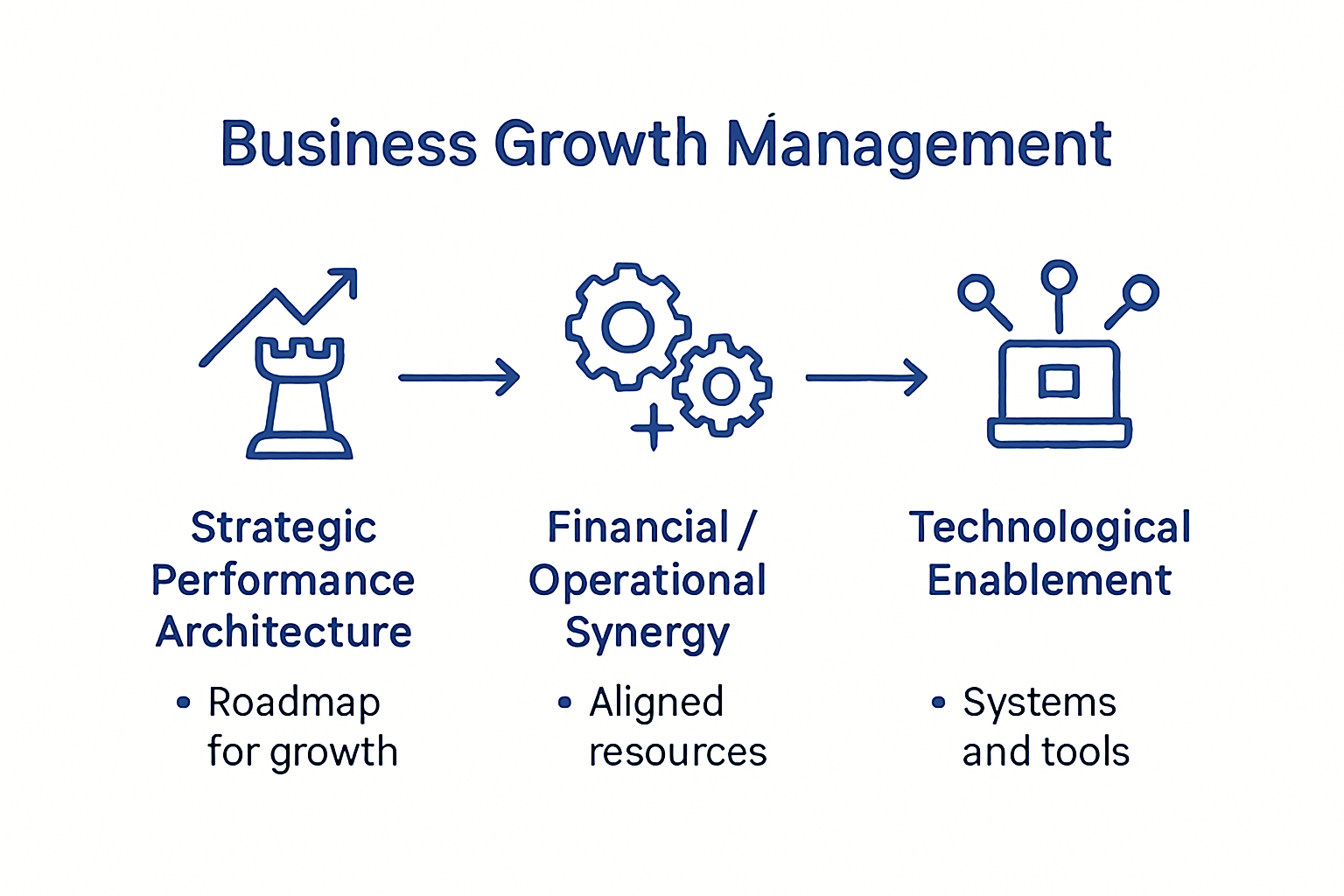
Strategic Performance Architecture
At the heart of business growth management lies strategic performance architecture – a comprehensive system for aligning organizational capabilities with growth objectives. This concept emphasizes creating robust infrastructures that can flexibly adapt to changing market conditions while maintaining core operational integrity.
Critical elements of strategic performance architecture include:
- Integrated performance measurement systems
- Dynamic resource allocation mechanisms
- Scalable technological platforms
- Agile organizational design principles
Financial and Operational Synergy
According to Harvard Business Review, successful business growth requires seamless integration between financial planning and operational execution. This synergy involves developing predictive financial models that directly connect investment strategies with operational capabilities, enabling more precise and strategic expansion decisions.
Key synergy drivers include:
- Alignment of financial resources with strategic initiatives
- Continuous performance monitoring and recalibration
- Investment in scalable infrastructure
- Risk management and scenario planning
Technological Enablement and Innovation
Modern business growth management increasingly depends on technological capabilities that enable rapid adaptation and innovation. Learn more about digital transformation strategies that can accelerate organizational growth.
Technological enablement involves creating ecosystems that support continuous learning, data driven decision making, and rapid prototyping of new business models. By developing technological architectures that can quickly integrate emerging tools and platforms, organizations can maintain competitive momentum and respond proactively to market shifts.
Ultimately, understanding these key concepts transforms business growth from a reactive process to a strategic, intentional journey of organizational transformation.
Why Effective Growth Management Matters for Businesses
Effective growth management represents a critical strategic imperative for businesses seeking sustainable success in increasingly complex and competitive market environments. It transcends traditional expansion approaches by providing a holistic framework for organizational development that addresses multidimensional challenges and opportunities.
Competitive Resilience and Market Positioning
Competitive resilience emerges as a fundamental outcome of strategic growth management. By systematically developing organizational capabilities, businesses can create robust defense mechanisms against market volatility and disruptive competitive forces. This approach enables companies to not just survive, but strategically position themselves for sustained advantage.
Key competitive advantages include:
- Ability to rapidly adapt to market changes
- Enhanced strategic flexibility
- Proactive innovation capabilities
- Improved risk mitigation strategies
Financial Performance and Stakeholder Value
According to Deloitte, organizations with structured growth management approaches demonstrate significantly higher financial performance and stakeholder value. Strategic growth management directly impacts financial metrics by:
- Optimizing resource allocation
- Reducing operational inefficiencies
- Creating predictable revenue streams
- Enhancing investor and shareholder confidence
Technological and Organizational Transformation
Modern growth management is intrinsically linked with technological innovation and organizational transformation. Explore digital marketing strategies that can accelerate business development.
Technological integration allows businesses to develop dynamic capabilities that enable continuous learning, data driven decision making, and rapid adaptation. By creating flexible technological infrastructures, organizations can transform potential disruptions into strategic opportunities, ensuring they remain agile and responsive to emerging market trends.
Ultimately, effective growth management is not just a strategy but a comprehensive approach to building resilient, innovative, and sustainable businesses capable of thriving in complex global ecosystems.
How Managing Business Growth Works in Different Sectors
Business growth management manifests uniquely across various industry sectors, reflecting the distinctive challenges, opportunities, and strategic dynamics inherent to each domain. Understanding these sector specific nuances is critical for developing targeted growth strategies that align with industry characteristics and market expectations.
To clarify the unique approaches to managing business growth across different industries, the following table summarizes the key sector-specific growth management characteristics discussed in the article.
| Sector | Growth Management Characteristics |
|---|---|
| Technology and Service | Continuous innovation, agile structures, rapid talent development, high R&D investment |
| Manufacturing and Industrial | Lean production, supply chain optimization, scalable infrastructure, process improvement |
| Service and Knowledge-Based Sectors | Talent ecosystem development, knowledge sharing, adaptive culture, rapid client responsiveness |
Technology and Service Sector Dynamics
Technological sectors demonstrate particularly dynamic growth management approaches characterized by rapid innovation cycles and continuous adaptation. Unlike traditional industries, technology driven sectors require agile organizational structures that can quickly pivot in response to emerging market trends and disruptive innovations.
Key technological sector growth characteristics include:
- Continuous product and service iteration
- High investment in research and development
- Rapid talent acquisition and skill development
- Flexible organizational design
Manufacturing and Industrial Sector Approaches
According to Harvard Business Review, manufacturing and industrial sectors adopt more structured and incremental growth management strategies. These approaches emphasize operational efficiency, scalable infrastructure, and systematic process optimization.
Critical growth management strategies in manufacturing include:
- Lean production methodologies
- Supply chain optimization
- Advanced technological integration
- Continuous performance measurement
Service and Knowledge Based Sector Transformation
Explore digital transformation strategies that can help service oriented businesses scale effectively.
Service and knowledge based sectors increasingly rely on intellectual capital and human performance as primary growth drivers. Their growth management strategies focus on developing robust talent ecosystems, creating knowledge sharing platforms, and building adaptive organizational cultures that can rapidly respond to client needs and market shifts.
Ultimately, successful business growth management requires a nuanced understanding of sector specific dynamics, enabling organizations to design targeted strategies that leverage their unique competitive advantages.
Real-World Examples of Successful Business Growth Management
Successful business growth management transcends theoretical frameworks, manifesting through strategic execution and adaptive organizational capabilities. Examining real world case studies provides invaluable insights into how businesses effectively navigate complex growth challenges across different industries and organizational contexts.
Technology Sector Transformation
Digital innovation platforms exemplify remarkable growth management strategies. Companies like Salesforce have demonstrated extraordinary growth by continuously evolving their business model, integrating emerging technologies, and maintaining a laser focused approach to customer experience.
Key growth management strategies observed include:
- Continuous product innovation
- Aggressive market expansion
- Strategic acquisitions
- Robust ecosystem development
Manufacturing Sector Adaptation
According to McKinsey & Company, manufacturing organizations like Toyota have revolutionized growth management through systematic process optimization and relentless commitment to operational excellence.
Critical growth approaches demonstrated include:
- Lean manufacturing principles
- Continuous improvement culture
- Global supply chain optimization
- Advanced technological integration
Service and Knowledge Economy Scaling
Explore enterprise digital marketing strategies that drive sustainable business growth.
Service sector leaders like Spotify illustrate sophisticated growth management by creating adaptive business models that leverage data analytics, user feedback, and continuous technological refinement. Their approach highlights how modern organizations can transform potential disruptions into strategic opportunities through intelligent, data driven growth strategies.
These examples underscore that successful business growth management is not about implementing a universal template, but developing a nuanced, contextually responsive approach that aligns organizational capabilities with strategic objectives.
Transform Strategic Growth Concepts into Real Business Wins
Stepping up your business growth is about more than just a few winning tactics. As you learned in this article, managing business growth depends on strategic planning, data-driven decisions, and continuous adaptation—all of which can feel overwhelming for leaders who lack time or the right resources. Are you struggling to align technology, marketing, and operational processes to create predictable growth? Do you want to move beyond theory and see real impact?
Let 12AM Agency bridge that gap for you. Our digital marketing experts turn the principles of business growth management into action by designing targeted, AI-powered campaigns that deliver measurable results. Harness SEO, advanced web design, and integrated digital strategies tailored to your industry and business stage. Do not let another quarter slip by with ordinary growth. Act now to build a system that scales confidently with you. Get in touch today via our contact page to start your tailored growth strategy. Your journey from insight to execution begins here.
Frequently Asked Questions
What is managing business growth?
Managing business growth refers to a strategic process that involves planning, executing, and monitoring the expansion of an organization to achieve sustainable development and a competitive advantage.
Why is effective growth management important for businesses?
Effective growth management is crucial as it helps businesses build competitive resilience, optimize financial performance, and drive technological and organizational transformation, ensuring long-term success in a volatile market.
How does strategic performance architecture contribute to business growth management?
Strategic performance architecture aligns organizational capabilities with growth objectives, facilitating integrated performance measurement systems and dynamic resource allocation for effective scaling and adaptation to market changes.
What role does technology play in business growth management?
Technology enables rapid adaptation and innovation, fostering ecosystems that support continuous learning and data-driven decision-making, which are essential for effective business growth management.
Recommended
- The Ultimate Guide to Small Business Automation: A 2025 Playbook for The Chief Everything Officer | 12AM Agency
- Social Media for Businesses: Growth Strategies for 2025 | 12AM Agency
- Digital Transformation for SMBs | 12 AM Agency
- Unlock Growth: Essential Digital Marketing Strategies for Small Business Owners in 2025 | 12AM Agency
- How to Manage Business Growth in South Africa: 2025 Guide – Ready Accounting
- Why Branding Matters: Unlocking Business Growth and Trust|BM