




Law firms relying strictly on traditional keyword strategies are becoming invisible in modern search results. Google’s rebuilt intelligent search engine prioritizes entity recognition, interactive visuals, and conversational project spaces over legacy blue links. To maintain visibility, a specialized law firm SEO agency must transition from standard keyword optimization to full-stack Generative Engine Optimization (GEO).
KEY TAKEAWAYS
- The Search Box is Rebuilt: Google has replaced traditional autocomplete strings with a dynamic entry point that parses long, multimodal, and highly conversational queries.
- Traditional SEO Is No Longer Enough: Ranking first on traditional Google rankings does not guarantee your firm will show up in automated AI answers or conversational search summaries.
- Structured Data Matters Most: AI crawlers rely heavily on advanced schema markup and self-contained content blocks to extract domain recommendations.
- Traffic Patterns are Changing: Search behavior is shifting from clicking multiple raw destination links to executing stateful tasks directly within the native interface.
- One Firm Per Market: As AI interfaces condense real estate to singular, citable endorsements, local market exclusivity is the only way to insulate your pipeline.
The Day the Ten Blue Links Died
At Google I/O on May 19, 2026, the technology company unveiled what it calls the most definitive change to Search since the input box first debuted more than 25 years ago. The foundational era of the standard “ten blue links” is officially over. Google is systematically transforming its core engine from a static directory of external website destinations into an interactive, agentic ecosystem filled with direct conversational answers, autonomous tracking agents, and interface layouts compiled on the fly.
For the modern business owner, this shifts of Google’s new conversational search engine the entire landscape of digital visibility. Prospective clients are no longer typing short keyword fragments like “car accident lawyer Memphis” and methodically browsing through a list of legal directories. Instead, they are entering highly conversational, multi-step scenarios into a dynamic search window.
If your marketing partner is still using a playbook optimized for 2019, your digital pipeline is at risk. When a platform delivers direct, interactive summaries above the fold, the standard metric of raw pageviews begins to collapse. To survive, your practice must adapt to the mechanics of conversational search optimization.
Google and AI Search: Two Entirely Different Signals
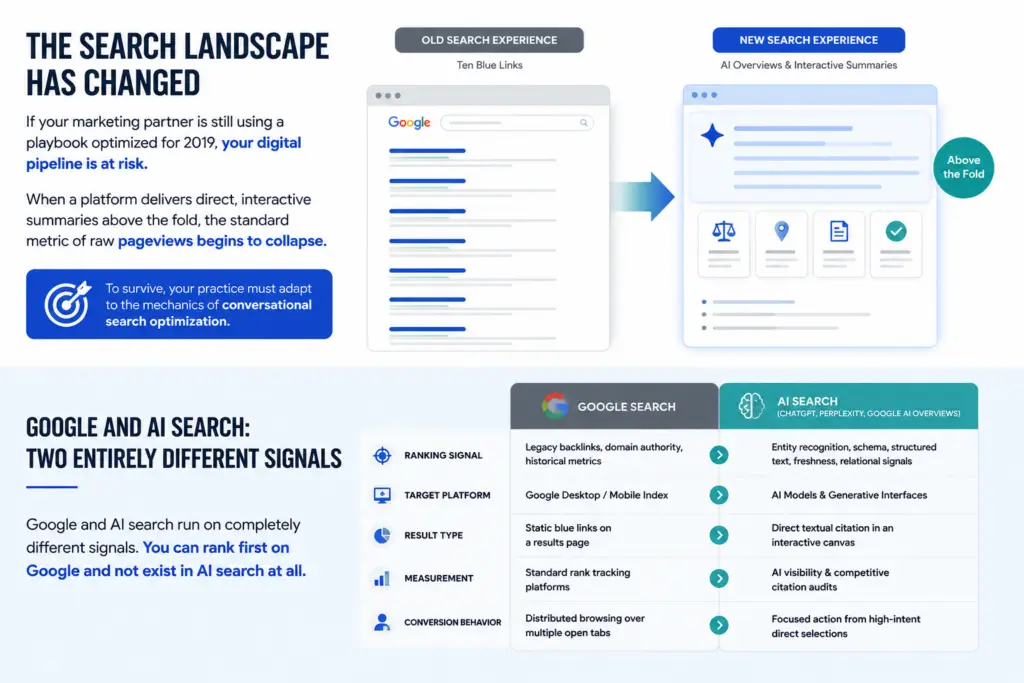
Many digital firms mistakenly assume that high visibility on traditional Google index charts automatically translates to dominance in generative search models. This assumption is wrong.
Google and AI search run on completely different signals. You can rank first on Google and not exist in AI search at all.
See exactly where your profile stands right now.
Our GBP audit shows your current rank position across your market, how your profile completeness scores against competitors, and the specific gaps holding you back from the Map Pack.
Traditional indexing values legacy backlinks, historical domain age, and generalized page authority metrics. Generative UI and large language models care about machine-readable entity data, contextual extractability, information freshness, and verified relational signals.
Because legal and YMYL (Your Money or Your Life) queries trigger automated summaries 23.6% of the time—the highest across any consumer sector—failing to position your brand for these signals means completely forfeiting a quarter of your potential search real estate. The solution requires a technical strategy built specifically to establish your firm as an explicit, undeniable authority to automated scrapers.
| Factor | Traditional SEO | Generative Engine Optimization (GEO) |
| Target Platform | Google Desktop/Mobile Index | ChatGPT, Perplexity, Google AI Overviews |
| Ranking Signal | Legacy backlinks and historical domain authority | Entity recognition, technical schema, structured text |
| Result Type | Static blue links on a partitioned result page | Direct textual citation in an interactive canvas |
| Measurement Tool | Standard rank tracking platforms | Cognizo competitive visibility audits |
| Conversion Behavior | Distributed browsing over multiple open tabs | Focused action from high-intent direct selections |
The Anatomy of the Intelligent Search Engine
The completely overhauled search infrastructure functions via two core elements introduced to handle complex, real-time user intent:
1. Reengineered Input Box
The standard search field has been structurally expanded. It now accepts long paragraphs, uploaded internal files, structural documents, images, and live tabs simultaneously. It utilizes predictive autocomplete logic that helps users map out entire multidimensional scenarios rather than isolating single terms.
2. Search Agents and Antigravity Code
Powered by Gemini 3.5 Flash and Google’s Antigravity platform, results are no longer pulled from rigid web templates. The engine creates tailored user interfaces on the fly—assembling dynamic comparative tables, interactive timelines, and project workspaces that persist over multi-day sessions.
Autonomous background agents run 24/7 to monitor specific conditions, track price fluctuations, or compile local litigation changes, delivering organized outputs directly to the user without requiring them to visit a single original source site.
Why Generative UI Requires an Adaptive Law Firm SEO Agency
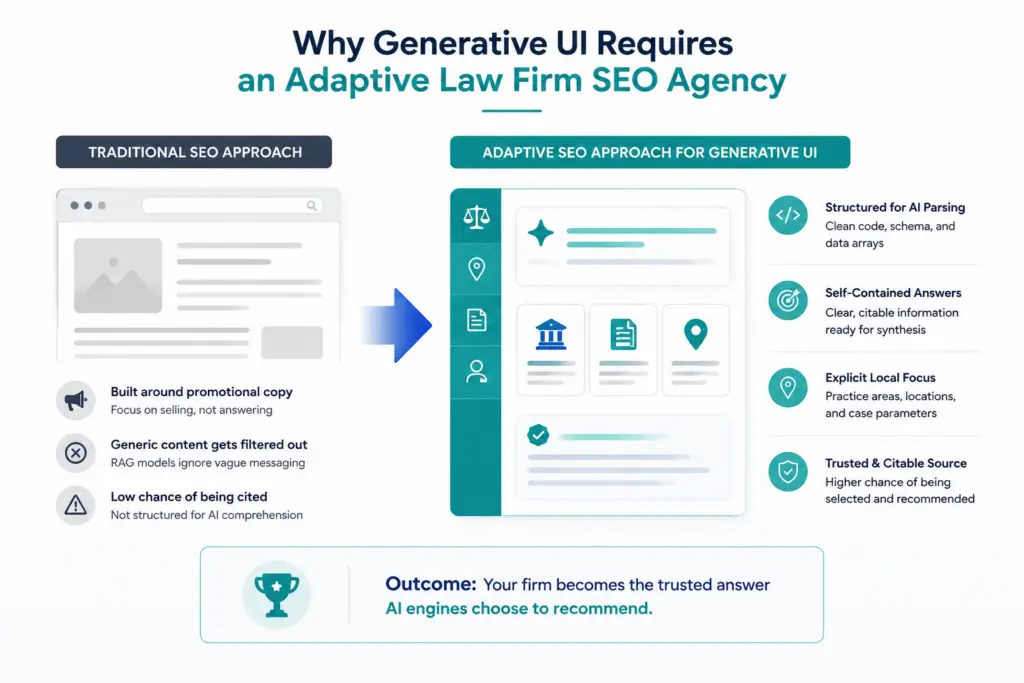
When an intelligent search engine stops acting like a card catalog and starts acting like an interactive workspace, your content must be architected differently. Large language models do not read websites the way humans do. They parse code seeking clear, definitive data arrays that can be safely synthesized into a direct recommendation.
Most traditional agencies fail here because their infrastructure is built to frame information behind generic promotional copy. Advertisements filled with empty taglines get filtered out by retrieval-augmented generation (RAG) models. To be pulled as a reliable reference, your digital properties must provide self-contained, citable answers that explicitly detail your localized focus, practice areas, and physical case parameters.
How to Force AI Engines to Cite Your Practice
Earning consistent real estate inside ChatGPT, Perplexity, and Google AI Overviews requires an intentional architecture across your entire web footprint:
- Deploy Technical Schema Markup: Advanced data markup is what AI systems read before processing your text blocks. Your domain must prominently utilize legal service profiles, authoritative organization blocks, and explicit author validation definitions.
- Build Factual Comparison Modules: Comparative table layouts account for 32.5% of all Perplexity search citations. Incorporating crisp comparative matrices directly on your service pages gives autonomous models a clean data map to scrape.
- Structure Standalone Q&A Sections: Build highly targeted, self-contained sections around the precise conversational prompt clusters your local audience is asking. Each response must serve as a functional, independent answer block that a model can extract without contextual drift.
- Secure Third-Party Reference Footprints: External validation sources like Clutch significantly influence cross-platform AI citations. Establishing a dominant, top-tier standing on these major verified hubs helps solidify your relational entity map across the web.
The 12AM Strategy: Proven Under the Hood
At 12AM Agency, we do not experiment on your marketing budget. We are an AI-agentic digital firm that treats generative tracking as our native operating system, not a marketing bolt-on.
Before offering our core tracking systems to a single external client, we deployed the system internally on our own properties. That self-test yielded 4.66 million AI search impressions and an immediate 46.9% increase in our baseline AI visibility score.
Our standing is independently verified by third-party platforms. According to a 30-day Cognizo AI Visibility Report, 12AM Agency ranks #3 out of 19 tracked legal marketing agencies nationwide with a 13.8% current visibility score—marking a +2.4% growth wave that outpaces legacy competitors like Scorpion, which sits at 11.7%.
Cognizo 30-Day AI Visibility Leaderboard (Legal Category)
| Rank | Agency | Share (%) | Change |
|---|---|---|---|
| 1 | iLawyer Marketing | 17.4% | +1.4% |
| 2 | Law Rank | 14.8% | -1.6% |
| 3 | 12AM Agency | 13.8% | +2.4% 🟢 Fastest growing (Top 5) |
| 4 | Scorpion | 11.7% | +1.2% |
| 5 | Rankings.io | 10.4% | +2.2% |
Long before we engineered our autonomous visibility models, our deep legal marketing expertise was already setting records. For example, our custom digital rebuild for Jackson Spencer Law delivered a 522% increase in qualified conversions.
“Before we ever built the AI Lead Engine, we were already delivering results like this for law firms—522% more qualified conversions for Jackson Spencer Law. That’s the depth this system is built on.”
We combine this proven, foundational client experience with our proprietary technical asset, Nova—an internal platform built to systematically refine your local citations, map packs, and code schema so your practice remains readable to every crawling LLM.
Frequently Asked Questions
Q: What is the difference between SEO and GEO for law firms?
A: SEO helps law firms rank on Google’s traditional results page. GEO (Generative Engine Optimization) helps law firms get cited by AI models like ChatGPT, Perplexity, and Google AI Overviews when prospective clients ask for direct legal recommendations. The two structures rely on different indexing signals. A firm can rank first on standard search results and completely vanish from conversational search answers, which is why modern law firms must optimize for both parameters.
Q: How does Google’s new intelligent search box affect lawyer marketing?
This is the work we do for you. Every week, without exception.
Managing GBP at this level takes 6–8 hours a week when done right. Nova handles the entire system — posts, photos, reviews, Q&A, citations, heatmap tracking — so you can focus on running your business.
A: The intelligent search box permits users to enter complex, conversational case descriptions using text, images, and files simultaneously. Because the platform uses generative UI to synthesize answers directly on-screen, standard click-through rates to traditional informational articles are declining. Lawyer marketing must pivot toward building authoritative, data-dense entity signals that force Google’s layout models to embed your firm as a primary citable option.
Q: How does ChatGPT decide which law firm to recommend to users?
A: ChatGPT utilizes entity recognition, machine-readable schema code, and localized authority signals to isolate business recommendations. It places strong emphasis on domains that demonstrate clear, consistent citation data across prominent directories, legal indexes, review databases, and consumer networks like Clutch. Vague, un-vetted keyword stuffing provides no algorithmic value to these modern retrieval systems.
Q: What specific schema markup does a law firm require for conversational search optimization?
A: At a minimum, a firm must deploy detailed LocalBusiness or LegalService schema to define its specific practice concentrations and geographical courts. Furthermore, Article and Author schema must guide every editorial asset to solidify domain expertise, while FAQPage schema blocks must frame answers to provide clean data maps for automated answers. Pages featuring comprehensive technical coding are significantly more citable by generative crawlers.
Q: How long does it take to see measurable results from a GEO visibility campaign?
A: Most law firms executing a structured conversational search campaign see a measurable lift in their tracked AI citation frequency and competitive share of voice within 30 to 60 days. Gaining a dominant regional position over well-entrenched local competitors typically takes 90 to 180 days, depending entirely on the saturation and technical depth of your specific metropolitan market.
Are You Ready to Secure Your Market?
Google Search box boundaries have permanently shifted, and the real estate is shrinking to a few core recommendations. We maintain a strict policy of working with one firm per market to protect our clients’ competitive visibility advantage.
If your market territory is still available, a 30-minute consultation with our consulting team will detail exactly what your current AI search profile looks like and show you how to protect your conversion pipeline. No generic sales pitches. No recycled slide decks. Just an honest look at your numbers and your region.

