


Every business wants their website to get found online and keyword tracking is the engine behind that visibility. Most people think simply picking a handful of search terms is enough and then the magic happens. But studies show that choosing the wrong keywords can sink your rankings from the start and even the best content will go unnoticed. What really moves the needle is a mindful, data-driven approach to tracking that goes way deeper than surface-level rankings.
Table of Contents
- Step 1: Define Your Target Keywords
- Step 2: Choose Your Tracking Tool
- Step 3: Set Up Your Tracking Campaign
- Step 4: Monitor And Record Keyword Performance
- Step 5: Analyze Results And Adjust Strategy
Quick Summary
| Key Point | Explanation |
|---|---|
| 1. Define Relevant Keywords | Focus on long-tail keywords that reflect genuine user intent for better targeting and visibility. |
| 2. Choose the Right Tracking Tool | Select a keyword tracking tool that fits your business size and budget for effective monitoring. |
| 3. Set Up a Focused Campaign | Configure your tracking campaign with precision to ensure accurate data collection and insights. |
| 4. Monitor Performance Regularly | Schedule consistent performance reviews to identify trends and make necessary adjustments. |
| 5. Analyze and Adjust Strategy | Use performance data to refine your keyword strategy and prioritize keywords with high conversion potential. |
Step 1: Define Your Target Keywords
Successful keyword tracking begins with strategic keyword selection. This foundational step determines the precision and effectiveness of your entire tracking strategy. Before diving into complex analytics, you need to pinpoint the exact keywords most relevant to your business goals.
Start by understanding your target audience’s search behaviors. Consider the specific language and phrases potential customers use when searching for products or services similar to yours. This means moving beyond generic terms and identifying long-tail keywords that represent genuine user intent. For instance, instead of targeting broad terms like “marketing services,” focus on more specific phrases like “small business digital marketing solutions in [your region].”
Explore our comprehensive guide on keyword analysis tools to streamline your research process. Professional keyword research involves analyzing search volume, competition level, and potential organic traffic. Use tools like Google Keyword Planner, SEMrush, or Ahrefs to generate comprehensive keyword insights. Look for search terms with reasonable monthly volumes that aren’t overly competitive but demonstrate clear commercial intent.
Your keyword selection strategy should balance three critical factors: relevance, search volume, and competition. Relevance means the keyword directly connects to your business offerings. Search volume indicates how frequently users search for that term monthly. Competition reveals how challenging it will be to rank for that keyword. Aim for keywords with moderate search volumes and lower competition levels, which offer better opportunities for visibility.
Key verification criteria for successful keyword definition include:
- Keywords directly relate to your products or services
- Search terms have measurable monthly search volumes
- Identified keywords reflect genuine user search intent
- Selected keywords represent various stages of customer journey
Remember that keyword selection isn’t a one-time task. Market dynamics shift continuously, so regularly revisit and refine your keyword strategy. The most effective tracking approach involves maintaining a dynamic, evolving keyword portfolio that adapts to changing market trends and customer preferences.
Step 2: Choose Your Tracking Tool
Selecting the right keyword tracking tool is crucial for transforming your raw keyword data into actionable insights. The marketplace offers numerous solutions, ranging from free platforms to sophisticated enterprise-level tracking systems. Your choice will significantly impact the precision and effectiveness of your keyword monitoring strategy.
See exactly where your profile stands right now.
Our GBP audit shows your current rank position across your market, how your profile completeness scores against competitors, and the specific gaps holding you back from the Map Pack.
Begin by evaluating your specific business requirements. Small businesses might find free tools like Google Search Console sufficient, while larger organizations typically require more comprehensive analytics platforms. Professional-grade tools provide deeper insights into keyword performance, including ranking fluctuations, competitor analysis, and detailed search visibility metrics.
Consider tools that offer real-time tracking capabilities and comprehensive reporting features. SEMrush, Ahrefs, and Moz Pro represent top-tier options with robust keyword monitoring functionalities. These platforms enable you to track keyword rankings across multiple search engines, monitor competitor strategies, and receive automated performance reports. Integrate tools that seamlessly connect with your existing digital marketing infrastructure, ensuring smooth data collection and analysis.
Budget plays a significant role in tool selection. While enterprise solutions offer extensive features, they come with substantial price tags. Mid-range and smaller businesses should prioritize tools offering the most critical tracking features within their budget constraints. Look for platforms providing:
- Comprehensive keyword ranking reports
- Competitor keyword analysis
- Mobile and desktop ranking tracking
- Localized search result monitoring
- Export and integration capabilities
Verification of successful tool selection involves assessing its alignment with your tracking objectives. Test the platform’s user interface, data accuracy, and reporting depth. Most reputable keyword tracking tools offer free trials, allowing you to evaluate their performance before making a financial commitment. Pay attention to the tool’s update frequency, data granularity, and the ease of interpreting generated reports.
Here is a table to help compare popular keyword tracking tool options mentioned in the article, highlighting features and best use cases. This overview enables quick selection based on business needs.
| Tool Name | Features | Best For |
|---|---|---|
| Google Search Console | Free, basic keyword ranking, site health data | Small businesses, beginners |
| SEMrush | Advanced tracking, competitor analysis, reports | Medium to large businesses |
| Ahrefs | In-depth keyword insights, ranking history, export | Agencies, enterprises |
| Moz Pro | Comprehensive analytics, easy UI, local tracking | Local businesses, SEOs |
Remember that no single tool provides a perfect solution for every business. Your ideal keyword tracking platform should evolve alongside your digital marketing strategy, offering flexibility and comprehensive insights that drive meaningful business growth.
Step 3: Set Up Your Tracking Campaign
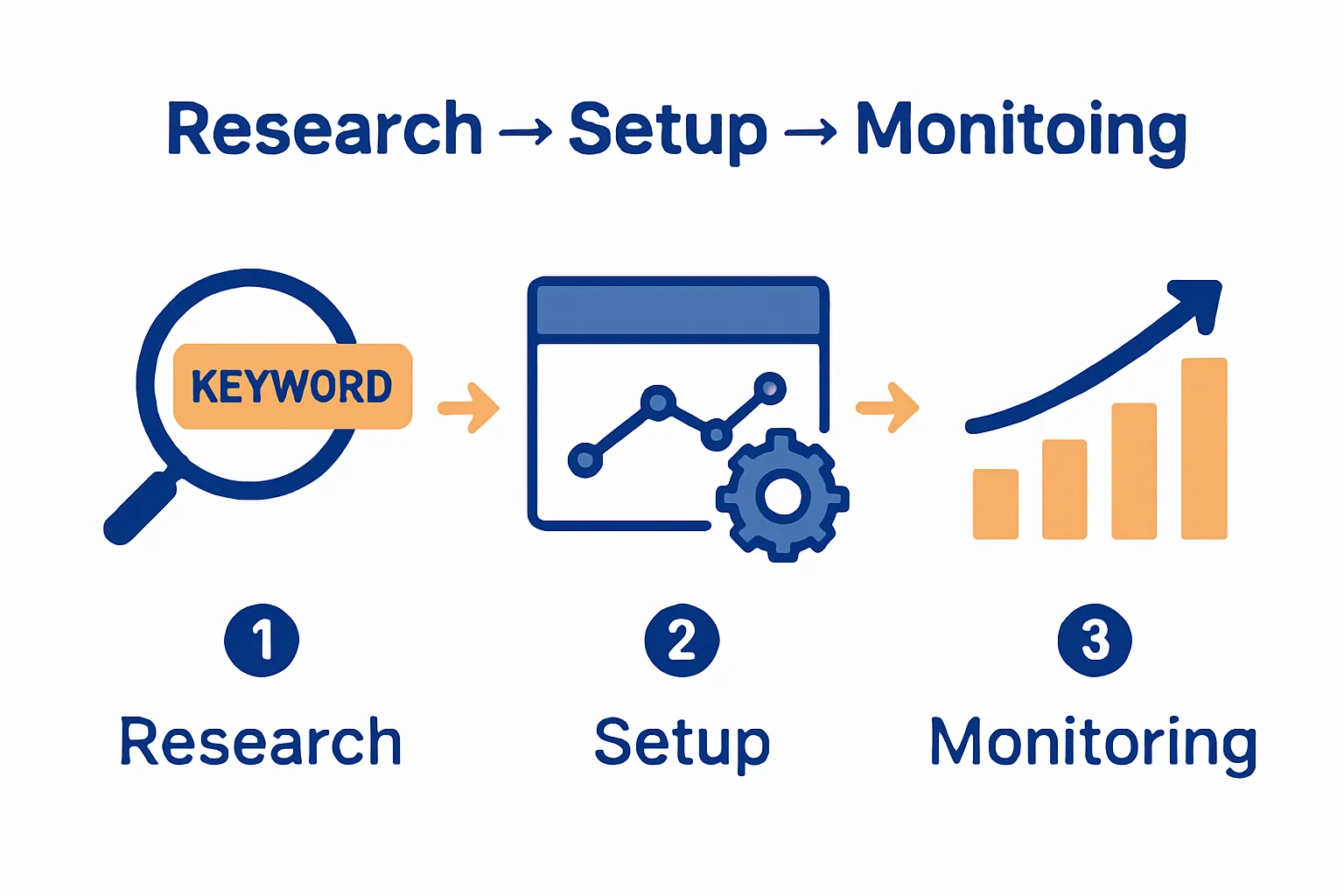
Establishing a keyword tracking campaign transforms raw data collection into a strategic intelligence operation. This critical phase determines how effectively you’ll monitor and interpret your keyword performance across digital landscapes. Precision in setup directly impacts the quality of insights you’ll generate.
Learn more about advanced tracking configurations to enhance your campaign’s effectiveness. Begin by configuring your chosen tracking tool with meticulous attention to detail. Input your target keywords systematically, ensuring each term represents a genuine reflection of your business objectives. Most professional tracking platforms allow you to categorize keywords by groups or campaigns, enabling more granular performance analysis.
Configuration involves more than simple keyword entry. Create custom tracking parameters that align with your specific business goals. This means defining geographic targeting, device preferences, and search engine selections. For local businesses, specify regional settings to capture localized search performance. Enterprise organizations might require multi-language or international tracking configurations.
Understand that initial setup is just the beginning. Your tracking campaign needs ongoing refinement. Implement a regular review process where you assess and adjust keyword parameters. Some tools offer automated suggestions based on emerging search trends, which can help you stay ahead of market shifts. Pay close attention to how your selected keywords perform across different search contexts and be prepared to pivot your strategy accordingly.
Key verification criteria for a successful tracking campaign setup include:
- All target keywords are correctly inputted
- Tracking settings match your specific business objectives
- Geographic and device targeting is precisely configured
- Reporting dashboards are customized to your needs
- Automated alerts are established for significant ranking changes
Remember that a well-configured tracking campaign acts like a sophisticated early warning system for your digital marketing efforts. It provides real-time insights into how your online visibility evolves, allowing you to make data-driven decisions quickly and confidently. Treat your tracking setup as a dynamic, living strategy that requires continuous monitoring and intelligent adaptation.

Step 4: Monitor and Record Keyword Performance
Monitoring keyword performance transforms raw data into strategic intelligence, enabling businesses to understand their digital visibility with precision. This step is where your tracking efforts convert into actionable insights that drive marketing decisions and search engine optimization strategies.
Discover advanced techniques for keyword analysis to enhance your monitoring approach. Establish a consistent tracking rhythm by scheduling regular performance reviews. Most professional tracking tools offer weekly or monthly reporting cycles, but the ideal frequency depends on your specific business goals and market dynamics. Create a standardized tracking template that captures essential metrics like current ranking, ranking changes, search volume, and potential organic traffic for each keyword.
According to Search Engine Journal, recording ranking data over time provides critical context for understanding your digital marketing efforts. Develop a systematic approach to data recording. This means not just capturing current rankings, but maintaining a historical log that allows you to identify trends, seasonal variations, and the impact of your marketing initiatives. Use spreadsheets or specialized tracking software to create a comprehensive keyword performance archive.
Effective monitoring goes beyond simple number tracking. Analyze the nuanced performance indicators that reveal deeper insights about your keyword strategy. Look for patterns such as keywords that consistently fluctuate, those showing steady improvement, and terms that might require strategic intervention. Pay attention to not just rankings, but also click-through rates, search intent alignment, and competitive landscape shifts.
Key verification criteria for effective keyword performance monitoring include:
- Consistent and timely data collection
- Comprehensive tracking across multiple performance metrics
- Clear documentation of ranking changes and trends
- Regular comparative analysis against previous periods
- Identification of emerging opportunities or potential challenges
Remember that keyword tracking is an ongoing process of refinement. Your monitoring approach should be flexible, adapting to changes in search algorithms, market trends, and your business objectives. Treat each performance review as an opportunity to gain deeper understanding of your digital marketing ecosystem, enabling more intelligent and responsive strategy development.
Below is a checklist table summarizing key verification criteria for effective keyword performance monitoring. Use this to ensure your monitoring process covers all critical aspects.
| Verification Step | Description |
|---|---|
| Timely Data Collection | Collect keyword data on a consistent schedule aligned with business needs. |
| Track Multiple Metrics | Record current ranks, ranking changes, search volume, and organic traffic. |
| Document Ranking Trends | Maintain a log to observe keyword trends and performance over time. |
| Comparative Analysis | Regularly compare recent data against historical performance periods. |
| Spot Opportunities/Challenges | Identify keywords improving or declining and adjust efforts as needed. |
Step 5: Analyze Results and Adjust Strategy
Analyzing keyword performance results transforms raw data into a strategic roadmap for digital marketing success. This pivotal step determines whether your tracking efforts translate into meaningful business growth. Think of this process as a diagnostic tool that reveals the hidden potential within your keyword strategy.
Explore advanced keyword performance optimization techniques to enhance your analytical approach. Begin by conducting a comprehensive review of your keyword tracking data. Look beyond surface-level rankings to understand the deeper narrative behind the numbers. Identify keywords that demonstrate consistent performance, those showing potential for improvement, and terms that might require strategic recalibration.
Critical analysis involves examining multiple performance dimensions. Evaluate each keyword’s contribution to your overall digital marketing objectives. Consider metrics such as click-through rates, conversion potential, and alignment with user search intent. Some keywords might rank well but fail to drive meaningful traffic or generate valuable leads. Conversely, lower-ranked keywords could represent untapped opportunities with high conversion potential.
This is the work we do for you. Every week, without exception.
Managing GBP at this level takes 6–8 hours a week when done right. Nova handles the entire system — posts, photos, reviews, Q&A, citations, heatmap tracking — so you can focus on running your business.
Develop a systematic approach to strategy adjustment. Create a scoring mechanism that weights keywords based on multiple factors: current ranking, search volume, relevance to business goals, and potential return on investment. This nuanced evaluation allows you to prioritize optimization efforts more intelligently. Focus on keywords with the highest strategic value, allocating resources to improve their performance and visibility.
Key verification criteria for effective result analysis include:
- Comprehensive review of keyword performance across multiple metrics
- Clear identification of high-potential and underperforming keywords
- Strategic prioritization of optimization efforts
- Alignment of keyword strategy with broader business objectives
- Documented insights and proposed adjustments
Remember that keyword strategy is not a static concept but a dynamic, evolving process. The most successful businesses approach keyword tracking as an ongoing conversation with their digital marketplace. Each analysis provides an opportunity to refine your approach, uncovering new insights and adapting to changing market dynamics. Maintain flexibility, be willing to experiment, and continuously learn from your data-driven discoveries.
Elevate Your Rankings With Proven Digital Marketing Expertise
Are you struggling to turn keyword tracking into measurable business growth? This article highlighted the very real challenge of moving from keyword selection and tracking setup to real-world results that drive revenue. Many businesses wrestle with gathering data but never see more leads or local visibility. You are not alone if you feel that painstaking monitoring and analysis still leaves you unsure how to outpace competitors or secure a top spot in search results. Now imagine having a partner who not only tracks every keyword, but also transforms those insights into a strategic digital roadmap tailored to your goals.
Your journey toward smarter ranking strategies begins with a simple step. Let our team of data-driven experts at 12AM Agency take your analytics to the next level. We are experienced in advanced keyword analysis, Google Analytics 4 setup, and ongoing optimization for local and industry-specific searches. Connect now for a personalized consultation and discover how our AI-powered solutions will convert your keyword tracking efforts into profitable business growth. Do not let valuable opportunities slip away. Contact us today and start outperforming your competition.
Frequently Asked Questions
What are long-tail keywords and why are they important?
Long-tail keywords are specific phrases that target particular search intents. They are important because they tend to have less competition and attract users who are looking for precisely what you offer, ultimately leading to higher conversion rates.
How can I track the performance of my selected keywords?
You can track keyword performance using various keyword tracking tools like Google Search Console, SEMrush, or Ahrefs. These tools offer insights into ranking changes, search visibility, and competitor performance, helping you make informed adjustments to your strategy.
What metrics should I monitor for effective keyword tracking?
Key metrics to monitor include current keyword rankings, ranking changes over time, search volume, click-through rates, and conversion potential. These metrics will help you understand your keywords’ performance and align them with your business goals.
How often should I analyze my keyword performance?
Frequency of analysis can vary, but it is recommended to review your keyword performance at least monthly. This allows for timely adjustments based on market trends and search engine algorithm changes, ensuring your strategy remains relevant and effective.
Recommended
- SEO Keyword Analyzers: Tools to Boost Your Rankings | 12AM Agency
- Website Keyword Analysis Tools: Which One Should You Choose? | 12AM Agency
- Boost Your SEO with Keyword Clouds: A How-To Guide | 12AM Agency
- The 9 Google Ranking Factors That Actually Matter in 2025 (A Data-Backed Guide) | 12AM Agency
- How to Track SEO Performance in 2025

